
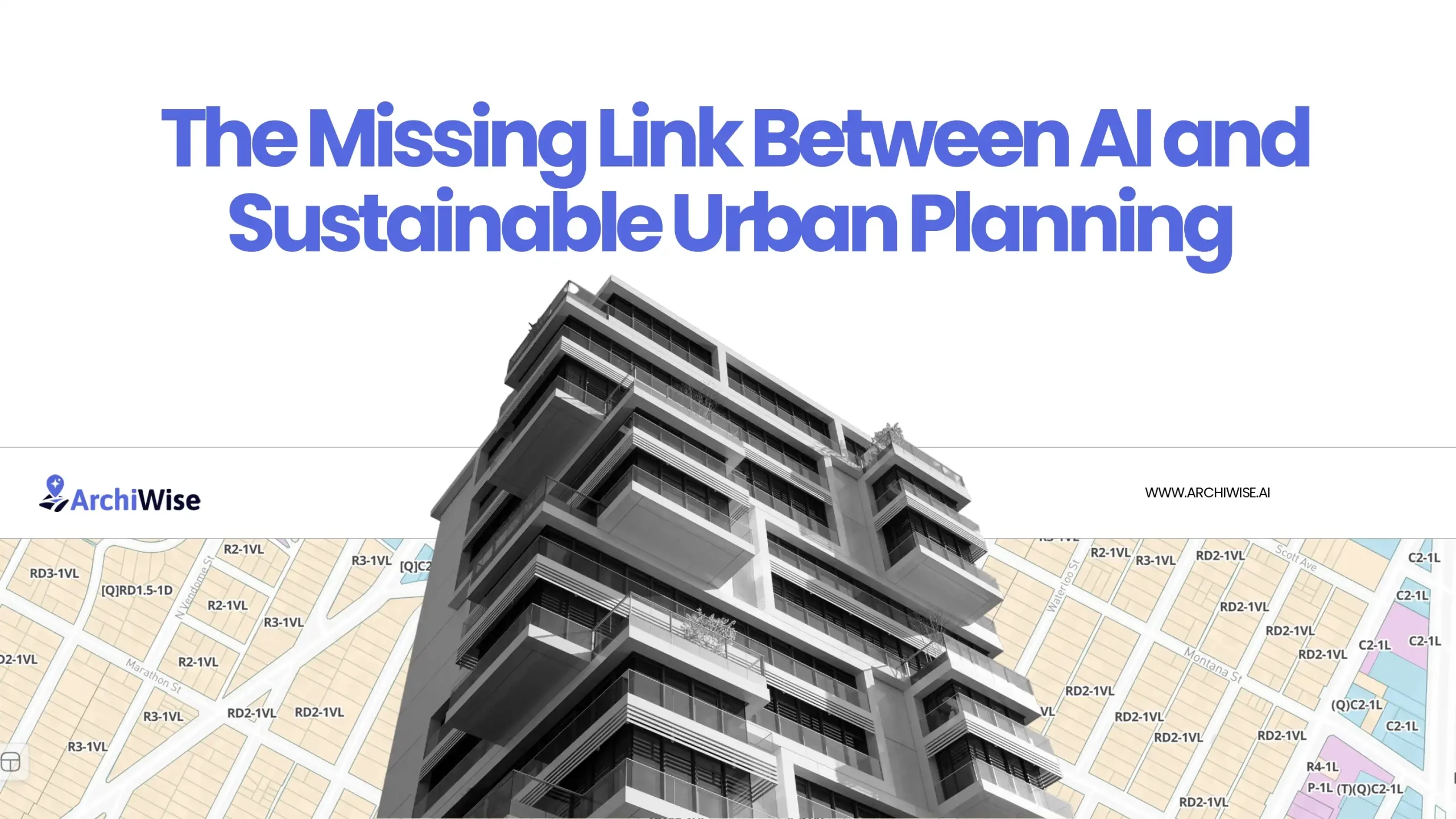

Los Angeles County is home to over 10 million people, spread across 88 cities and a wide network of unincorporated areas – each with its own character and challenges. The Department of Regional Planning works to maintain coordination, but every community faces the same core questions:
- How do we create enough housing?
- How do we support economic growth?
- How do we protect the environment?
- How do we do all of this while navigating a complex and fragmented web of zoning rules?
Despite ambitious planning goals, most cities in LA County still rely on outdated tools. Zoning information remains buried in static PDFs. Parcel data is inconsistent. Development reviews move slowly and manually, with each city following different processes.
The result?
Longer timelines, rising costs, and sustainability targets that slip further out of reach for planners, developers, architects, government agencies, and communities alike.

So what could be the solution?
Not “AI” as a buzzword – but AI-powered spatial intelligence: a unified platform that merges zoning, environmental information, and infrastructure data, giving planners real-time insights for better decisions.
Let’s dig deeper.
Overview of AI and Smart Cities
AI is already transforming urban planning. Tools like AI-enhanced GIS improve how cities are designed and managed. Drones, sensors, and intelligent systems help forecast growth, identify environmental risks, and evaluate future infrastructure needs – essential for resilient, adaptable cities.
But a key challenge remains: distinguishing what’s truly new about AI from the older “smart city” paradigm.
Research on urban AI and AI urbanism shows that AI-driven cities are not just upgraded smart cities – they represent a shift toward more autonomous, data-centered governance. This changes not just the tools cities use, but how cities think and make decisions.
And LA County should follow this path.

How AI Bridges the Gap Between Growth and Sustainability
AI doesn’t just analyze data – it transforms how cities like Los Angeles understand zoning, development, and land use.
Where planners once manually reviewed code layers one by one, AI can process thousands of geospatial and regulatory inputs simultaneously, in minutes.
Imagine feeding AI:
- The full Los Angeles Zoning Code
- Community and specific plans
- TOC incentives
- Fire, flood, liquefaction, and seismic hazard layers
- Transit networks: Metro rail, bus rapid transit, major bus lines
- Parcel dimensions, slope, existing uses
- Sustainability targets
AI instantly identifies:
- parcels with the strongest development potential
- sites with lowest environmental risk
- areas aligned with climate and housing goals
- constraints that may affect approvals

Cities across LA County are beginning to adopt these approaches.
- Santa Monica uses predictive analytics to understand how changes in height or density affect energy use and mobility.
- Los Angeles City Planning uses AI-powered scenario modeling to speed up General Plan updates and visualize zoning outcomes.
- Tools like ZIMAS show early potential – AI expands that potential dramatically.
These aren’t technology experiments anymore – they mark the beginning of a county-wide AI-driven planning ecosystem.
From Reactive to Predictive Planning
Historically, LA County has taken a reactive approach:
- Build a new road → congestion worsens
- Adjust zoning → only after housing becomes scarce
- Address environmental damage → only once harm is visible
AI makes proactive planning possible.
Imagine simulations that show:
- how converting commercial corridors into mixed-use zones shapes neighborhoods
- how increased density near Metro stations changes mobility patterns
- how redeveloping strip malls influences citywide heat islands
These tools don’t replace planners – they empower them to stay ahead instead of playing catch-up.
A Smarter Standard for Sustainable Development
Developers in LA County must navigate:
- CEQA
- climate action plans
- TDM requirements
- stormwater rules
- coastal regulations (Malibu, Santa Monica Bay, unincorporated coastline)
- ESG expectations
AI accelerates and enriches the entire analysis process.
It can:
- review zoning, overlays, and specific plan rules
- assess environmental hazards
- analyze TOC tiers, density bonuses, transit access
- highlight constraints affecting feasibility or approvals
The results:
- faster feasibility reviews
- smarter site selection
- reduced reliance on manual consultant work
- more sustainable and compliant projects
AI doesn’t replace planners or architects – it gives them sharper, faster insights.
The Future of Urban Growth in LA County Relies on Data
LA is at a pivotal moment: strong planning expertise, major transit investment, ambitious climate targets, and meaningful zoning reforms.
But one piece is missing: a unified data system.
Today, zoning, land use, environmental data, and infrastructure constraints live in separate silos. This fragmentation slows down planning and development.
AI platforms like ArchiWise unify these datasets into a single spatial intelligence system.

With AI:
- Planners gain predictive modeling tools
- Developers assess feasibility in seconds
- Cities coordinate growth across boundaries
- Communities receive clear, accessible planning information
AI-powered cities don’t just grow faster – they grow smarter, denser, cleaner, and more resilient.
How ArchiWise AI Helps Transform Urban Planning
ArchiWise AI turns zoning codes, environmental layers, and raw GIS data into clear, actionable intelligence for planners, developers, and government agencies.
1. Instant, All-In-One Zoning Analysis
Across on- and off-market parcels in LA County:
- height limits, FAR, density, setbacks
- environmental hazards
- overlays, specific plans, community plans
- use restrictions</li
- automatic compliance summaries
No manual PDFs. No fragmented research.
2. Data-Driven Site Selection and Feasibility
Evaluate thousands of parcels using:
- zoning compatibility
- lot size and geometry
- transit proximity and TOC tiers
- environmental & infrastructure constraints
Compare parcels across the entire county in seconds.
3. Automatically Generated Reports
ArchiWise produces:
- feasibility summaries
- zoning and land-use reports
- environmental assessments
- AI-generated visual diagrams (Visualizer Beta)
These reports keep planners, developers, agencies, and communities aligned.
4. Advancing Sustainable, Climate-Resilient Development
By integrating zoning, environmental overlays, and infrastructure constraints, ArchiWise helps cities:
- promote transit-oriented development
- accelerate infill housing
- reduce carbon emissions
- adhere to climate action plans
- support long-term sustainability
Conclusion
ArchiWise AI is redefining urban planning in LA County. By providing real-time data, advanced analytics, and predictive modeling, it empowers cities and developers to build smarter, greener, and more resilient communities.
Try ArchiWise AI for free and share your feedback – we’d love to hear how it supports your planning workflow.