
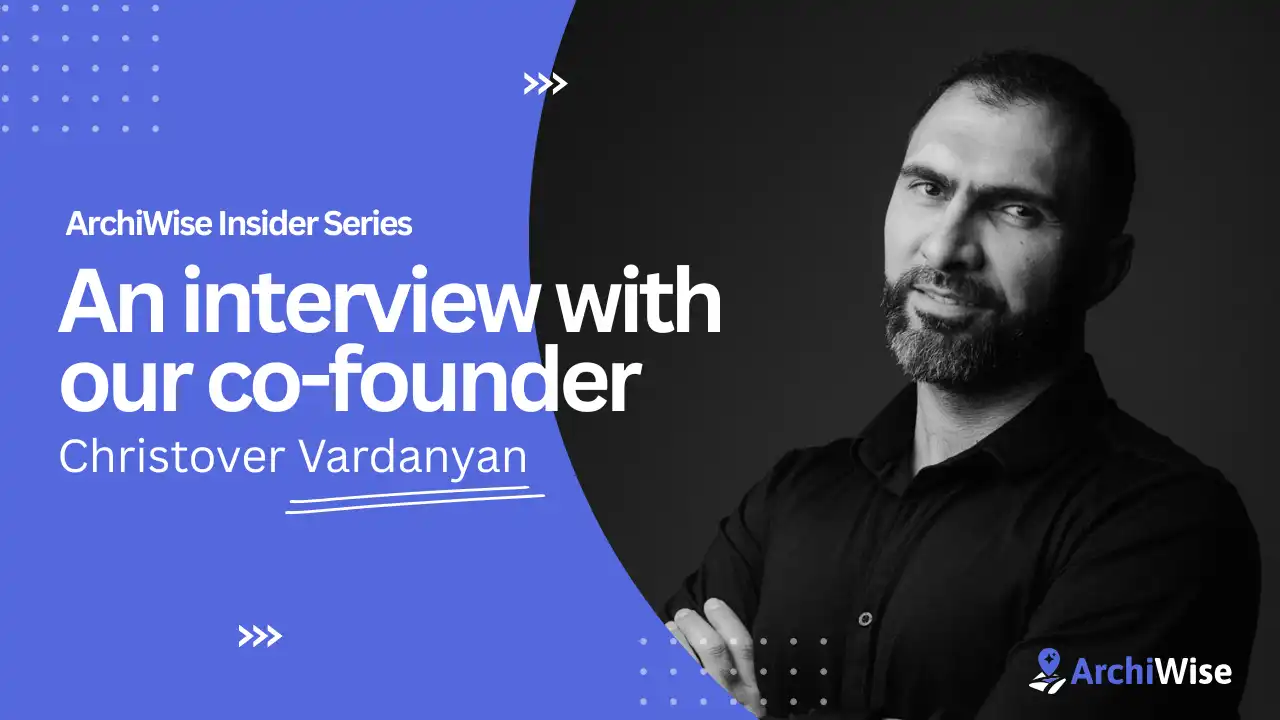

There’s something powerful about a startup built from lived experience rather than theory. ArchiWise wasn’t dreamed up in a brainstorm – it was born from the real frustrations our founder and team hit again and again in the field. Lost deals, slow zoning answers, bottlenecks that shouldn’t exist.
Instead of waiting for someone else to fix it, they decided to build the solution themselves.
In this Q&A, we sit down with our founder, Christopher Vardanyan, to talk about where ArchiWise really came from and how AI is transforming the future of development.
ORIGIN STORY & INSPIRATION
Chris, what was the moment you realized the pre-construction process needed to change?
As a developer, every project I touched got bottleneck at the same point – zoning analysis and truly understanding a site’s potential. What should’ve taken days somehow dragged into weeks because the data was all over the place, manual, and hard to interpret. Finding good deals wasn’t any easier.
My co-founder and I realized this pain wasn’t just ours – it was industry-wide. That’s when we decided to solve it once and for all, and ArchiWise was born to streamline site selection and zoning analysis through AI.
What personal experiences led you to build ArchiWise?
There were two “last straw” moments:
- First was a project in LA where we couldn’t get zoning answers from our architect in time – by the time he got back to us five days later, the deal was gone. It was a $10M opportunity lost simply because zoning intel wasn’t fast or accessible.
- The second was in Glendale. We went to the planning department for clarity on a 6-unit possibility in La Crescenta, and no one could give a definitive answer. The planner was checking multiple computers, nothing was centralized, and after ten days, we still didn’t know what was actually allowed. We lost that deal, too.
Those two experiences made it clear: the pre-development process was broken, and AI needed to fix it. That frustration is what sparked ArchiWise.
Why did you feel AI was the right solution for this industry problem?
Because the bottlenecks in pre-development come from slow, manual, and fragmented information. AI is the only technology capable of reading complex regulations instantly, centralizing scattered data, and producing zoning, feasibility, and compliance answers in seconds instead of weeks. It turns the industry’s biggest pain point – time – into its biggest advantage.
Before ArchiWise existed, what were the biggest inefficiencies you saw in early due diligence?
Before ArchiWise, early site analysis was slow and messy. Developers and architects had to read through huge zoning documents, jump between different city websites, wait for consultants, and rely on outdated PDFs or confusing GIS tools. Even answering a basic question like “What can I build here?” could take weeks or months.
I’ve been in real estate development for over seven years, and I’ve dealt with these slow processes on almost every project. After running into the same problems again and again, I realized the process wasn’t going to change unless someone changed it.
That’s why I built ArchiWise – to turn something that used to take months into something you can get in seconds.
BUILDING ARCHIWISE
What was the hardest part of building an AI platform for real estate development?
- Unifying all the fragmented data – zoning codes, parcel rules, and city regulations – into a format the AI can actually understand. Every jurisdiction speaks a different “language,” which makes accuracy a real challenge.
- The real estate community is slow to evolve. Many professionals are deeply used to their old workflows – some still operate with pen and paper – so introducing a brand-new AI tool requires breaking long-standing habits and earning trust in a space that rarely adopts innovation quickly.
How do you ensure ArchiWise stays accurate with zoning and code information?
ArchiWise stays accurate by pulling zoning and code data directly from official city and county sources, then structuring and validating it before any AI interpretation happens. The AI doesn’t “guess” – it interprets verified rules and links every result back to its exact code source.
What went into choosing LA County and Seattle as your first markets?
LA County and Seattle were chosen because they are two of the most complex zoning environments in the U.S. LA has 88 cities with different rules, and Seattle has progressive, detailed zoning codes. If ArchiWise can master these markets, scaling to others becomes much easier.
How do you balance speed and accuracy when delivering feasibility results in seconds?
ArchiWise separates data processing from AI interpretation. All the zoning and parcel data is cleaned and structured in advance, so when a user enters an address, the AI responds instantly using already-verified information. This allows for both speed and accuracy at the same time.
INDUSTRY INSIGHT
Why do you think the real estate development world has been slow to adopt technology?
Real estate is highly regulated and risk-averse. Most teams still rely on traditional workflows, consultants, and long-established processes. Zoning is also extremely complex, so most tech companies avoid it. Now that AI is capable of handling this complexity, the industry is finally starting to shift.
What misconceptions do people still have about AI in pre-construction?
Many think AI “guesses,” but modern systems don’t – they interpret structured code and real data. Another misconception is that AI will replace architects or planners. In reality, tools like ArchiWise support professionals and help them work faster; they don’t replace expertise.
How do you see AI transforming the acquisition and feasibility process in the next 3–5 years?
AI will become the starting point for every acquisition and feasibility study. Developers will test hundreds of parcels instantly, compare scenarios, and understand yield potential before hiring consultants. Early-stage decisions will move from weeks to minutes.
PRODUCT VISION
What is ArchiWise today – and what do you hope it becomes two years from now?
| Today | In Two Years |
|---|---|
| Instant zoning summaries, feasibility results, allowed uses, setbacks, heights, density, and conceptual build-out potential | A full decision-making platform with automated massing, financial modeling, multi-scenario analysis, and nationwide coverage |
What new features or markets are you most excited about next?
- New dashboard for developers to manage projects
- AI visualiser
- Features related to permits
- Expansion to Phoenix, Austin, Miami
- Team collaboration tools
How do you ensure ArchiWise remains a tool that supports professionals rather than replaces them?
ArchiWise gives direction and clarity, but it doesn’t produce a final design or legal determinations. It accelerates the early phase so professionals can focus on strategy, creativity, and decision-making – not paperwork. It basically automates all the manual processes that developers, consultants, and architects are already doing – just making it much easier for them to find the right information.
BEHIND THE SCENES
What has been the most surprising feedback you’ve received from early users?
That the speed and clarity of the zoning answers felt “unreal.” Many told us they didn’t expect an AI to understand local regulations better than the people they usually rely on. The common theme was: “I didn’t realize how much time I was wasting until I used this.”
What’s something people don’t know about how ArchiWise works under the hood?
Most people don’t realize ArchiWise is basically a nationwide parcel data center on steroids. Under the hood, we run a turbocharged RAG system layered with multiple AI models trained to interpret zoning, planning, and parcel data like a specialized expert – instantly and at scale.
What does a typical day look like for you as a founder building an AI product?
Honestly, it feels exactly like Alexis Ohanian said – as a founder you’re uncomfortable 99% of the time. Every day is a mix of solving problems you’ve never seen before, making fast decisions with imperfect information, and constantly pushing the product forward. That is the routine.
What part of the product are you personally most proud of?
It’s hard to single out one part – it’s like asking which part of your child you’re proud of. ArchiWise as a whole is something I’m proud of. But if I had to pick what truly sets us apart, it’s the AI Co-pilot. None of our competitors come close to matching its depth, speed, or the way it supports users through the entire pre-development process.
LOOKING AHEAD
What excites you most about the future of AI in urban development?
The idea that AI can finally remove the guesswork from how cities grow. Instead of slow, reactive processes, we’ll be able to design, plan, and approve projects with clarity, speed, and real data. AI will let us build smarter, faster, and more sustainable cities – and that shift is just beginning.
Where do you see the biggest opportunity for innovation in real estate tech?
The biggest opportunity is unifying all fragmented data – zoning codes, GIS layers, parcel data, plans, and feasibility inputs – into one real-time system. Once everything is connected, AI can unlock huge efficiency gains.
If ArchiWise succeeds at its mission, what will the development process look like in 2030?
By 2030, developers will be able to evaluate any site instantly, generate early massing and yield projections in minutes, and make confident decisions the same day. Pre-development will be fast, digital, and predictable.
FOUNDER PERSONALITY & HUMAN ANGLE
What’s one lesson you’ve learned as a founder that you wish you had known earlier?
Start yesterday. Don’t waste months trying to “validate” something you already know is a real pain point. If you feel the problem clearly, that’s your validation – build the solution.
What keeps you motivated during the long, difficult product cycles?
The vision. Knowing exactly where ArchiWise is headed – and how much impact it will have – is what keeps me going through every tough cycle.
What advice would you give to someone trying to innovate in a slow-moving industry?
It’s early for me to preach, but this much I know: don’t give up. Slow industries resist change by default. Remember why you started, stay patient, and keep pushing – consistency is what eventually breaks through.
What’s your favorite thing to build – code, product, vision, or team culture?
Vision and team culture.