
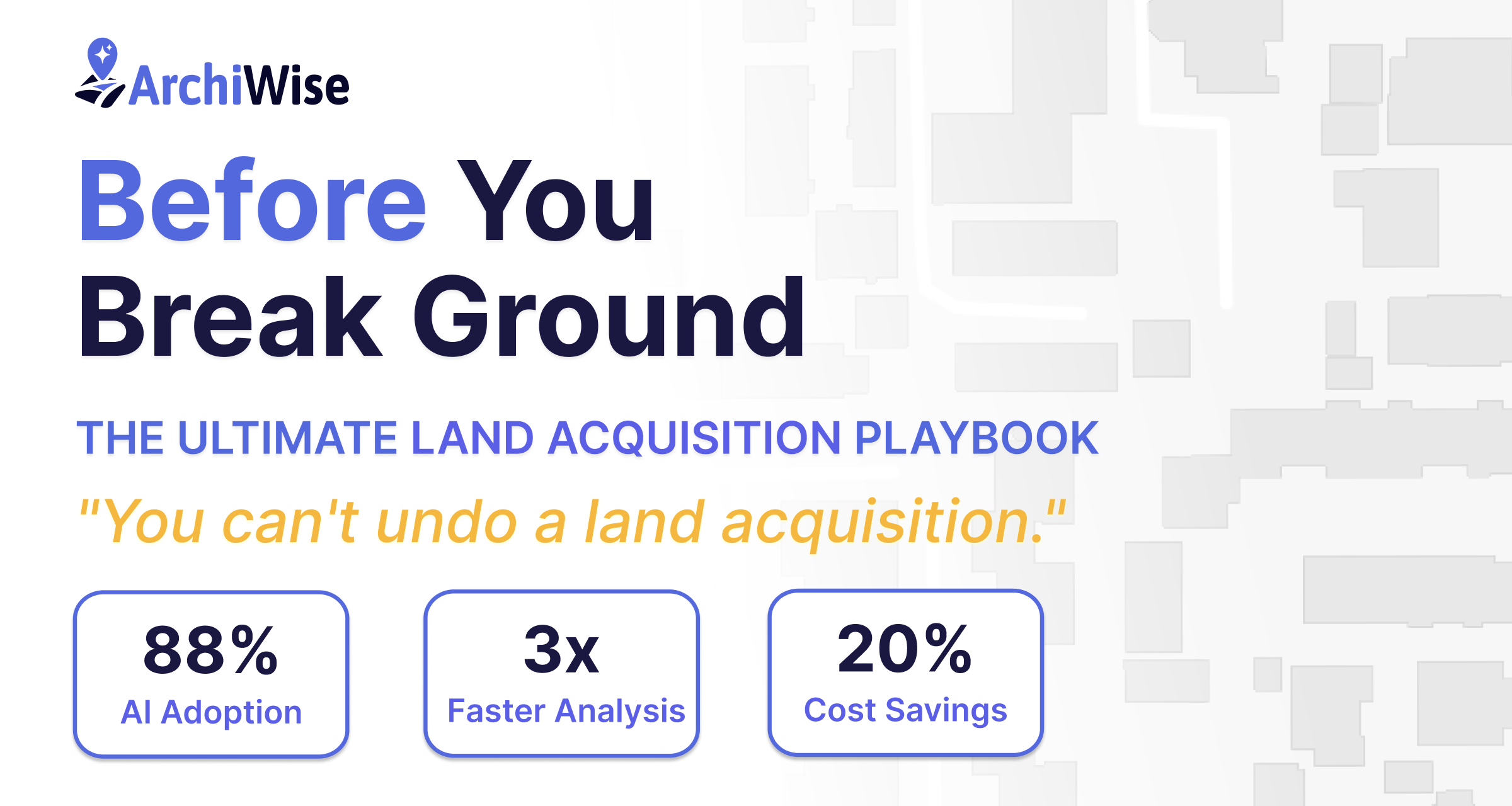

“You can redesign a building. You can refinance a loan. But you can’t undo a land acquisition.”For Developers, Architects & Investors
Land acquisition is the one decision in real estate that you truly can’t reverse. Every other mistake – a bad floor plan, a poorly timed loan – can be fixed. But the moment you close on a piece of land, you’ve committed: to its location, its regulatory environment, and all the risk that comes with it.
That’s why the most successful developers and investors treat land acquisition not as a transaction, but as a discipline. They approach it with process, data, and patience. Those who skip steps pay for it for years.
This guide walks you through every major stage: site selection, due diligence, zoning, negotiation, financing, and how AI is changing the game – fast.
What Is Land Acquisition – Really?
Land acquisition is the strategic process of identifying, evaluating, and purchasing land for development or investment. But it’s much more than signing a purchase agreement.
One important concept is land assemblage – when a developer buys two or more adjacent parcels and combines them. Think of a developer purchasing an entire block of homes to build a mixed-use project. It’s complex and time-consuming, but the combined parcel is often worth far more than the individual pieces.
The land decision also sets a ceiling on everything that follows. Its size, location, and zoning directly shape what you can build, who you can build it for, and what returns are realistic. And the costs add up quickly: application fees, professional consultants, and carrying costs during approvals can easily consume 15–30% of a project’s total budget.
TYPES OF LAND BY DEVELOPMENT READINESS
|
Site Selection: Find the Right Land Before You Fall in Love
The biggest mistake in site selection? Starting with a parcel instead of starting with a thesis. Before you search for land, define your development type, budget, target returns, and timeline. These filters cut through the noise and focus your energy where it matters.
Then apply the Five Layers of Location Intelligence:
- Macro market trends – population growth, employment, and demand for your product type
- Micro location – walkability, access to transit, proximity to amenities
- Competitive landscape – what’s being built nearby, and how fast it’s absorbing
- Zoning and regulatory environment – what’s permitted outright vs. what needs special approval
- Physical constraints – topography, utilities, flood zones, and environmental overlays
Speed matters here. Developers using an AI site selection tool can evaluate ten times more sites per decision cycle – which means better odds of finding the right parcel before a competitor does. Platforms like ArchiWise.ai – an AI real estate decision platform – bring zoning intelligence, geospatial analysis, and area intelligence together in one place, so you can ask “What can I build on this parcel?” and get an answer in minutes, not months.
Due Diligence: The Insurance Policy You Can’t Skip
Skipping due diligence steps is how a great deal becomes a costly liability. There is so much nuance in buying land that even one missed issue can reshape the entire project.
1. Title and Ownership Review
Review at least three prior title transfers. Identify any liens, easements, or access rights before you close. One developer acquired a site for townhomes only to discover mid-design that a neighbor held an access easement over part of the property – a litigation risk that a proper title review would have caught.
2. Zoning and Land Use Verification
Confirm the zoning designation matches your intended use — including permitted land uses by address, not just the broad classification. Understand the difference between “by-right” approvals and discretionary permits. A proper zoning code analysis at this stage catches conflicts that can kill a deal months later. And never count on a rezone to save a deal – acquiring land already zoned for your purpose is far safer than speculating on a favorable change.
3. Environmental Assessment
A Phase I Environmental Site Assessment (ESA) – a non-invasive records review – is required by most lenders. If it flags concerns, a Phase II follows with soil and groundwater sampling. Also check for flood zones, wetlands, and protected habitats. Budget a 15–20% contingency for unexpected environmental or infrastructure costs.
4. Infrastructure and Utilities
The difference between utilities “available on-site” and utilities “nearby” can cost hundreds of thousands of dollars and months of delay. Confirm water pressure and capacity, sewer capacity, power availability, and stormwater requirements before going hard on your deposit.
A SMART DUE DILIGENCE SEQUENCE
|
Zoning and Entitlements: The Most Underestimated Phase
Properly entitled land – land with government approvals to develop for a specific use – commands significant price premiums over raw land. But the entitlement process is where many developers underestimate both time and cost.
Even straightforward rezonings or conditional use permits can take 6–18 months, sometimes longer, depending on the jurisdiction and scope. During that time, developers carry property taxes, insurance, legal fees, and consultant costs – with no guarantee of approval.
The community dimension is equally important. A project that meets every legal requirement can still fail at a public hearing if community opposition is strong. Multi-million-dollar land deals have collapsed this way. The lesson: engage local planners, neighbors, and officials well before public hearings, not during them.
And before committing significant entitlement capital, run your demographic and absorption analysis. Entitled land creates no value if there are no buyers or tenants for the finished product.
Negotiating the Purchase: Protect Yourself Before You Close
Understanding a seller’s motivation is just as important as understanding the land. Financial pressure, estate liquidation, emotional attachment, and tax planning all drive different behavior at the table.
The most powerful tool in any land purchase contract is the contingency. Well-crafted contingencies let you withdraw from a deal if critical approvals don’t materialize – effectively shifting entitlement risk back to the seller.
Sophisticated developers often control land before they own it – keeping a site under contract while pursuing entitlements, and committing capital only once key regulatory milestones are cleared.
NEGOTIATION CONTINGENCY CHECKLIST
|
Financing Land Acquisition: Building the Right Capital Stack
Land financing is harder than financing improved property – because land generates no cash flow and has no existing structure to serve as collateral. Expect tighter loan-to-value ratios, higher interest rates, and bigger equity requirements.
Common structures include traditional bank land loans (lower cost, but demanding), private equity (faster and more flexible, but expensive), seller financing (often the most flexible – sellers carry part of the price), and joint ventures (a capital partner provides equity in exchange for a promoted interest).
Lenders underwrite the sponsor as much as the site. A detailed entitlement plan, a market feasibility study supported by real estate feasibility software, and a clear exit strategy are essential. Start lender conversations during due diligence – before your deposit goes hard – to confirm the site qualifies for the financing structure your business plan requires.
The AI Revolution in Land Acquisition
The most competitive development teams in 2026 have AI embedded across the acquisition process. Those still running market studies in Excel and waiting weeks for broker reports are losing deals to faster, better-informed competitors.
| 88%
of institutional investors have started piloting AI (JLL, 2025) |
3×
faster preliminary analysis for teams using AI underwriting (CBRE, 2025) |
20%
average cost reduction for firms using AI in deal processes (McKinsey, 2025) |
Where AI delivers real value: site screening that used to take weeks now takes hours. Due diligence document review that once required an attorney reading hundreds of pages can be compressed dramatically. Zoning analysis – now possible with an AI zoning analysis tool – that once took days can be delivered in minutes.
And yet – JLL’s 2025 survey also found that only 5% of firms have fully achieved their AI program goals, and over 60% of investors remain technically and strategically unprepared. For disciplined early movers, that gap is the opportunity.
“AI will become the starting point for every acquisition and feasibility study. Developers will test hundreds of parcels instantly, compare scenarios, and understand yield potential before hiring consultants – moving early-stage decisions from weeks to minutes.”
– Christopher Vardanyan, Co-founder,
ArchiWise AI
Common Mistakes That Kill Projects
- Buying before defining your thesis. Define your product type, target buyer, and return threshold first. Search second. Decisions made without clear criteria lead to scope creep and costly redesigns.
- Skipping the site walk. Satellite imagery and GIS data miss drainage patterns, neighboring conditions, and access obstacles. Walk every site before your deposit goes hard.
- Chasing cheap land. Underpriced land usually has a reason – legal complexity, entitlement friction, remediation costs. Overpaying for the wrong site hurts; buying an unbuildable one is worse.
- Optimistic entitlement timelines. Even straightforward rezonings regularly take 6–18 months. Build a buffer into your timeline and structure loan covenants accordingly.
- Ignoring community and political risk. Early engagement – well before public hearings – is not optional. It’s risk management.
- Not stress-testing your financing. Model at least three scenarios: base case, delayed approval, and rezone denial. Many land deals are structured around a single financing assumption that breaks the moment the entitlement timeline slips.
What Architects Bring to Land Acquisition
Architects are typically brought in after land is locked up. That’s the wrong model – and forward-thinking firms are changing it.
An architect who produces a quick massing study during the letter-of-intent phase gives the developer a stronger acquisition rationale and surface design constraints – setbacks, height limits, floor-area ratio, open space requirements – that directly affect land value and project viability.
Architects also translate zoning code into buildable three-dimensional reality. Understanding what FAR in real estate development means – for example, “40-foot height limit with 15-foot street setback and 0.5 FAR” on a specific parcel – is a design skill that most developers genuinely lack.
And when entitlements go to public hearings, architects who can visualize the project’s impact on neighboring streetscapes – through renderings, shadow studies, and simulations – are a material advantage in securing approval.
ArchiWise AI platform built for pre-development – architects can independently analyze any parcel before the first client meeting – understanding permitted uses, setbacks, and development potential in minutes. That positions the firm as a strategic partner, not just a service provider.
The Land Is the Thesis
Great developments aren’t born on the construction site. They’re born in the acquisition phase – in the careful decisions made before a single dollar is spent on design or permitting.
Every downstream choice – design, financing, entitlement strategy, and exit – traces back to the land decision. Those who master this process build outsized returns. Those who cut corners pay for it for years.
The modern edge is AI: compressing months of research into minutes, surfacing zoning constraints and market signals that used to require teams of analysts. Site feasibility analysis and land use analysis software have made what once took weeks available in a single platform. The tools are here. The gap between those using them and those still catching up is the opportunity for disciplined early movers.
| Stop guessing. Start knowing.
The best land deals go to whoever moves fastest. While others are waiting on consultants and digging through zoning codes, you could already have your answer. ArchiWise.ai tells you exactly what you can build on any parcel – zoning rules, setbacks, permitted uses, development potential – in minutes, not weeks. No back-and-forth. No waiting. Just clarity, right when you need it. Your next great deal is out there. Find it first. |
Learn more
ArchiWise helps developers, investors, architects, and brokers go from address to decision in minutes, not weeks.
Whether you’re screening sites for multifamily development, evaluating zoning constraints, surfacing incentive eligibility like QCT and LIHTC, or assessing hazard risk before committing capital, ArchiWise runs every layer of analysis in one place.
Explore how ArchiWise helps teams screen development sites, analyze zoning, and make confident go/no-go decisions faster.