

One of the most underestimated variables in affordable housing development is not design.
It is not land price.
It is not even zoning.
It is whether the site qualifies as a Difficult Development Area (DDA) – and most development teams do not check it early enough.
What a Difficult Development Area (DDA) Actually Is
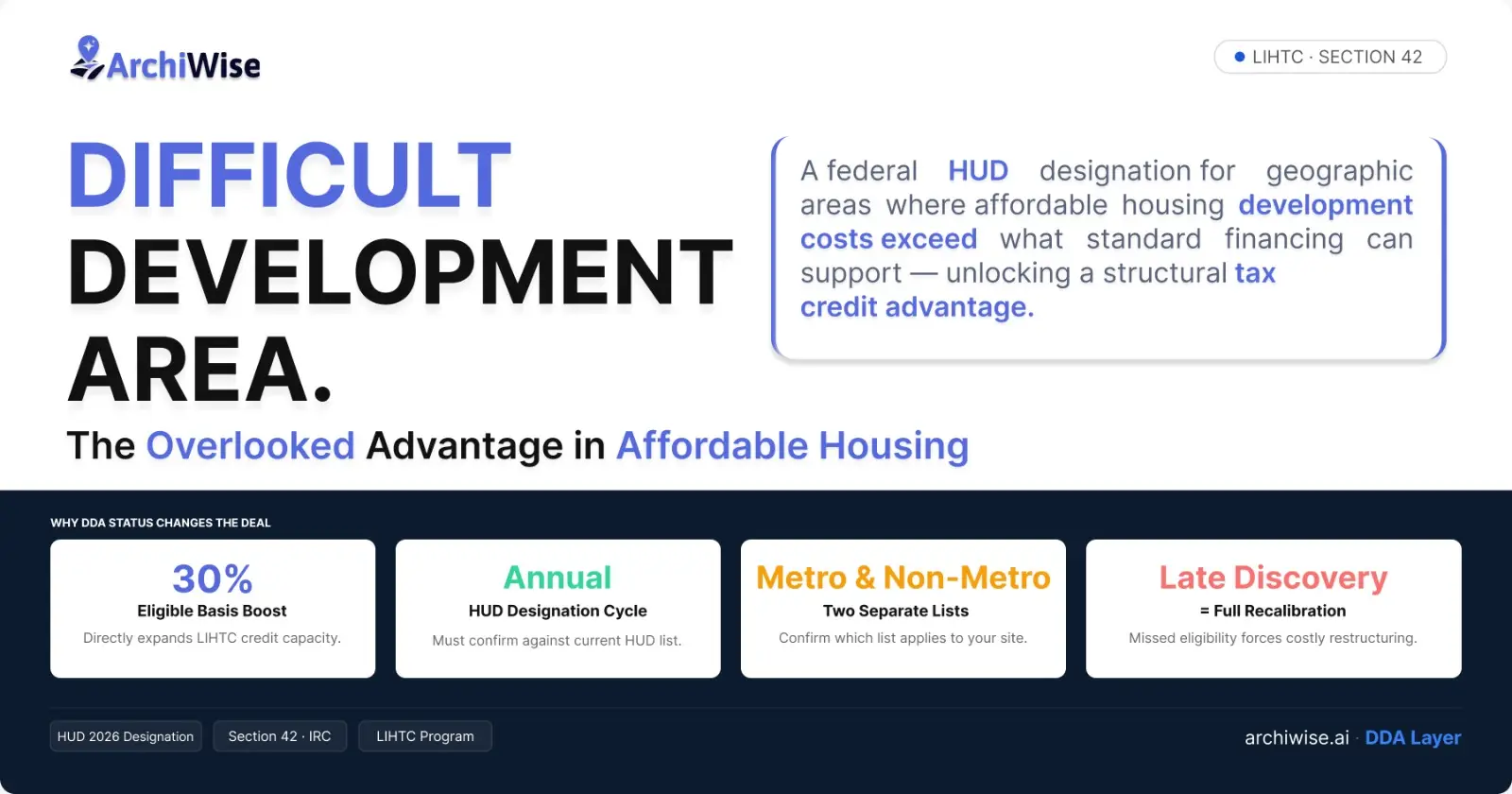
A Difficult Development Area (DDA) is a federally designated geography identified annually by the U.S. Department of Housing and Urban Development (HUD). These are markets where construction costs, land values, and labor expenses are high relative to local income levels.
In practical terms, a DDA is a high-cost market where it is structurally harder to build affordable housing because rents – restricted by Area Median Income (AMI) limits – cannot naturally support development costs.
To correct this imbalance, federal policy allows projects located in DDAs to receive a basis boost under Section 42 of the Internal Revenue Code through the Low-Income Housing Tax Credit (LIHTC) program.
What the 30% Basis Boost Actually Means
There is often confusion around how this number works.
Projects in a DDA qualify for a 130% eligible basis calculation – meaning eligible development costs are multiplied by 1.30 before tax credits are calculated.
That 130% figure represents a 30% increase in eligible basis.
For example:
If a project has $10 million in eligible basis, a DDA designation increases that to $13 million for credit calculation purposes. That 30% increase then expands the total tax credit allocation. And because LIHTC equity is priced per dollar of credit, this adjustment can materially increase the amount of equity raised.
It is not a marginal incentive. It is a structural shift in the capital stack.
The Quiet Lever Inside Section 42
Under Section 42, that 30% basis boost can:
- Increase total tax credit allocation
- Expand investor equity capacity
- Reduce permanent debt sizing pressure
- Improve yield-on-cost metrics
- Close funding gaps without redesign or additional subsidy
Affordable housing deals operate within thin margins. A 30% basis adjustment does not slightly improve feasibility – it can reconfigure the financial architecture of a project.
Yet many teams verify DDA status only after underwriting is underway.
By then, the sequencing advantage is already lost.
Why Timing Matters More Than Most Developers Realize
Most developers screen sites based on land price, density potential, and comparable rents. Those variables matter in market-rate development.
Affordable housing operates under a different logic.
Incentive alignment is foundational.
A parcel inside a DDA may unlock materially stronger financing assumptions from day one – backed by a 30% basis boost that reshapes what the capital stack can support.
A comparable parcel outside a DDA may require deeper subsidy layering, deferred fees, or competitive public financing.
The designation does not change what you can build.
It changes whether the project pencils.
From Manual Lookup to Embedded Intelligence
HUD publishes DDA lists annually, separated into metropolitan and non-metropolitan areas. Confirming eligibility traditionally requires:
- Identifying the relevant census tract
- Cross-referencing HUD PDF documents
- Verifying the applicable designation year
- Correctly interpreting eligibility rules
It is a manual and fragmented process – often completed under time pressure.
Within ArchiWise, DDA status is integrated as one of several Low-Income Housing data layers available directly at the parcel level.

Instead of checking a document after preliminary underwriting is complete, developers can see DDA eligibility immediately during early parcel evaluation – before acquisition, before modeling, before capital conversations begin.

This is where ArchiWise creates structural advantage.
It does not simply surface regulatory data.
It restructures when that data enters the decision cycle.
And in affordable housing, timing determines leverage.
The Risk of Discovering DDA Status Too Late
When DDA verification happens after:
- Site control
- Pro forma modeling
- Investor discussions
the consequences ripple:
- Capital stack restructuring
- Revised underwriting assumptions
- Equity renegotiation
- Delayed closings
- Land repricing risk
In some cases, developers price land assuming a 30% basis boost that does not exist. By the time the mistake surfaces, negotiating leverage has already shifted.
In affordable housing, regulatory timing is financial timing.
Why This Matters Now
Construction costs remain elevated.
Interest rates increase carry risk.
Institutional equity is more selective.
Public gap financing is more competitive.
And affordable housing demand continues concentrating in high-cost metropolitan markets – where DDA designations and their 30% basis boost are often most relevant.
As margins compress, overlooked incentive variables become amplified risk factors.
DDA status is not a bonus discovered during due diligence.
It is a structural lever.
The Competitive Shift in Affordable Housing
Sophisticated developers increasingly treat incentive eligibility as a primary screening filter – not a secondary confirmation step.
Density matters.
Land cost matters.
But in Section 42 development, a 30% basis boost can matter just as much as either.
DDA designation can materially change:
- Equity raised
- Debt sizing
- Developer return
- Gap financing exposure
- Overall feasibility threshold
Platforms that surface Low-Income Housing data layers early in the process reduce invisible risk and increase decision clarity.
ArchiWise does not replace underwriting judgment.
It strengthens it – by aligning regulatory intelligence with financial modeling at the moment when decisions are still flexible and leverage is still intact.
Final Thought
In modern affordable housing development, the most expensive mistakes rarely begin in construction.
They begin in assumption.
Assuming a site is financially viable without confirming its incentive eligibility introduces fragility into the capital stack before it is even assembled.
A 30% basis boost may sound like a technical adjustment.
In reality, it can reshape the equity raise, the debt structure, and the feasibility threshold of a deal.
Understanding it early does not guarantee success.
But ignoring it increases uncertainty.
And in affordable housing, uncertainty is cost.
Learn More
ArchiWise helps developers, investors, architects, and brokers move beyond zoning theory and into parcel-level reality – applying verified, city-specific regulations directly to the land being evaluated.
Whether screening sites, validating underwriting assumptions, or preparing for feasibility analysis, ArchiWise provides decision-ready intelligence before time and capital are committed.