

For architects, real estate developers, and investors
Ask ten architects what the density is on a piece of land, and you’ll get ten different answers – all of them correct. That’s not a riddle. It’s how density actually works.
Density isn’t a single number. It’s the result of five different calculation systems running at the same time. Miss one, and you could leave units on the table, overpromise to a client, or run into a rule you never saw coming.
Here’s a plain-language breakdown of each system, how they interact, and where the real opportunities (and traps) are hiding.
Units Per Lot (DU/AC): The Starting Point

Dwelling units per acre (DU/AC) is the most common way zoning codes express how much housing is allowed. The formula is simple:
Density (DU/AC) = Total Homes ÷ Total Land Area (in acres)To convert square feet to acres: divide by 43,560
One thing people overlook: how fractions are handled. On a 15,000 sq ft lot zoned for 12 DU/AC, the math gives you 4.13 homes. Some cities always round down. Others use standard rounding. A single fraction can mean the difference between 4 and 5 units. Always check the local code.
| Zone Type | Typical DU/AC | What Gets Built |
| Single-family (R-1) | 1–8 | Houses on individual lots |
| Medium-density (R-2, R-3) | 8–25 | Duplexes, townhomes, small apartments |
| High-density (R-4, RH) | 25–100+ | Mid-rise and high-rise buildings |
But DU/AC only counts units. It doesn’t tell you how big those homes can be, or how much of the lot you can build on. That’s where FAR comes in.
Floor Area Ratio (FAR): The Volume Controller
FAR measures how much total floor space you can build relative to lot size. It’s the most powerful density tool in any zoning code – and the one investors most often misread.
FAR = Total Floor Area ÷ Lot SizeExample: A 10,000 sq ft lot with FAR 2.0 = 20,000 sq ft of buildable floor space
FAR doesn’t care how you stack the space. On that same lot, you could build two stories covering the whole lot, four stories covering half, or eight stories on a quarter. That flexibility is exactly why it matters so much for developers figuring out how to maximize a site.
What FAR excludes: Parking garages, basements used only for parking, mechanical floors, stairwells, and elevator shafts typically don’t count. Finding and using these exclusions is one of the most reliable ways to gain floor space without hitting your FAR cap.
FAR vs. DU/AC: Two buildings can have identical DU/AC numbers but very different FARs, depending on unit size. That’s why most jurisdictions regulate both. DU/AC limits how many households you add. FAR limits the physical mass of the building.
For investors: FAR is the best proxy for land value. More FAR = more rentable space = higher land prices. A 2022 NYC study confirmed that lower FAR limits directly drove down land values.

Bulk Controls: The Silent Killers
DU/AC and FAR get all the attention. But a whole set of “bulk controls” can quietly make those headline numbers unachievable. These are the blind spots that hurt professionals most when they move into a new market.
Things to check against any density calculation: minimum lot width, front/rear/side setbacks, maximum height, maximum lot coverage, minimum unit size, required open space, and parking requirements. Any one of these can be the real constraint.
The Minneapolis example is a good one. When the city became the first major U.S. city to allow triplexes on any residential lot (2018), it was celebrated as a big housing win. But a 0.5 FAR cap in two interior districts meant a house on a standard 5,000 sq ft lot could only be 2,500 sq ft total – making triplexes practically unbuildable in those areas, regardless of what the zoning map said.
Lot width bonuses: Some cities use minimum lot width to limit density, then offer waivers as incentives. Salt Lake City goes further: it removes minimum lot area, width, and street frontage requirements entirely for missing middle housing types like townhomes and duplexes.
Density Bonuses: The Official Way to Build More
Density bonuses are the formal mechanism cities use to let developers exceed base zoning in exchange for public benefits. They’re the most widely used affordable housing incentive – and one of the most powerful tools on the table when properly modeled.
A bonus typically gives you permission to add more units (higher DU/AC), more floor space (higher FAR), or both. Most programs offer 10–20% above the base limit in exchange for affordable set-asides.
California’s statewide Density Bonus Law lets developers build 35% more homes than base zoning if they hit the required affordability thresholds – and it overrides stricter local rules statewide.
Other bonus triggers: Affordable housing isn’t the only path. Arlington County, VA ties extra FAR to LEED certification. Portland, OR gives a FAR bonus for green roofs. San Diego allows 100% bonus density for micro-unit buildings that stay within the standard building footprint.
Real example – Brooklyn’s South Park Slope: Without the city’s Inclusionary Housing Program, max FAR is 5.4. Participate, and it rises to 7.2. That’s the difference between a mid-size apartment building and a significantly larger one on the exact same lot.
The financial warning: Bigger buildings cost more to build. A Grounded Solutions Network study found that over half of eligible Seattle projects chose not to use bonus density because the extra construction costs exceeded the revenue from added units. Always run a sensitivity analysis before treating a bonus as a guaranteed yield increase.
Transferable Development Rights (TDRs): The Private Market for Air
While density bonuses are negotiated with the city, TDR programs create a private market for unused development capacity.
When a building uses less floor space than zoning allows, the difference is called “unused development rights” or “air rights.” In many cities, these can be sold or transferred to other parcels.
A landowner in a “sending area” (somewhere the city wants preserved) sells their unused rights to a developer in a “receiving area” (somewhere the city wants more density). For the buyer, it’s essentially a purchased upzoning.
The legal foundation was set by Penn Central Transportation Co. v. New York City (1978), when the Supreme Court ruled that NYC hadn’t illegally taken property by blocking construction above Grand Central – partly because the owners still had transferable air rights. TDRs have been legally solid ever since.
TDR markets work best where demand for extra density is strong and the credit market is active. Thin or illiquid markets tend to see very little transaction activity.
Putting It All Together
Here’s a real example: a 20,000 sq ft urban infill lot in a medium-density zone, zoned at 20 DU/AC with a base FAR of 2.0.
| Step | Calculation | Result |
| Starting units (DU/AC) | (20,000 ÷ 43,560) × 20 = 9.18, round down | 9 homes |
| Max buildable area (FAR) | 20,000 sq ft × 2.0 | 40,000 sq ft |
| Net area after setbacks (~25% loss) | Remove ~25% of gross area | ~15,000 sq ft net |
| Realistic floor area on net land | 15,000 × 2.0 FAR | 30,000 sq ft |
| Density bonus (20% affordable) | +20% FAR bonus | +6,000 sq ft = 36,000 sq ft |
| Final unit count (avg. 1,000 sq ft/unit) | 36,000 ÷ 1,000 | ~36 homes |
The zoning map said 9 units. The full worked-out number is 36. Four times as many. This isn’t unusual – it’s the normal gap between what the headline shows and what you can actually build. Professionals who know all five layers consistently build more, make fewer promises they can’t keep, and find value others miss.
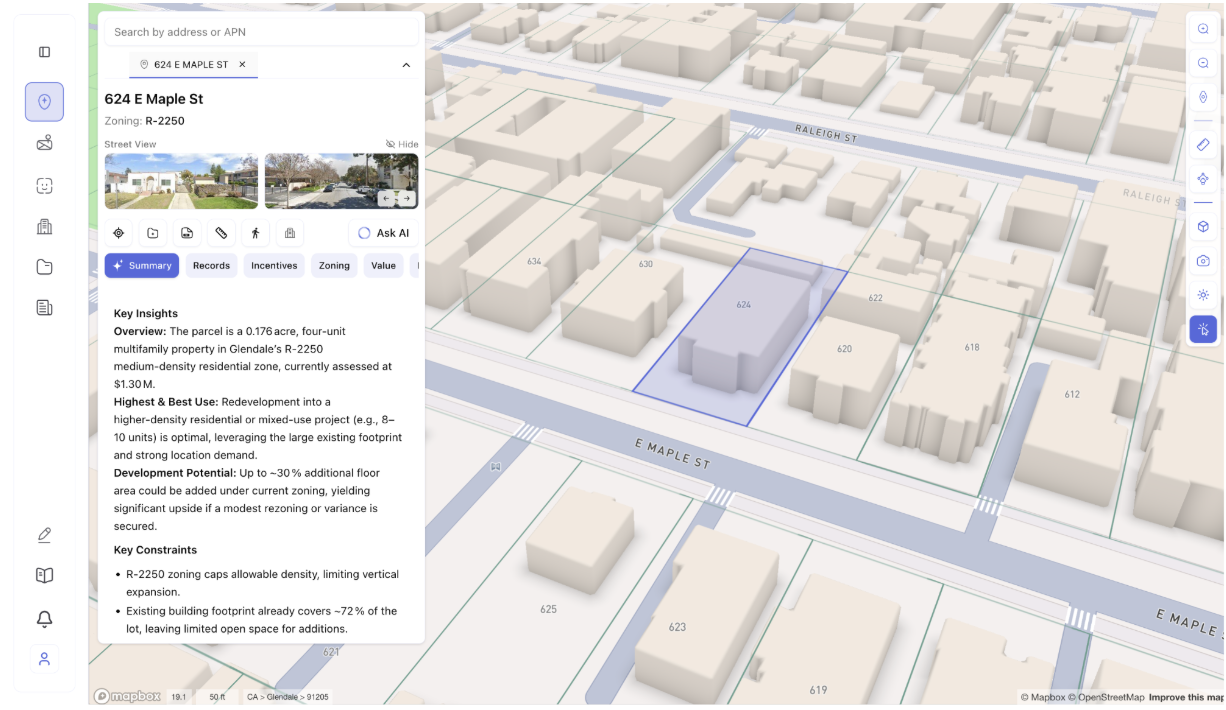
Ready to see what your site can actually build?
Most density analyses stop at the zoning map – but the real number is almost always higher once you factor in FAR, bulk controls, and bonus eligibility.
Drop your parcel address into ArchiWise and get the full picture in minutes – units, FAR, bonuses, and buildable area, all in one place.