
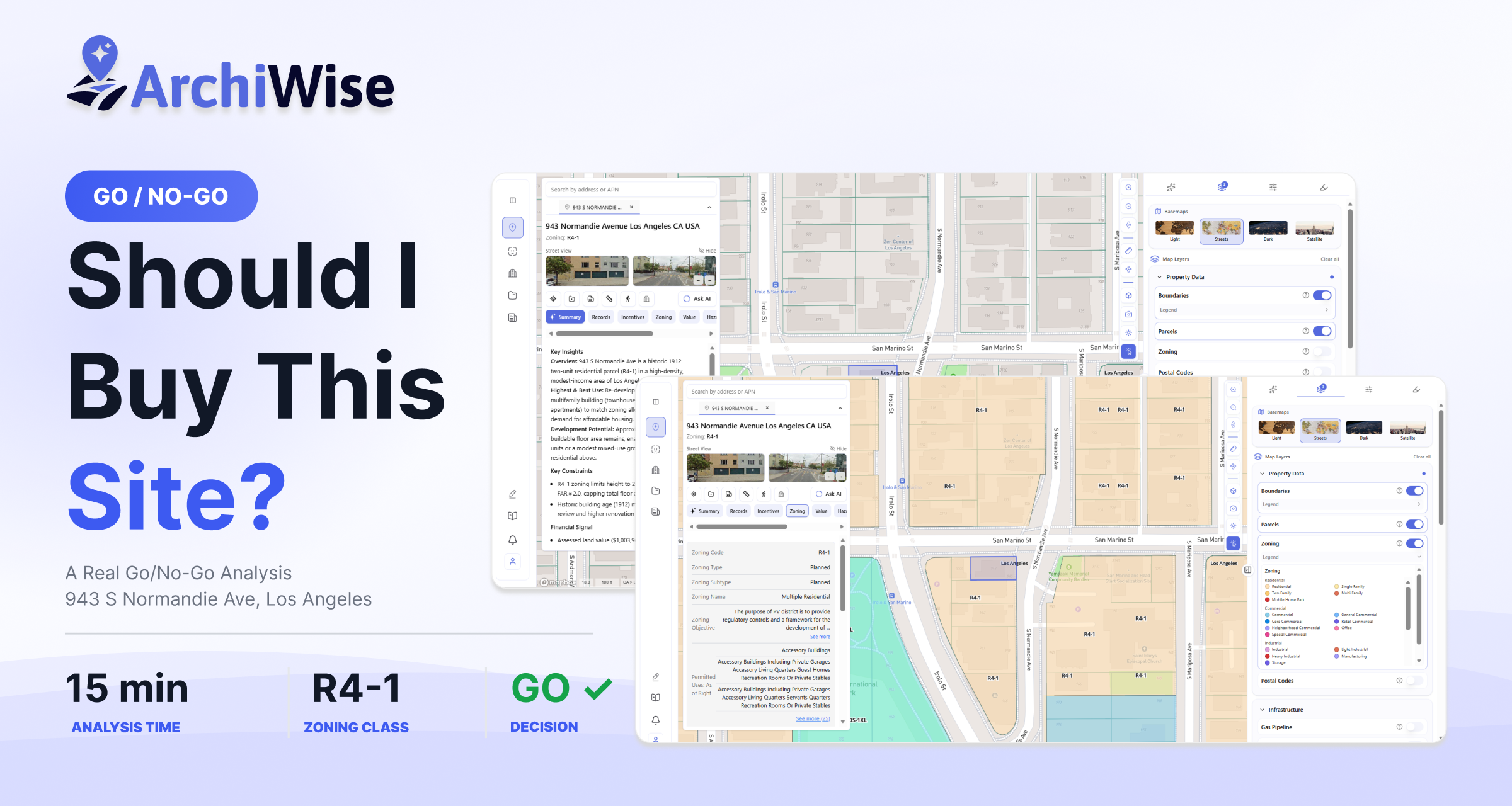

One real address. Every data layer. Fifteen minutes. Here’s exactly how we made the call.
There’s a property on a quiet street in Los Angeles. A two-unit building originally constructed in 1912, owned by an out-of-town LLC that acquired it in 2019.
For a developer, the setup is hard to ignore an out-of-town owner, an underutilized lot, in a neighborhood where rental demand is through the roof.
But a promising-looking site and a profitable site are two very different things.
So we didn’t rely on instinct. We opened ArchiWise, entered the address — 943 S Normandie Ave, Los Angeles, CA 90006 — and ran a complete AI site selection analysis covering zoning, hazards, incentives, value, and neighborhood demographics — entirely within the platform, from start to finish.
We had a clear decision in fifteen minutes.
Here’s exactly how it happened, step by step.
Step 1: The Site Summary – What Are We Dealing With?
The first thing ArchiWise shows you when you click a property is an AI-generated summary. Think of it as a one – page briefing on everything that matters about the site – before you’ve looked at a single other tab.
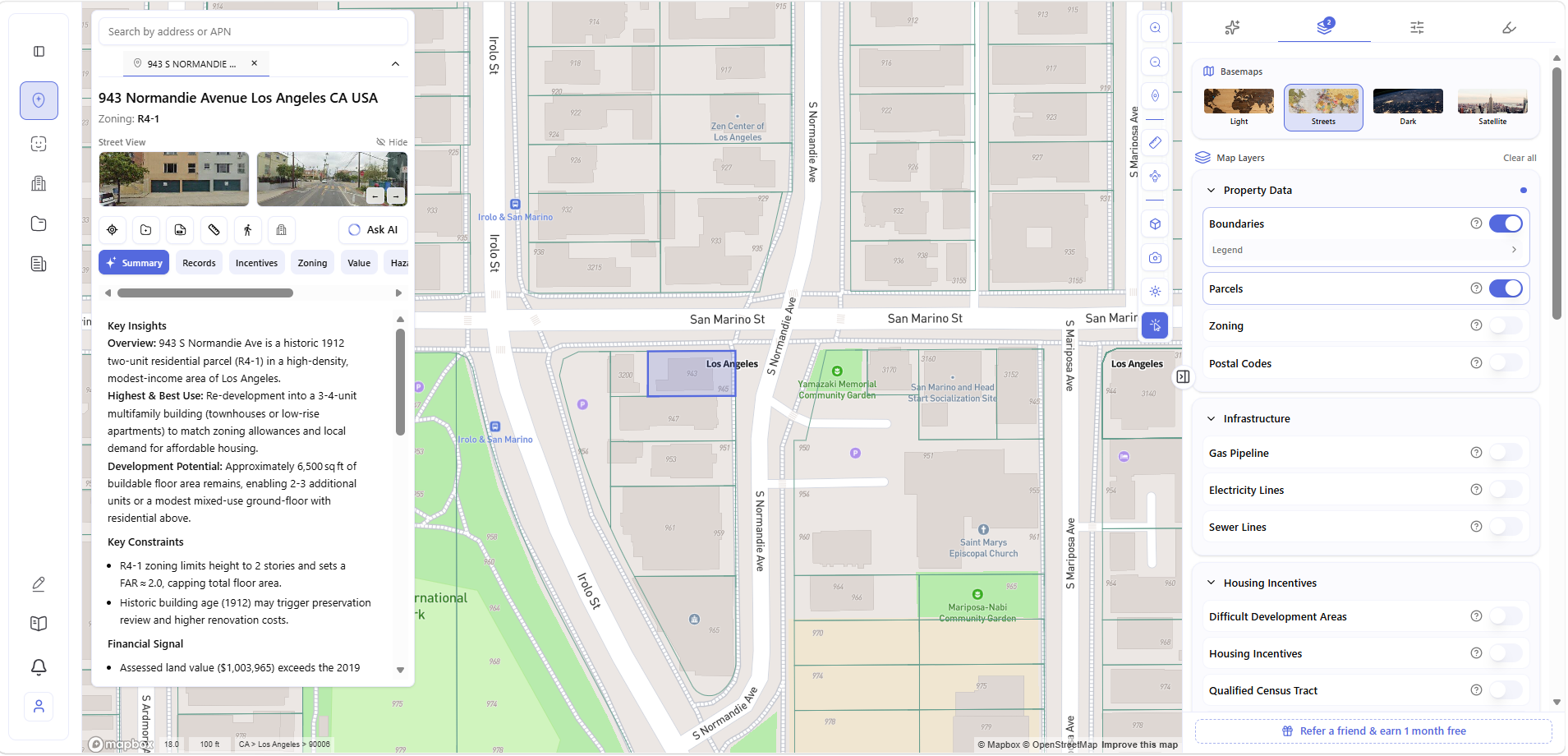
Here’s what the summary told us:
- Lot size: 4,135 sq ft (just under a tenth of an acre)
- A two-unit residential building, originally constructed in 1912
- Zoning: R4-1 -approved for multi-unit residential development
- Existing building covers about 41% of the lot -leaving significant room to build on
- The Archiwise summary estimates roughly 6,500 sq ft of buildable floor area -enough for 3 to 4 new units
One thing immediately stood out: the land is currently assessed at $1,003,965 -against a last recorded sale price of $900,009 in 2019. The land alone is now assessed above what the whole property sold for six years ago. That’s a meaningful signal for anyone considering the land acquisition.
The AI recommendation: acquire the site and develop a 2-story, 3-4 unit apartment building -whether through renovating the existing structure or rebuilding – designed to qualify for affordable housing incentives.
Archiwise’s summary also flagged that the 1912 construction date may trigger a historic preservation review, which could add cost and time to any renovation or demolition plan.
Confidence level: Medium. This doesn’t mean the deal is shaky – it means there are real things to check before committing. That’s exactly what the rest of the analysis is for.
Step 2: Zoning Analysis – What Does the Law Allow Here?
Before anything else, you need to know what you’re legally allowed to build. If the zoning doesn’t support your plan, nothing else matters.
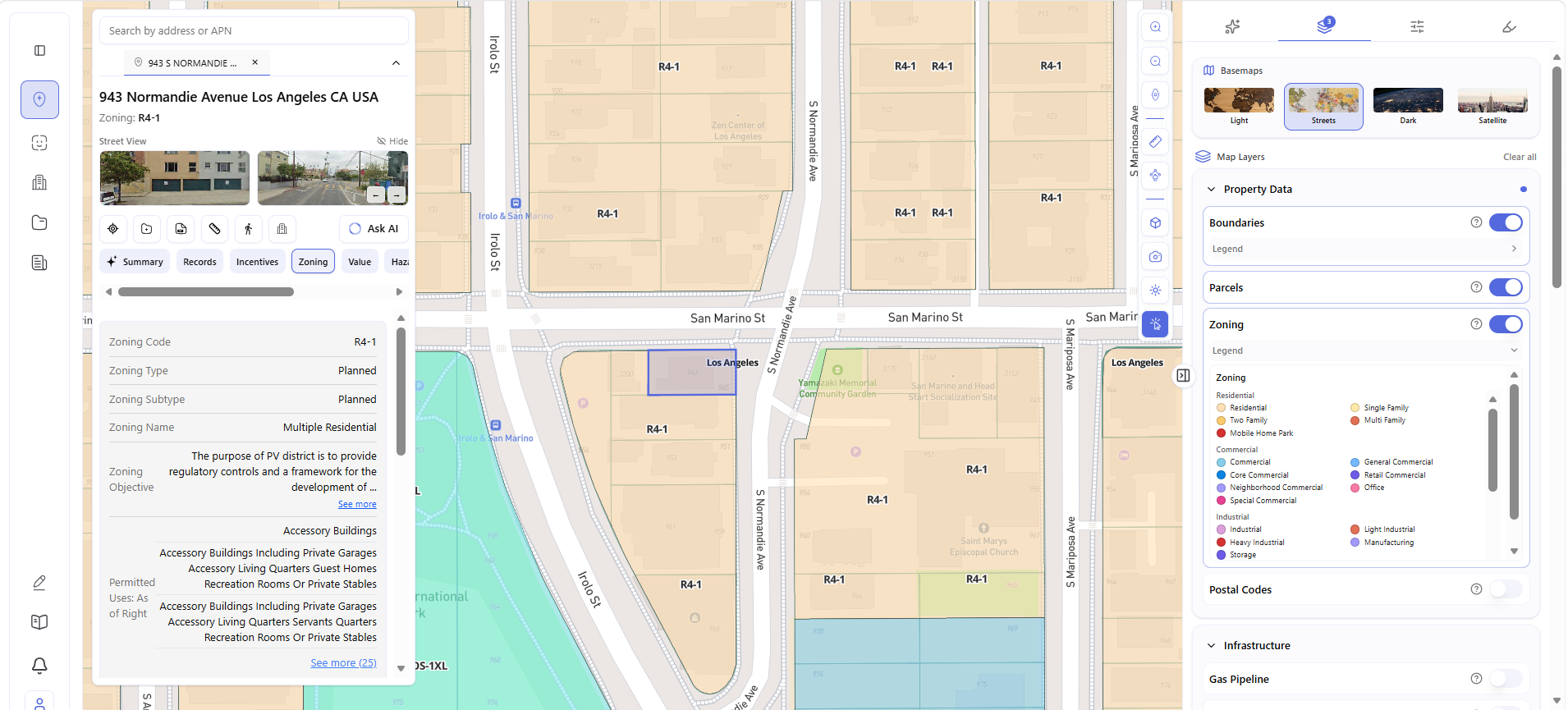
This property is zoned R4-1-Multiple Residential. The city permits apartment buildings here. Short-term rentals and commercial spaces are also allowed.
The zoning tab confirms a maximum Floor Area Ratio (FAR) of 3.0. FAR is a simple multiplier -it tells you how much total floor space you can build relative to the lot size. On a 4,135 sq ft lot, FAR 3.0 allows up to roughly 12,400 sq ft of total floor area in theory. The actual buildable amount will be shaped by setbacks and height limits -but the zoning headroom is clearly there to support 3–4 units.
One thing worth noting: R4 -1 lists a minimum lot area of 5,000 sq ft, but this applies to lot subdivision – not to building on an existing lot. Development here is not blocked by that requirement.
The bottom line: you can build here, but density comes from building up, not out. The lot is too tight to spread sideways.
Step 3: Real Estate Feasibility – What Can Actually Be Built Here?
Zoning analysis tell you what’s permitted. Feasibility analysis answer the next question: what does the physical space actually allow?
We asked the Archiwise AI Chat: “What are the setback requirements?”
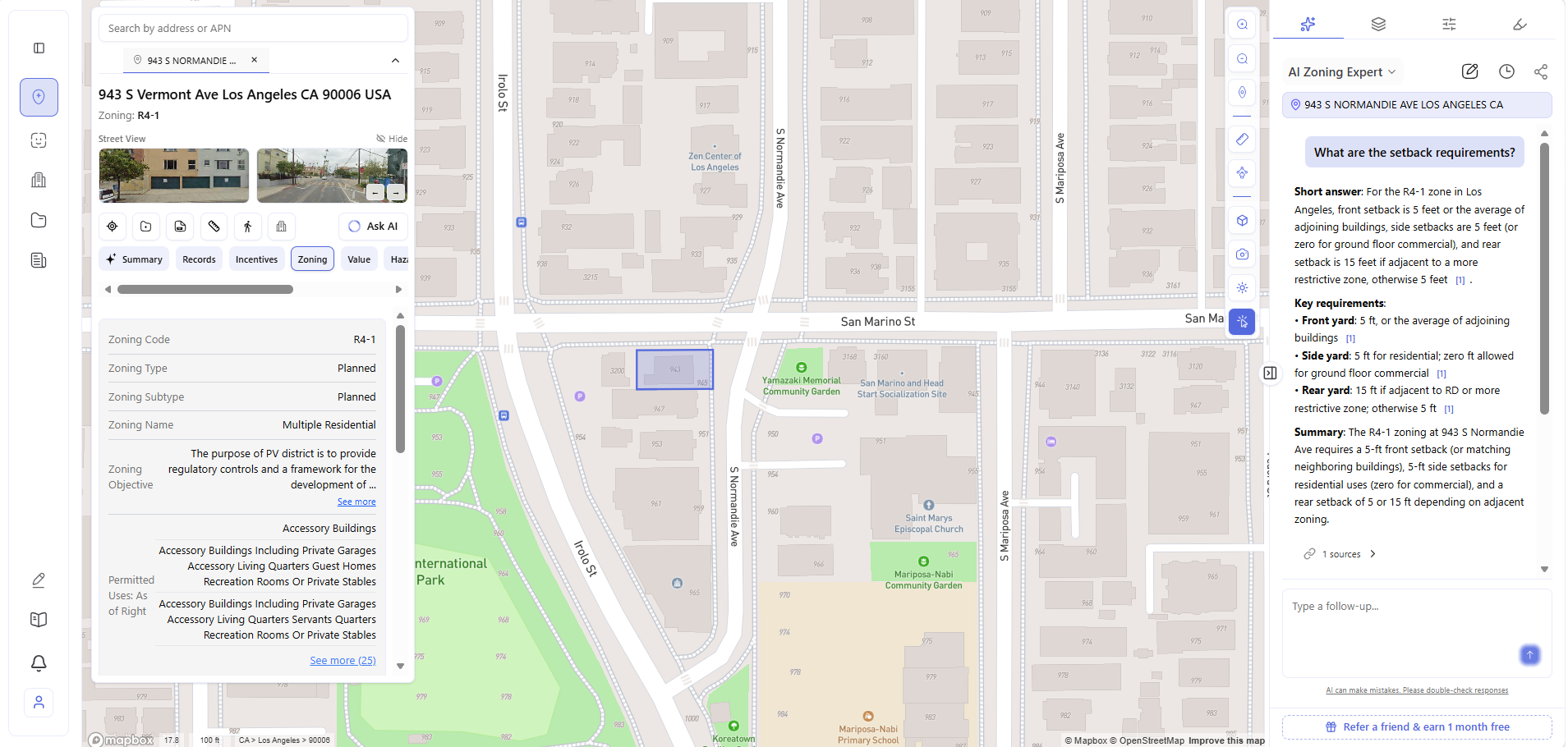
Setbacks are the minimum distances a building must sit from each edge of the lot. The answer came back instantly, pulled directly from the R4-1 zoning code:
- Front: At least 5 ft from the street, or match the setback of neighboring buildings
- Sides: At least 5 ft for residential use; zero for ground-floor commercial
- Rear: At least 15 ft if adjacent to a more restrictive zone; otherwise 5 ft
With a 4,135 sq ft lot and setbacks on all four sides, the net buildable footprint is tighter than the total lot area, which is exactly why ArchiWise gives you the FAR-based floor area figure upfront, so you know what’s realistic before spending anything. What the zoning makes clear is that density here comes from building up within the 2-story limit, not from spreading out.
No searching through planning documents. No calls to the city. One question, one answer, in seconds. That’s the kind of speed that changes how you evaluate deals.
Step 4: Hazards – Know What You’re Working With
Most developers skip hazard screening until they’re under contract. Archiwise puts it in front of you before you’ve committed to anything – so you can price every risk into your offer, not discover it afterward.
Turn on three layers in the Archiwise right-hand panel: Flood Hazard Zones, Earthquake Faults, and Seismic Hazard. For this site, all three came back with clear, actionable data.
Flood Risk – Clear
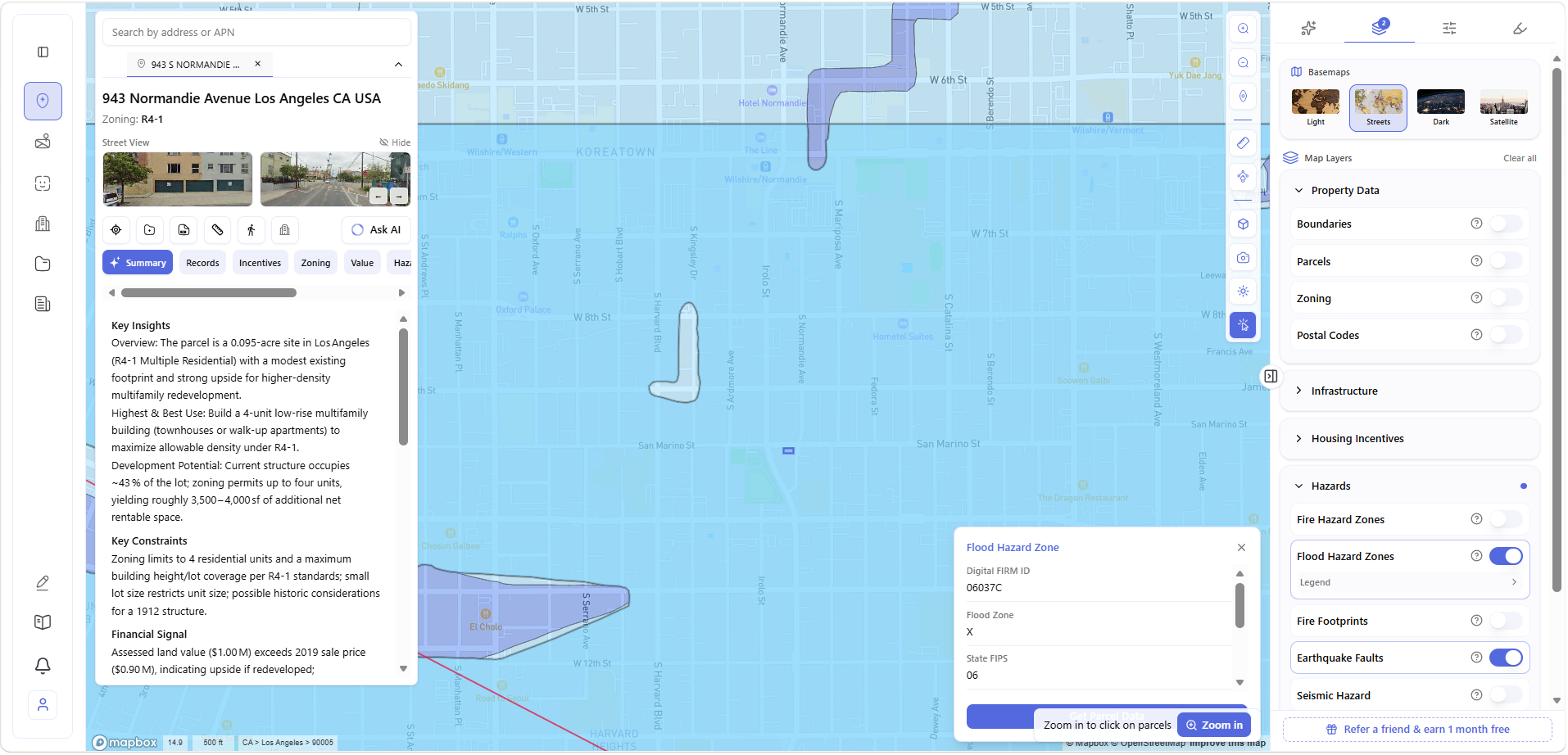
The FEMA designation for this parcel is Zone X – minimal flood hazard, the best classification a property can receive. A secondary designation covers the broader area at a 0.2% annual chance of flooding, but at the parcel level the exposure is low. This one comes off the risk checklist immediately.
Seismic Risk – Real, Quantified, and Manageable
The Lower Elysian Park Thrust fault runs through this part of Los Angeles – rated Class A, the most serious fault classification. Archiwise also flags a relatively high NRI risk rating, and its recommended development strategy includes seismic retrofits as a baseline. This is exactly the kind of data you need on the table before negotiating a price.
The USGS seismic acceleration figures, pulled directly by Archiwise, quantify the exposure:
- 2% probability in 50 years (maximum considered earthquake): Peak Ground Acceleration rated VIII Severe – 0.84 to 0.85g
- Spectral acceleration at 0.2 seconds: X Extreme – 2.04 to 2.06g
- Moderate scenario (10% probability in 50 years): IX Violent -1.01 to 1.02g
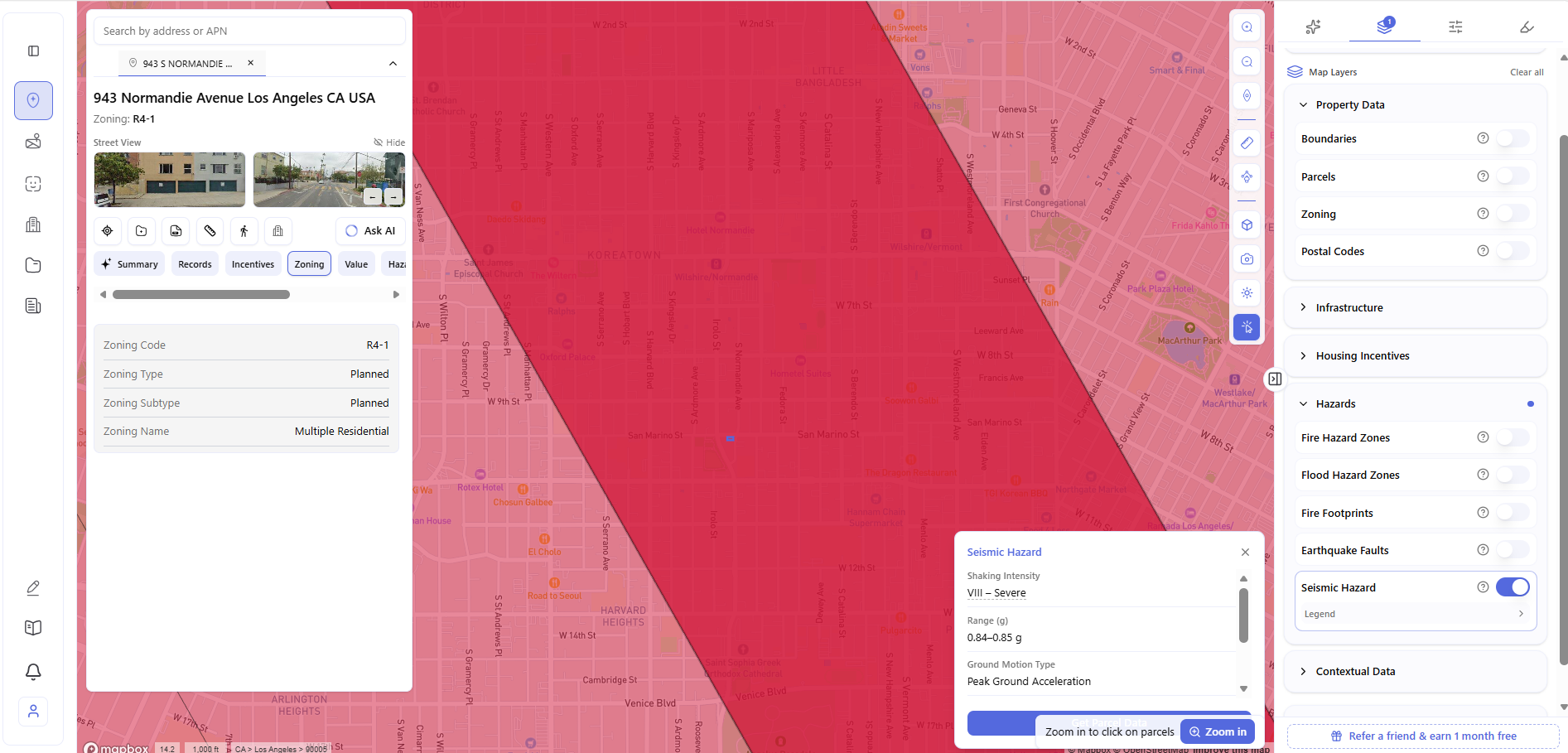
The map shows the entire area in the dark red VIII Severe band. This isn’t unique to this parcel – it’s the baseline condition across most of Los Angeles. The city builds thousands of units here every year because seismic risk in LA is a known cost, not an unknown obstacle. Here’s what that cost actually looks like.
What seismic compliance adds to this project:
In Los Angeles, seismic engineering isn’t a separate budget line – it’s built into the standard cost of every permitted building. According to NP Line Design (2026), LA construction costs run 20–40% above national averages in part because seismic design to ASCE 7 SDC D standards is already factored in. For wood-frame multifamily, the standard rate is $200–$350 per sq ft -seismic compliance is inside that number, not added on top.
The actual seismic-specific costs to budget for separately are:
- Geotechnical study: $3,000–$10,000 – required before construction to confirm soil conditions and fault proximity. This is the one guaranteed seismic-specific expense.
- Additional measures if the study reveals soft-story conditions: $20,000–$100,000 – only triggered if site-specific reinforcement is needed. Not guaranteed. (Source: Silver Hammer Builders, 2026)
Everything else – foundations, shear walls, structural engineering – is already priced into standard LA construction rates. The seismic exposure on this project is predictable, bounded, and financeable.
Several programs help offset those costs:
- Earthquake Brace + Bolt (EBB) program – FEMA-funded rebates of $3,000–$7,000, extended to rental properties in 2025 (Source: NP Line Design / FEMA)
- CalCAP loan program – state-backed financing covering up to 100% of retrofit costs, repayable over up to 10 years
- California Revenue & Taxation Code §74.5 – seismic improvements are excluded from property tax reassessment, so completing the work won’t increase your annual tax bill
Bottom line on seismic: Budget $3,000–$10,000 for the geotechnical study. Seismic engineering is already inside standard LA construction rates of $200–$350/sq ft. If additional retrofit work is needed, plan for $20,000–$100,000 – offset by FEMA rebates and state financing. These are known numbers. Put them in the pro forma and move forward.
Step 5: Incentives – Is There Government Funding Available?
When building affordable housing, incentive programs can make or break whether a project is financially viable. The Incentives tab shows which programs this site qualifies for – though it’s worth noting that Archiwise surfaces the programs it tracks, and additional local, state, or federal programs may exist that a tax credit specialist would identify.
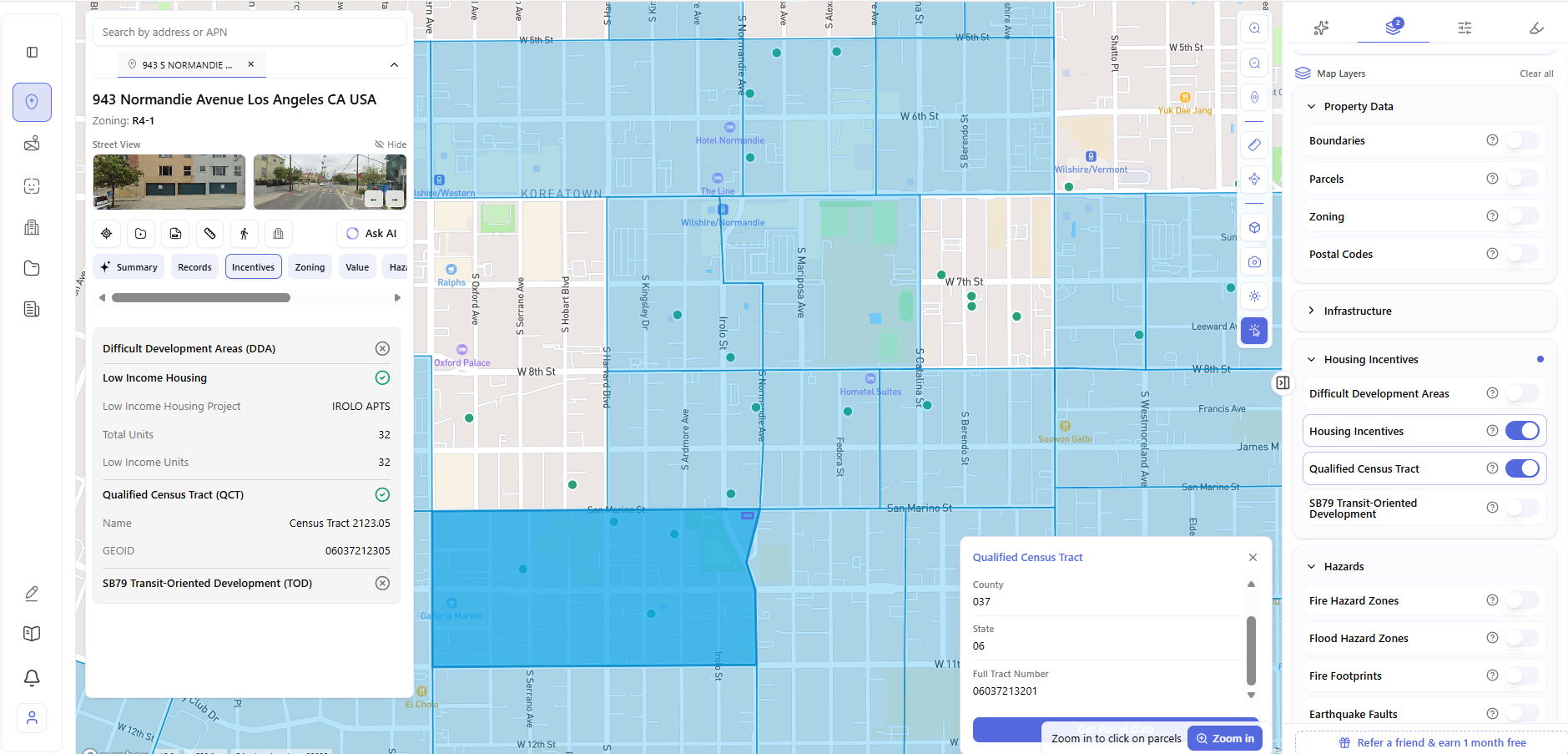
Qualified Census Tract (QCT) – Eligible
This property sits within Census Tract 2123.05, officially a Qualified Census Tract. That unlocks a 30% bonus on Low Income Housing Tax Credits (LIHTC). LIHTC is one of the main tools developers use to fund affordable housing – investors purchase the credits to reduce their federal tax bill, and that money flows directly into the construction budget.
To make this concrete, here’s what the QCT bonus looks like in practice. Assume a total development cost of $2,000,000, with $1,000,000 allocated to land (land is excluded from the credit calculation). That leaves an eligible basis of $1,000,000. With 100% affordable units and the QCT 30% boost applied, the qualified basis becomes $1,300,000. At the 9% competitive credit rate, that generates $117,000 in annual tax credits – or $1,170,000 over the standard 10-year period. Without the QCT boost, the same project yields $900,000 in total credits. The designation alone adds $270,000 in credit equity. These are illustrative figures; actual amounts depend on final costs, unit mix, and credit pricing at time of application.
Low Income Housing Precedent – Confirmed
ArchiWise flagged that IROLO APTS – a 32-unit, 100% affordable development – was built just 222 ft away from this parcel using this same financing pathway. That’s less than a minute’s walk, essentially the same block.
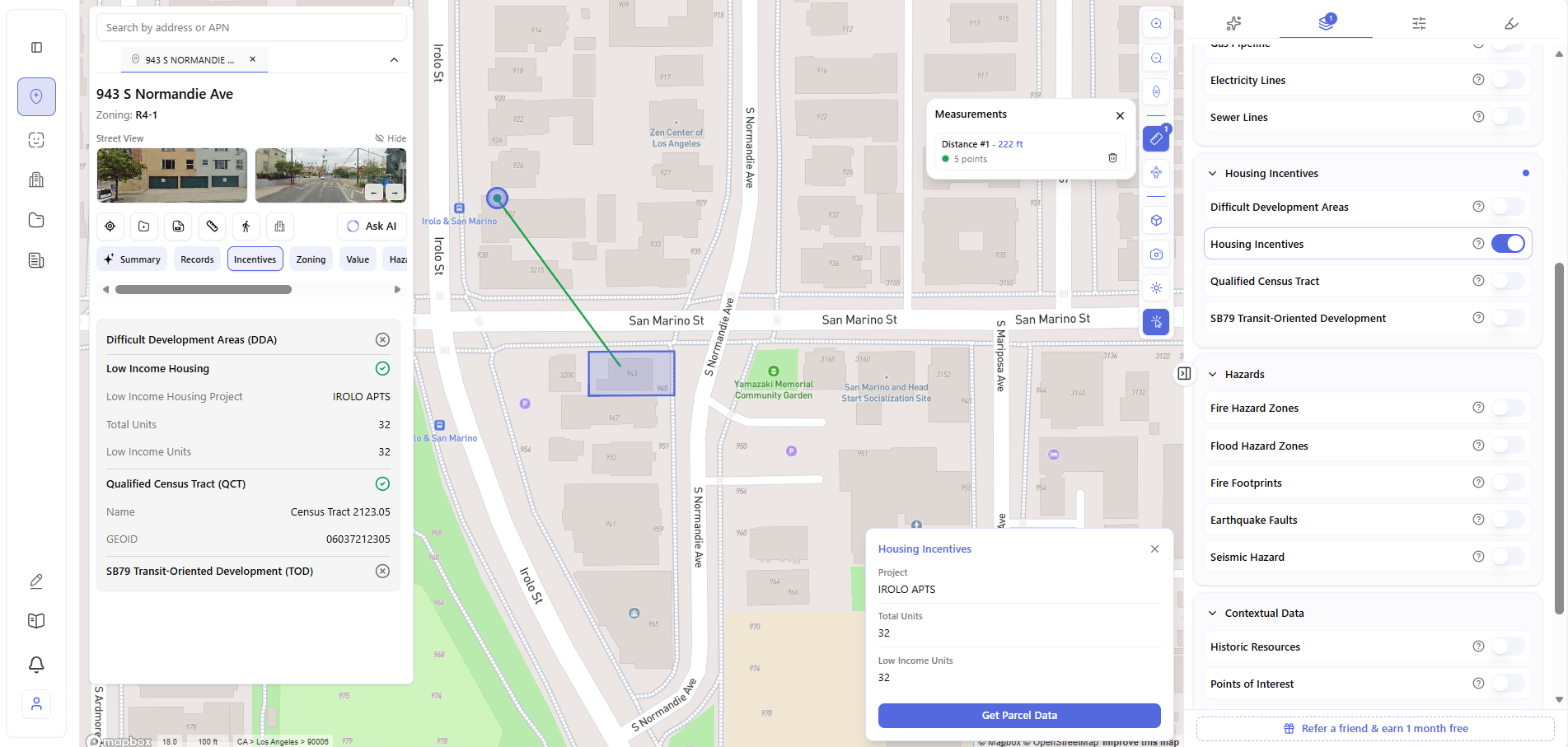
That proximity matters. It confirms the LIHTC process has been successfully navigated in this immediate neighborhood – not just the broader area.
Of the programs ArchiWise tracks, two came back not applicable for this site: Difficult Development Area (DDA) and SB79 Transit-Oriented Development. That doesn’t mean no other programs exist – ArchiWise surfaces what it monitors, and a tax credit specialist may identify additional local, state, or federal incentives worth pursuing alongside the QCT/LIHTC pathway.
Step 6: Value – Is the Price Justified?
The Value tab delivers the official assessed figures and full transaction history – without pulling county records manually.
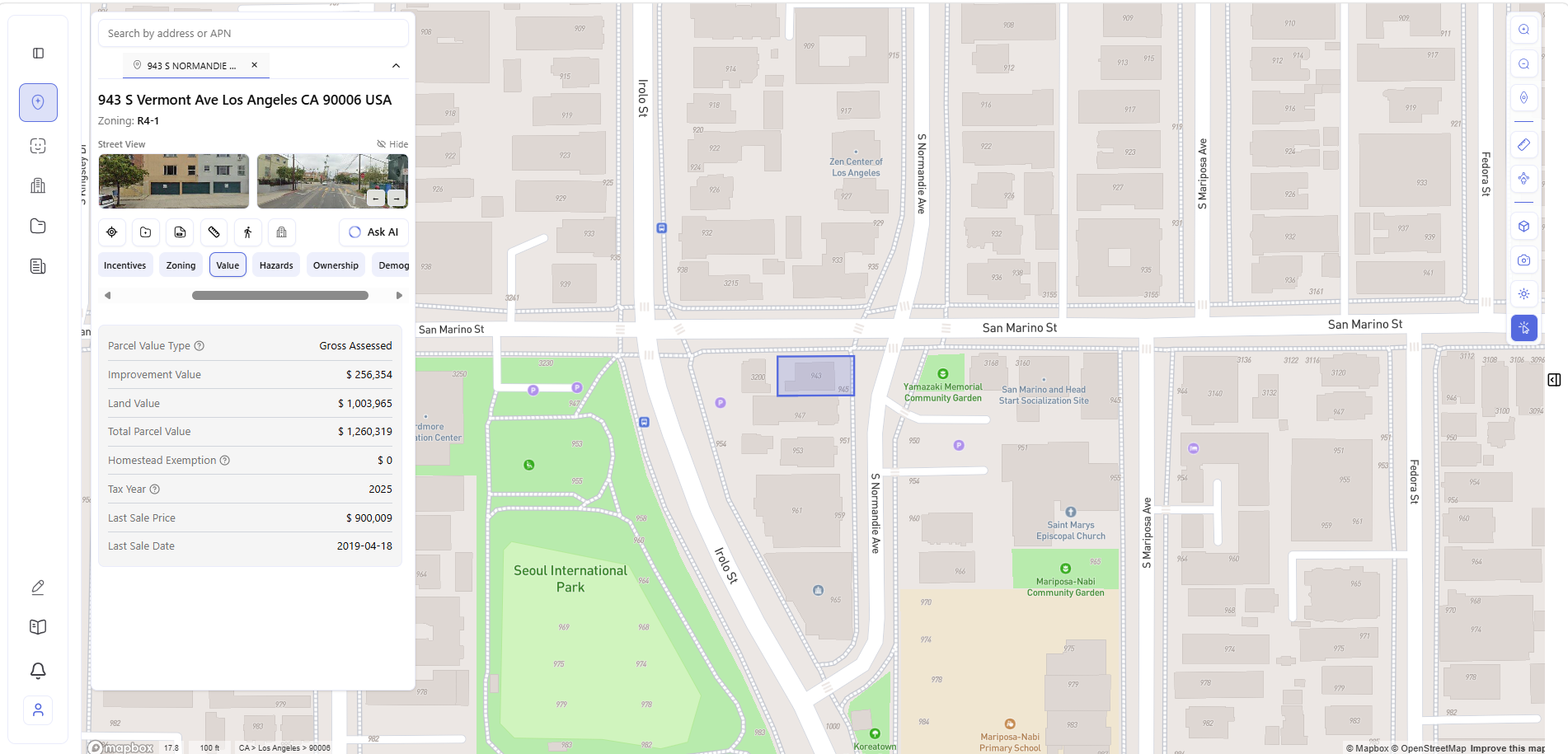
- Building value: $256,354
- Land value: $1,003,965
- Total assessed value: $1,260,319 (Tax Year 2025)
- Last sale: $900,009 – April 18, 2019
- No homestead exemption – purely an investment property
The last recorded sale was $900,009 in 2019. Today the land alone is assessed above that figure. That gap is a real signal – the land has appreciated, and the seller’s expectations relative to today’s assessed value are the key variable in any negotiation.
Step 7: The Neighborhood – Is There Real Demand for Rentals Here?
All the zoning and financial analysis in the world doesn’t matter if no one wants to live there. The Demographics layer answers whether genuine rental demand exists in this neighborhood.
To visualize this on the map, turn on the following layers in the Demographics section: Median Household Income, Homeownership Rate, Median Rent, Rent Burden, and Poverty Rate.
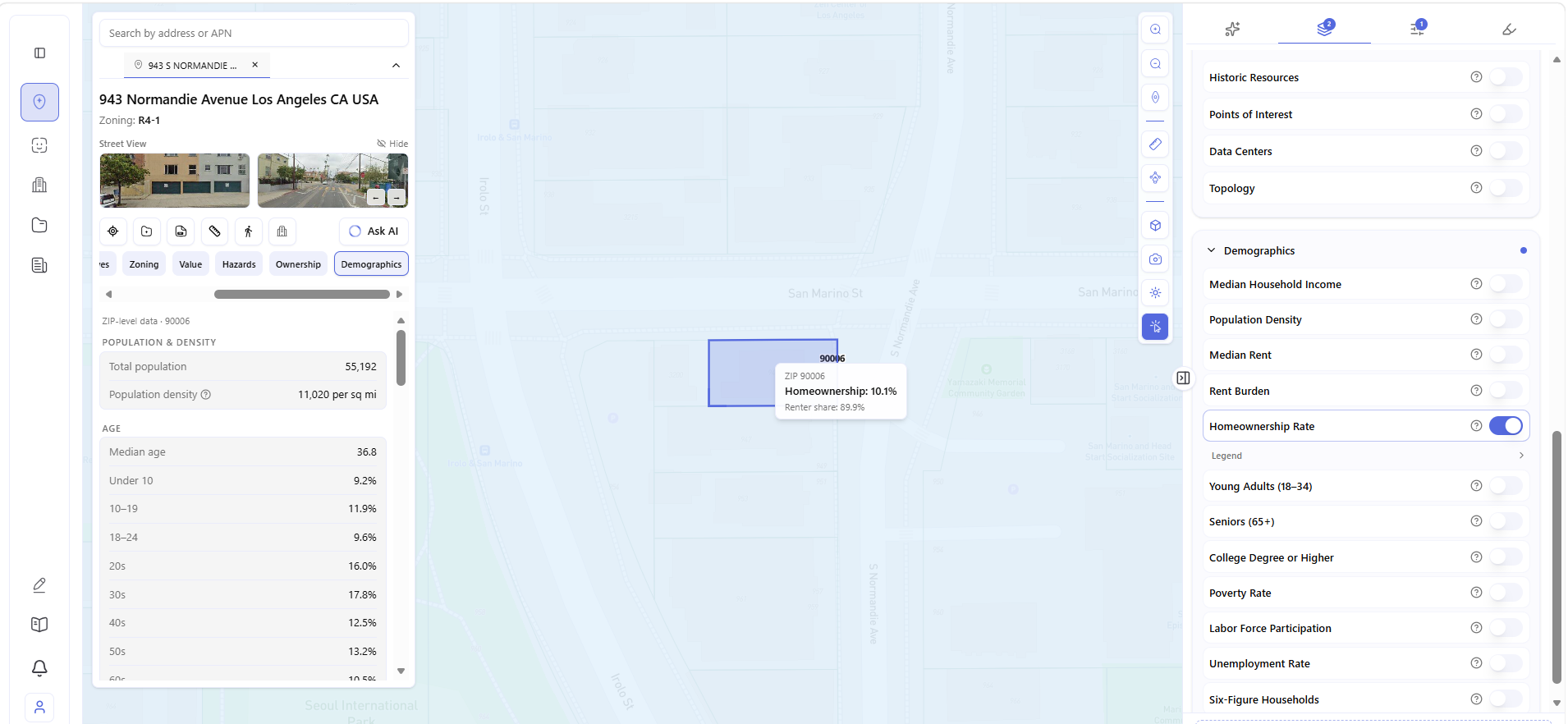
ZIP code 90006 tells a clear story:
- 55,192 residents at a density of 11,020 per square mile
- Only 10.1% own their home – the Archiwise map popup confirms a renter share of 89.9%. Nearly 9 in 10 residents here are renters.
- 37% rent burden – the average renter spends well above the 30% affordability threshold
- Median household income: $49,847 – individual median just $27,589
- Typical home value: $843,870 -homeownership is out of reach for most people here
- Poverty rate: 24.4%, median age 36.8
Behind these numbers are working people who are priced out of ownership and already spending more than they should on rent. The demand for affordable housing here isn’t a trend – it’s a persistent reality that a well-priced rental project can directly address.
The Decision: Go
After running every layer of analysis, the verdict on this site is: go. The seismic risk is real and fully documented in Step 4 – with costs that are known, bounded, and standard for Los Angeles development. Everything else on this site works in favor of moving forward.
What the analysis showed in favor:
- R4-1 zoning supports 3–4 unit multifamily development with FAR 3.0
- Flood risk minimal -Zone X, best-case FEMA classification
- Qualifies for 30% LIHTC basis boost via QCT -worth up to $270,000 in additional credit equity on a $2M project
- IROLO APTS – a 32-unit affordable precedent just 222 ft away, proving the financing pathway works here
- Land assessed above the 2019 purchase price – upside potential exists
- Nearly 90% of the neighborhood rents -genuine, documented demand
Every factor on this site points toward opportunity. ArchiWise surfaced all of it in fifteen minutes — before a single dollar was committed. That’s the kind of clarity that changes how you make offers.
This is what fifteen minutes of real estate feasibility analysis with ArchiWise looks like — a complete pre-development analysis of a site, every layer checked, every cost surfaced, and a clear answer. The zoning works, the market is real, the incentives are there, and the seismic costs are known and manageable.
That’s the kind of confidence you want before making an offer.
Learn More
ArchiWise helps developers, investors, architects, and brokers go from address to decision in minutes, not weeks.
Whether you’re screening sites for multifamily development, evaluating zoning constraints, surfacing incentive eligibility like QCT and LIHTC, or assessing hazard risk before committing capital, ArchiWise runs every layer of analysis in one place.
Explore how ArchiWise helps teams screen development sites, analyze zoning, and make confident go/no-go decisions faster.