
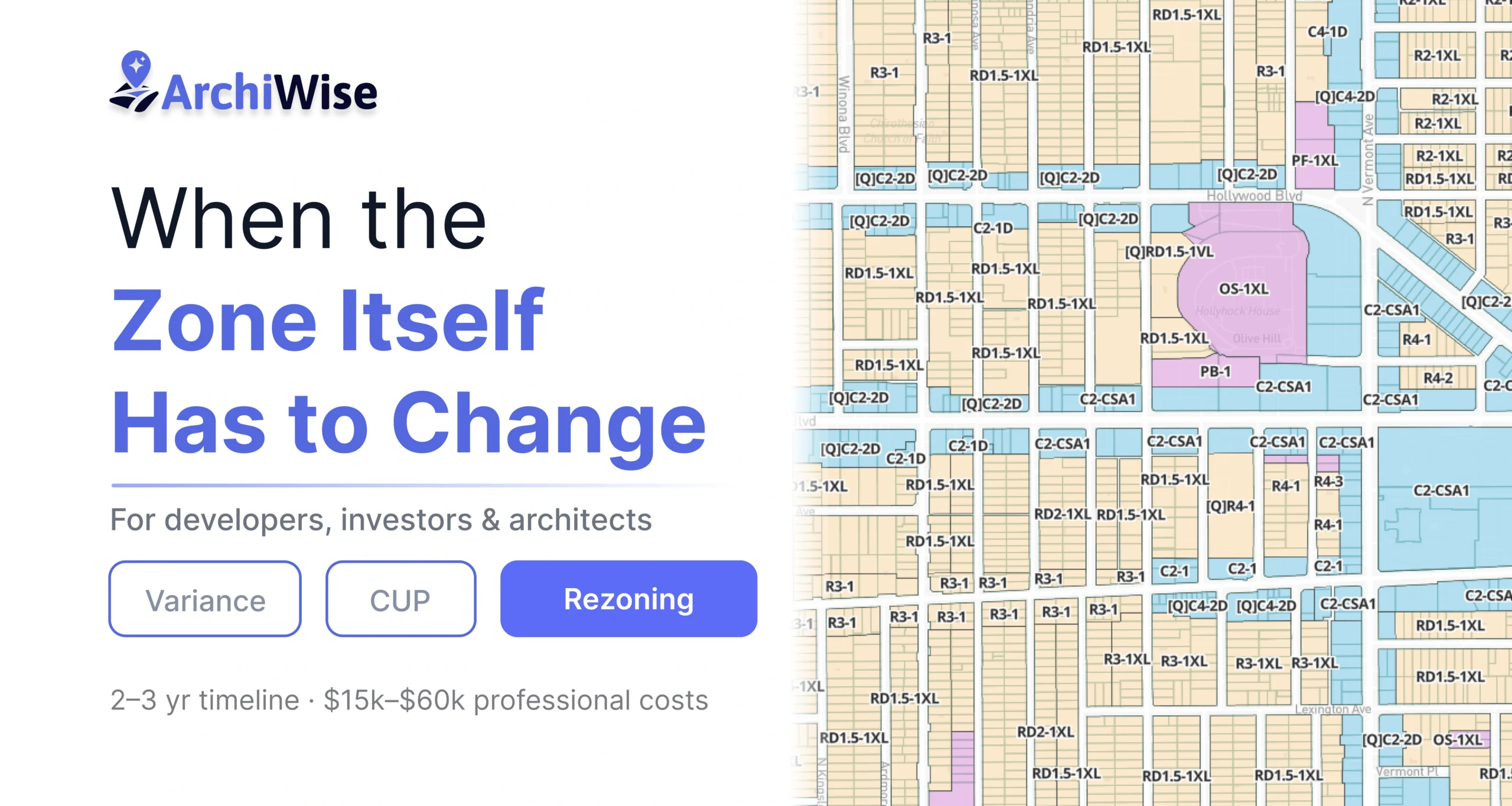

A plain-language guide for developers, investors, and architects.
When a Variance Won’t Fix It and a CUP Won’t Cover It
You’ve looked at the zoning. The use you want isn’t conditionally permitted – it’s flat-out prohibited. A Conditional Use Permit won’t help because CUPs only cover uses that are conditional, not banned. A variance only adjusts a physical rule – setbacks, height, lot coverage – not what you’re allowed to do on the land.
You’re not dealing with a rule that doesn’t fit the land. You’re dealing with a zone that doesn’t fit your vision.
That’s when the conversation turns to rezoning.
Rezoning is the most powerful – and most difficult – tool in the entitlement system. It doesn’t adjust one rule or grant one exception. It changes the zoning designation of the property entirely, rewriting what can be built there, how dense it can be, and what uses are permitted at all.
It’s also the longest, most uncertain, and most politically exposed path in real estate development. Understanding what it is, when it applies, and what it actually costs is essential before you commit to any site that needs one.
What Rezoning Actually Is
Rezoning – also called a zoning map amendment – is a formal change to a property’s zoning classification. When a property is rezoned, the new zone’s full rulebook replaces the old one. The result is permanent and runs with the land.
Most developers think of rezoning purely as unlocking a new use – converting commercial to residential, or industrial to mixed-use. But permitted uses are just one part of what changes. When a zone changes, everything changes:
Density. The number of units allowed per acre is set by zone. Rezoning from R2 to R4 doesn’t just permit apartments – it unlocks a completely different density allowance, often doubling or tripling the number of units you can build.
FAR (Floor Area Ratio). Each zone has its own FAR cap. A higher FAR means more total buildable floor area relative to the lot. Rezoning to a higher-intensity zone can dramatically increase what’s buildable on the same footprint.
Height limits. Zones set maximum building heights. Rezoning to a denser zone typically unlocks more stories – which directly affects project economics.
Setbacks and lot coverage. Different zones have different setback requirements and lot coverage caps. A rezoning can open up more of the lot for development or change how close to property lines you can build.
Parking requirements. Zones set minimum parking ratios. Higher-density residential or commercial zones near transit often carry reduced parking requirements, which frees up significant site area.
This is why rezoning can be so transformative – and why it’s so heavily scrutinized. A single zone change affects not just what you can do on the land, but how much you can build, how tall, how dense, and at what cost.
This is also fundamentally different from a CUP or a variance. A CUP evaluates whether a conditional use is appropriate within the existing zone. A variance adjusts one physical rule within the existing zone. A rezoning replaces the zone itself – and every standard that comes with it.
The stakes are higher, the process is longer, and the city has far more discretion. Unlike a variance – where a physical hardship can be objectively demonstrated with a survey – a rezoning asks the city to make a policy judgment: should this piece of land be governed by different rules than it is today?
There is no formula that guarantees approval.
The Three Situations That Actually Justify Rezoning
Cities don’t grant rezonings simply because a developer wants to build something different. There are three recognized justifications that give a rezoning application its best chance (LandSearch, 2025):
An error in the original classification. The property was zoned incorrectly when the zoning map was first drawn, and the current designation doesn’t reflect how the land has historically been used or what surrounds it.
Changed conditions in the surrounding area. The neighborhood has evolved significantly since the zone was assigned – new infrastructure, demographic shifts, adjacent development – and the current zone no longer fits the context.
Consistency with the general plan. The city’s long-term land use plan already anticipates a different use for this area, and rezoning the parcel simply brings the zoning map into alignment with that vision.
The strongest rezoning applications make at least one of these arguments clearly and credibly. Applications that simply assert “this use would be more profitable” almost always fail.
Two Real Examples
The underutilized commercial corridor:
A developer identifies a strip of aging single-story retail on a major arterial road. The city’s general plan designates the corridor for mixed-use intensification – more density, more housing, more activation at the street level. The parcels are zoned C-1 (neighborhood commercial), which permits retail but not residential above the ground floor.
The developer applies to rezone from C-1 to MU-2 (mixed-use), which would allow residential units above commercial – exactly what the general plan envisions. Because the application is consistent with the general plan and responds to a documented shift in the corridor’s function, it has a credible planning argument. Community opposition to density is real, but the case is sound.
The industrial parcel near a transit station:
A developer acquires an M1 (light manufacturing) parcel two blocks from a new light rail station. The area has already begun transitioning – residential projects nearby have been approved through spot rezonings. The developer applies to rezone from M1 to R4 (multi-family residential), arguing that transit infrastructure, surrounding development, and the city’s housing goals all support the change.
This is a more contested case. Industrial land near transit is often protected by cities concerned about job loss. In New York City, when a rezoning involves residential zoning districts, the Department of City Planning will often attach the Inclusionary Housing Program to the approval – a mandate requiring a percentage of the building to be affordable (Fontan Architecture, 2025). Many cities across the US operate similarly. The developer gets the upzoning; the city gets affordability units in return.
In both cases, the outcome is uncertain. Rezoning is a negotiation with the city, not a permit process.
What the Process Actually Looks Like
Every jurisdiction runs it differently, but the stages are consistent across the US.
Pre-application meeting – before filing anything, meet with planning staff. Find out whether your proposed rezoning is consistent with the general plan and whether staff is likely to support it. This costs nothing and can save months.
Application submission – filed with the local planning department with site plans and justification materials. Application fees range from $250 in small municipalities to $7,500 or more in large metropolitan areas (Hoozzee, 2026).
Environmental review – many rezoning applications trigger environmental review under state law: CEQA in California, SEQRA in New York. A full Environmental Impact Report can add a year or more to the timeline.
Staff review – planning staff analyze the application against the general plan, zoning code, and infrastructure capacity. Their recommendation carries significant weight at the hearing.
Public hearing – the planning commission hears staff, the applicant, and the public, then votes to recommend approval or denial to the city council.
City council decision – the final call. Some jurisdictions require three separate council readings before a rezoning is final. This adds time and political exposure.
Appeal period – after a decision, opponents can appeal. In cities with organized neighborhood groups, this risk is real and should be planned for.
What It Costs and How Long It Takes
Rezoning is the most expensive entitlement path – by a significant margin.
A straightforward rezoning in a smaller market – like converting agricultural land to residential – can cost as little as $3,000–$5,500 in application fees and a basic environmental study (DealMachine, 2026). A typical commercial-to-residential rezoning in an urban market is a different proposition. Here’s what the professional costs alone look like (Hoozzee, 2026):
- Municipal application fee: $250–$7,500 depending on city size
- Zoning attorney: $4,000–$20,000
- Land use consultant: $2,250–$12,000
- Planner or architect: $3,000–$21,000
- Environmental consultant: $2,000–$15,000
- Traffic engineer (if required): $1,800–$8,750
- Surveyor: $2,000–$5,000
Total professional service costs for a typical urban rezoning: $15,000–$60,000 – before carrying costs, community outreach, or appeals.
Timeline is the bigger risk. Simple rezonings can move in a few months. Contested urban rezonings routinely take 2–3 years. In New York City, the ULURP process alone typically takes one and a half to two years (Fontan Architecture, 2025).
Every month the process runs is a month you’re carrying land without building. On a $2M acquisition at current financing rates, a two-year entitlement period adds $200,000–$300,000 in carrying costs before a single building permit is pulled. This is one of the biggest hidden costs in pre-development research – and one of the most common reasons deals that looked good on paper fall apart.
The Biggest Risk: Denial With No Clear Path Back
A variance denied can be revised and resubmitted with stronger evidence. A CUP denied can often be restructured with different conditions. A rezoning denied is a policy decision – and policy decisions are harder to reverse.
If the city council denies a rezoning, you typically cannot reapply for the same change for a defined period – often one year, sometimes longer. The denial goes on the record. Future applications for the same parcel carry the weight of that history.
This is why the pre-application process matters more for rezonings than for any other entitlement. Understanding whether the city will support the change – before you’ve acquired the site or committed money to consultants – is not optional. It’s the entire risk management strategy.
One practical advantage: the rezoning process has progressive milestones. If planning staff tell you early that your application has little merit, you can cut your losses before the full cost is committed – rather than finding out at the hearing.
“The DCP may tell you early on that your application does not have much merit and has a low likelihood of being approved. At this point, you can cut your losses and rethink your game plan.” – Fontan Architecture
Rezoning vs. CUP vs. Variance – The Complete Picture
This is the third article in a series covering the three main entitlement paths. Together they cover the full spectrum:
Variance – adjusts one physical rule for one property, based on unique hardship. Same zone, same permitted uses. Fastest and most objective.
Conditional Use Permit (CUP) – grants permission for a use that’s conditional in the current zone. Discretionary but bounded – the use must be in the conditional list.
Rezoning – replaces the zone entirely. New uses, new FAR, new density standards, new rules. Most powerful, most uncertain, most expensive, longest timeline.
The decision is straightforward: if your problem is how the building fits on the lot – variance. If the use isn’t automatic but is conditionally permitted – CUP. If the use is prohibited entirely – rezoning. Knowing which path you’re on before you make an offer is one of the most valuable things you can do in pre-development research.
How Archiwise Helps You Know Before You Commit
The most dangerous moment in a rezoning situation is making an offer before you know a rezoning is required. That’s when your leverage is gone, your clock is running, and your options have narrowed.
Archiwise shows you the full zoning picture for any parcel the moment you click it – pulled directly from the applicable zoning code, for that exact site. That includes:
Permitted, conditional, and prohibited uses – instantly see what’s allowed by right, what needs a CUP, and what’s off the table entirely.
FAR, height limits, and density standards – the development standards that change entirely when a zone changes.
Setbacks, lot coverage, and parking requirements – the physical controls that determine what can actually be built on the lot under the current zone.
Surrounding zone context – the zoning layer on the map shows adjacent parcels and their designations, giving you the neighborhood context that shapes any rezoning argument.
Take this C2-1 commercial parcel in Los Angeles as an example – Archiwise surfaces over 704 prohibited uses for that specific site alone. It also shows Max FAR 1.5, Min Lot Width 50 ft, detailed setback rules, ADU eligibility, and short-term rental permissions – the full rulebook for that exact parcel, in one scroll, before you’ve spent a dollar.

One parcel. A completely different zone. Visible the moment you open the map.
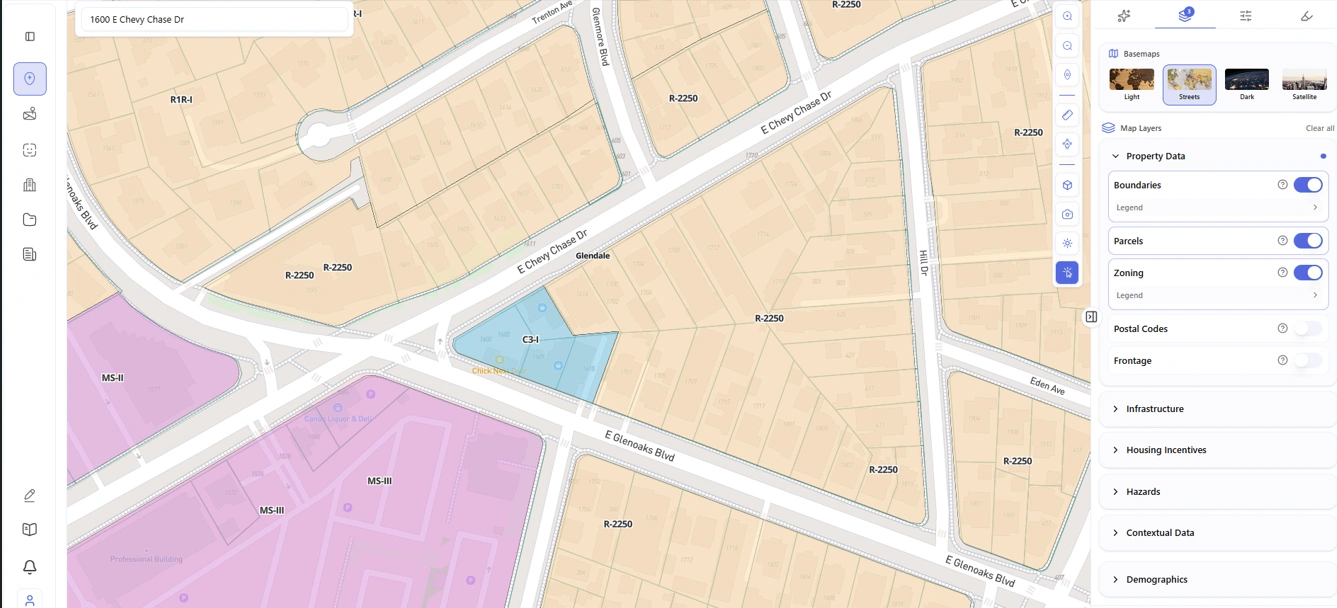
On the Archiwise map, a rezoned parcel stands out immediately. This C3-I parcel is the only one of its kind in the immediate area – surrounded entirely by R-2250 and MS zones. Zone differences that would take hours to research manually are visible in seconds.
If the use is prohibited and you’re considering whether a rezoning is viable, the AI Zoning Expert goes further. Just ask:
“What is the current zoning designation of this parcel, what uses are prohibited, and if I wanted to rezone it to allow multifamily residential, what factors would support or complicate that application?”
Archiwise pulls the current zone, identifies prohibited uses, assesses rezoning feasibility, and surfaces both supporting and complicating factors – with the applicable zoning code and general plan cited as sources.

Not just the rules. A complete picture. Before you’ve committed to anything.
The Takeaway
Rezoning is the last resort in the entitlement system – not because it’s wrong, but because it’s the hardest. It asks the city to change its mind about how a piece of land should be governed. That takes time, money, political skill, and a genuinely compelling argument.
The developers who succeed at rezoning are the ones who do the pre-application work before spending anything, build their case around general plan consistency, engage the community early, and price the full cost – including timeline – into their acquisition model from day one.
Knowing your entitlement path before you commit is the foundation of every good development decision. Whether it’s a variance, a CUP, or a rezoning – Archiwise tells you which one you’re dealing with the moment you click a parcel.
Find out what’s permitted on any site – before you commit.
The entitlement path determines the timeline, the cost, and the risk of every deal. Archiwise puts that information in front of you instantly, on any parcel, anywhere in the US.
Learn more
ArchiWise helps developers, investors, architects, and brokers go from address to decision in minutes, not weeks.
Whether you’re screening sites for multifamily development, evaluating zoning constraints, surfacing incentive eligibility like QCT and LIHTC, or assessing hazard risk before committing capital, ArchiWise runs every layer of analysis in one place.
Explore how ArchiWise helps teams screen development sites, analyze zoning, and make confident go/no-go decisions faster.