
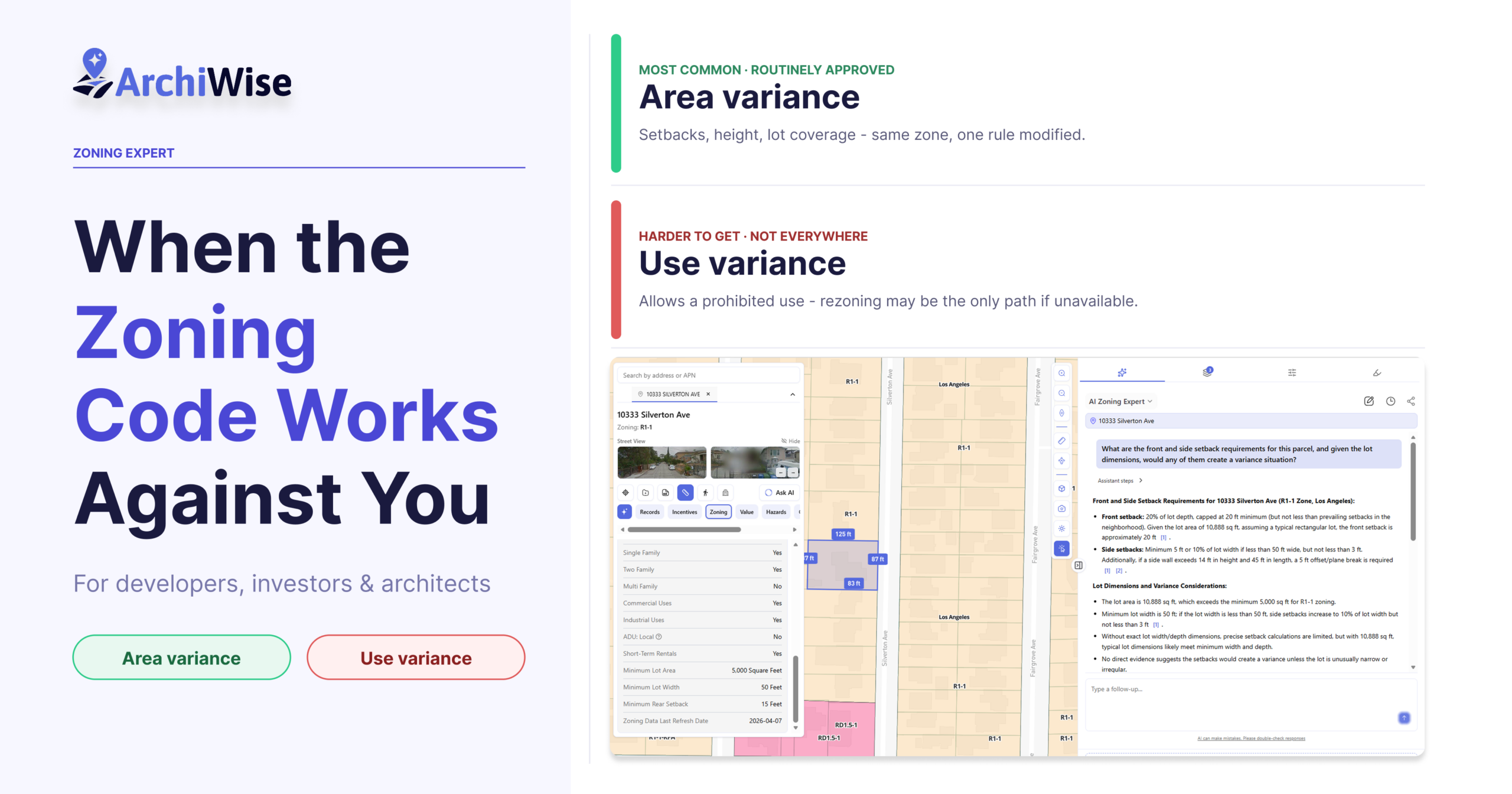

A plain-language guide for developers, investors, and architects.
When the Rules Don’t Fit the Land
Zoning rules are written for average lots. But land isn’t always average. It can be narrow, triangular, steeply sloped, or oddly shaped in ways the code never anticipated.
When a standard rule meets a non-standard lot, you sometimes end up in a situation where full compliance is technically required but physically impossible. That’s exactly what a variance is designed for.
A variance is a formal exception to one specific zoning rule – granted when following that rule would create an unfair hardship that’s unique to your property. It’s not a loophole. It’s a legal tool built into the zoning system for situations where the code, applied literally, produces an unreasonable result.
What a Variance Actually Is
A variance lets you deviate from one specific zoning standard – like a setback distance, height limit, or lot coverage cap – without changing the zone itself or what uses are allowed on the property.
It’s narrower than a CUP and far simpler than a rezoning. It modifies one rule, for one property, based on that property’s unique physical situation.
The city isn’t doing you a favor. It’s making sure the rules apply fairly – because a triangular lot and a rectangular lot in the same zone shouldn’t face the same impossible standard.
The Two Types of Variance
Area Variance – the most common type. Covers physical or dimensional rules: setbacks, height limits, lot coverage, parking, floor area. You’re not changing the use – just adjusting how the building sits on the lot. These are more routinely approved.
Use Variance — allows a use that’s prohibited in the zone. Much harder to get, and not available in every jurisdiction – Minnesota, for example, prohibits use variances entirely by statute (Minn. Stat. § 462.357). If the use is prohibited and a use variance isn’t available in your jurisdiction, rezoning is the only path.
For most site-specific problems, an area variance is what you need.
Two Real Examples
Example 1 – The triangular lot:
A developer buys a triangular corner lot. The zoning requires setbacks on all four sides. On a normal rectangular lot, those setbacks leave a clear buildable area in the middle. On a triangular lot, the setback lines converge before they ever reach the narrow end – leaving no buildable area at all.
This is the textbook variance case, cited in zoning law literature across the US (agoodcommunity.org; Hamblett & Kerrigan, P.A.). The hardship isn’t about money or design preference. It’s geometry. The city can’t literally apply the setback rule here without making the lot unbuildable – which is exactly what a variance is designed to fix.
Example 2 – The hillside height limit:
A developer is working on a steep hillside lot. Height limits are measured from finished grade – but on a slope, grade changes across the entire lot. A building designed to be 28 feet tall at the top might measure 40 feet at the bottom edge due to the natural slope, technically violating the height limit even though it’s no taller than neighboring buildings.
The hardship comes from the topography – a physical condition the developer didn’t create. According to the University of Wisconsin Land Use Training resources, conditions unique to the property such as steep slopes must prevent compliance with the ordinance – and when they do, that physical evidence is the strongest possible basis for a variance.
In both cases, the variance doesn’t give the developer more than anyone else. It gives them the same – fair development rights the physical land would otherwise deny.
The One Thing the City Is Always Asking
Every variance request comes down to one question: is the hardship real, unique, and not something you created yourself?
The city needs to see (these criteria are consistent across US jurisdictions, per the League of Minnesota Cities and NC Local Government Law resources):
- The hardship comes from the physical characteristics of the land – shape, slope, size – not from your budget or design choices
- The hardship is unique to your property – if every lot on the block has the same problem, the code should change, not individual variances be granted
- The variance doesn’t give you more than what’s fair – it just levels the playing field with other property owners
- Granting it won’t harm neighbors – no significant impact on light, privacy, traffic, or neighborhood character
What doesn’t qualify: wanting a bigger building, maximizing profit, or finding compliance expensive. As the Wisconsin Supreme Court ruled in Snyder v. Waukesha County Zoning Board (1976): “It is not the uniqueness of the plight of the owner, but uniqueness of the land which is the criterion.”
What Variances Typically Cover
Common reasons developers seek an area variance:
- Setback reductions – building closer to a property line due to lot shape or size
- Height exceptions – exceeding height limits due to slope or grade changes
- Lot coverage – covering more of the lot than permitted due to irregular geometry
- Parking reductions – fewer spaces when the site physically can’t fit them
- Floor area – exceeding FAR when lot conditions make standard development impractical
What variances do not cover: the use of the property. If you want to do something the zone doesn’t permit, that’s a CUP – not a variance.
What It Costs and How Long It Takes
A variance is lighter than a rezoning but still a real process.
Application fees vary significantly by jurisdiction – from as low as $250 in some counties to $14,000+ in larger cities (based on 2024 municipal fee schedules). When you add a land survey ($1,500–$2,000), attorney representation ($1,500–$5,000), and hearing preparation, total variance costs typically run $2,000–$15,000 depending on complexity (CalcBee, 2024).
Timeline runs 2–6 months from application to decision in most jurisdictions – covering staff review, public notification, hearing, and the decision period (CalcBee, 2024).
You’ll need supporting documentation – surveys, photographs, lot diagrams, elevation drawings. The stronger your evidence package, the cleaner your application.
Neighbors are notified and can object at the public hearing. A well-documented hardship case reduces opposition risk significantly.
Variance vs. CUP vs. Rezoning – In One Paragraph
Variance – one rule modified, same zone, same uses. For physical site constraints.
CUP – permission for a use that isn’t automatic in the zone. For use-based issues.
Rezoning – the whole zoning designation changes. The longest, hardest path.
Simple test: if your problem is about how the building fits on the lot – variance. If it’s about what you want to do on the lot – CUP. If neither works – rezoning.
How Archiwise Helps You Spot This Early
The most expensive time to find a variance problem is after you’ve already made an offer.
Archiwise shows you the development standards for any parcel across the US – setbacks, height limits, FAR, lot coverage – the moment you click it. The parcel dimensions are visible directly on the map. Cross those numbers against the zoning requirements and you know immediately whether a variance conversation is in your future.
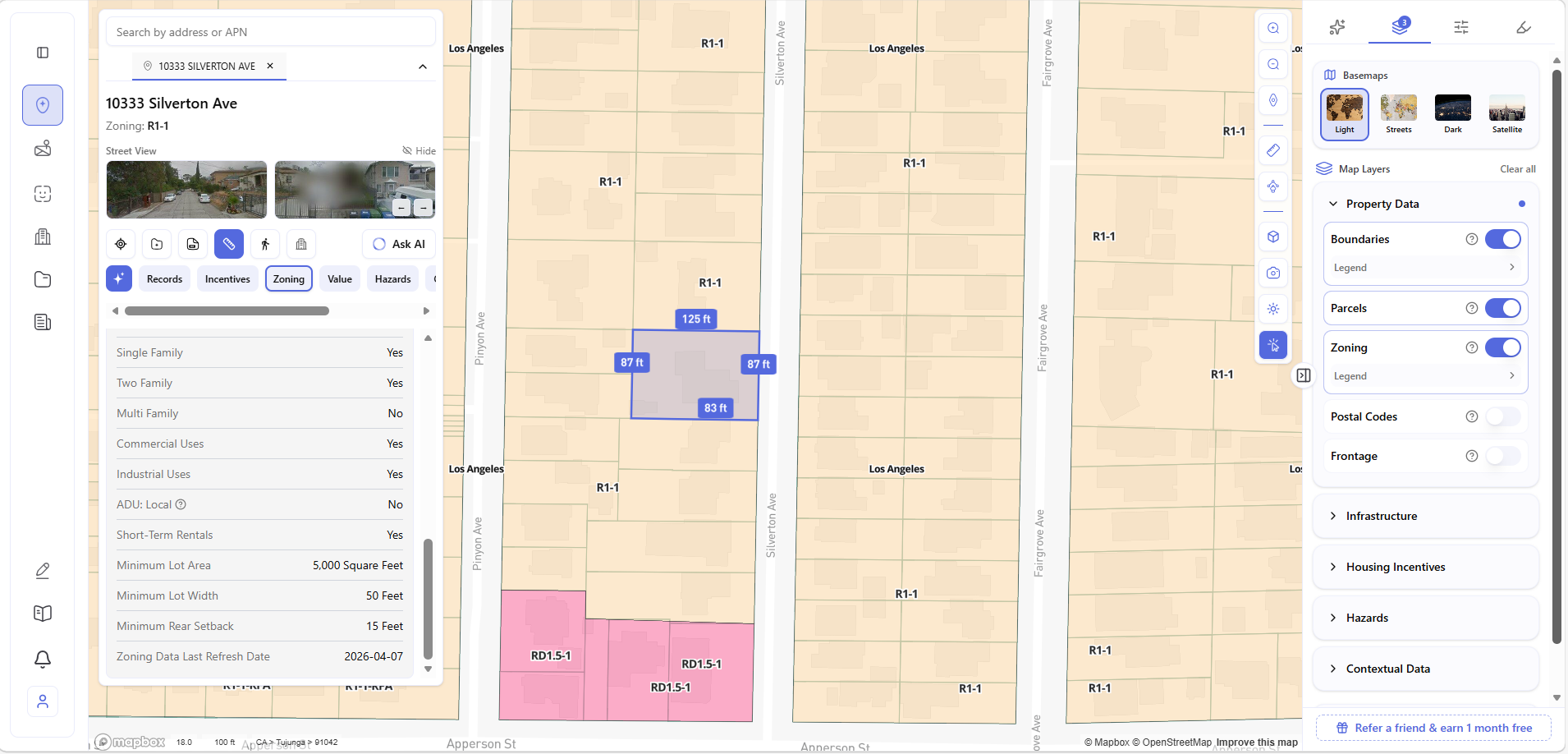
That’s the data. Dimensions, setback requirements, and permitted uses – all visible before you’ve made any commitment. If you want to go deeper, the AI Zoning Expert takes it one step further.
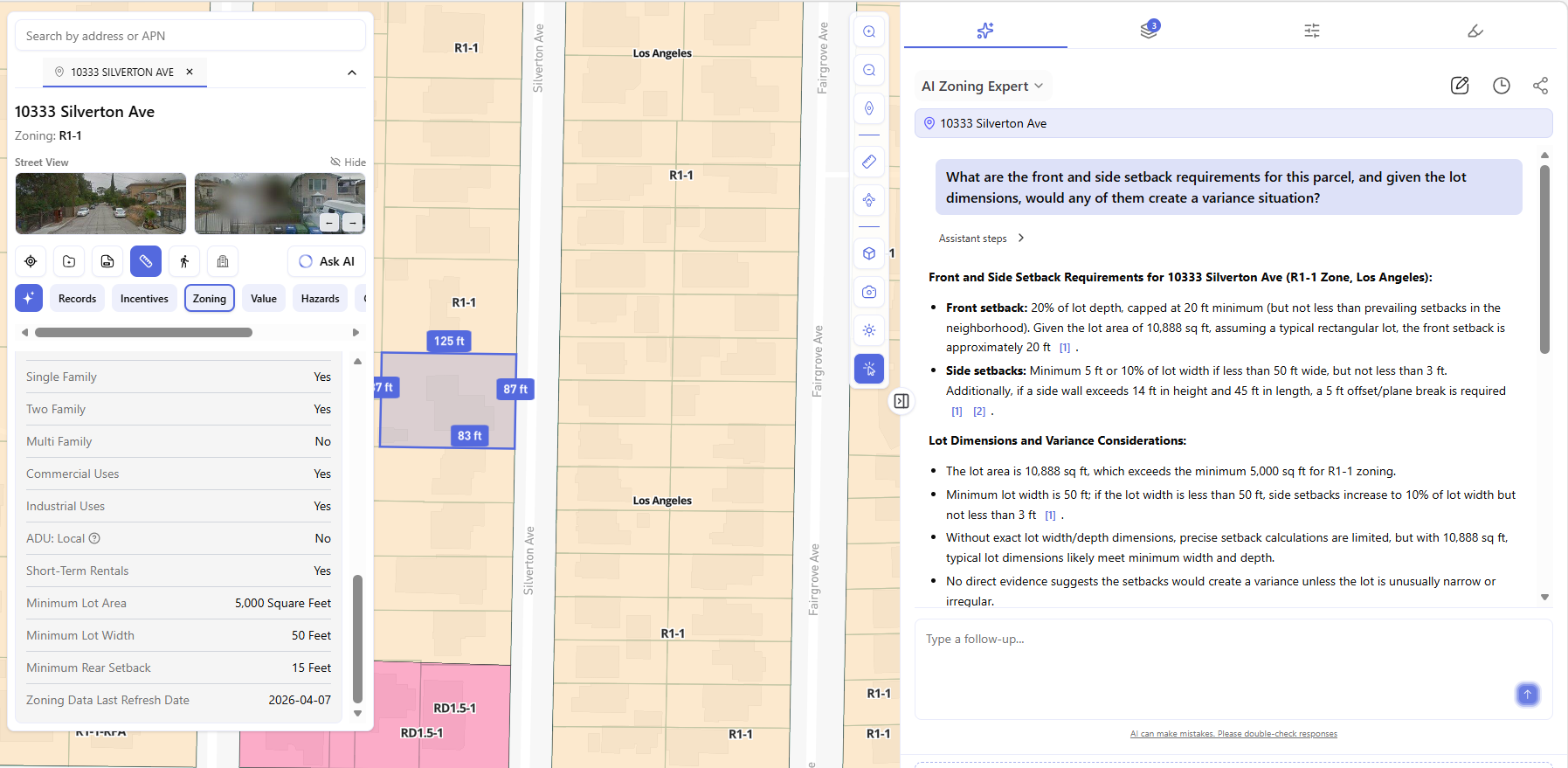
Not just the rules. A conclusion. Before you’ve committed to anything.
The Takeaway
A variance is the zoning system’s acknowledgment that standard rules don’t always fit non-standard land. When the code would create a real, unique, physical hardship – one you didn’t create – a variance is the mechanism that makes the rules fair again.
It’s not a free pass. The hardship must be documented. The findings must all be made. But compared to a CUP or a rezoning, a well-grounded variance is one of the cleaner paths through the entitlement system.
Know your site’s physical constraints before you make an offer. Archiwise shows you setbacks, height limits, and development standards the moment you click a parcel – so you see the problem before it becomes your problem.
Find out what’s buildable on any site – before you commit.
The developers who avoid variance surprises are the ones who check the numbers at the evaluation stage, not after signing. Archiwise puts parcel-level zoning standards in front of you instantly, on any site, anywhere you’re looking.
Learn more
ArchiWise helps developers, investors, architects, and brokers go from address to decision in minutes, not weeks.
Whether you’re screening sites for multifamily development, evaluating zoning constraints, surfacing incentive eligibility like QCT and LIHTC, or assessing hazard risk before committing capital, ArchiWise runs every layer of analysis in one place.
Explore how ArchiWise helps teams screen development sites, analyze zoning, and make confident go/no-go decisions faster.