
The Federal Government Is Making Publicly Owned Land Searchable
Starting October 1, 2026, CDBG grantees will have to publicly list the undeveloped land they own – making a historically difficult real estate dataset much easier to find.
Public land is one of the hardest things to find in real estate.
The government owns land. The records are public. But that doesn’t mean the information is easy to use.
Ownership records can be spread across different departments, stored in different systems, and described in different ways. If you’re looking for publicly owned land, you often have to know which government office to ask – and what to ask for.
A new federal housing law is starting to change that.
What Happened?
The 21st Century ROAD to Housing Act is now Public Law 119-101, an act “to increase the supply of housing in America,” dated July 11, 2026.
Both chambers passed identical text – the Senate on June 22, 2026 by 85-5, and the House on June 23 by 358-32. President Trump declined to sign it, in protest of the Senate’s inaction on an unrelated elections bill. Under the Constitution, the bill was enacted on July 11, 2026, once ten days elapsed following presentment.
Most of the attention has focused on housing supply, permitting, and institutional investors.
But there’s a smaller provision that matters for anyone who finds real estate through data.
Section 104.
Section 104: Put the Land on the Map
Section 104 amends the Housing and Community Development Act of 1974 to require that the grantee maintains, on a publicly accessible website, a searchable database that identifies all parcels of undeveloped land owned by the grantee.
CDBG stands for Community Development Block Grant, a federal program that funds community development, housing, and infrastructure work.
The requirement takes effect on October 1, 2026, as specified in the statute.
In simple terms:
If you’re a CDBG grantee, the public should be able to search the undeveloped land you own.
The land isn’t new. The information isn’t necessarily new.
What’s new is the requirement to make it searchable.
One important detail
The law applies to CDBG grantees, not literally every city.
As the National Association of Development Organizations notes, the requirement reaches non-entitlement communities indirectly. Technically the State is the CDBG grantee, so the State carries the obligation – though states routinely pass certification and reporting duties down to sub-recipients as a funding condition.
So the accurate framing isn’t “every city has to publish its empty land.” It’s that publicly owned undeveloped land is getting easier to find.
Why This Matters for Real Estate
Public land has never been secret. The problem has been finding it.
A private parcel is usually discoverable. There’s a listing, a broker, a property website, or a marketing package.
Government-owned land often has none of that. No listing. No broker. No asking price.
Section 104 addresses that from one angle: make the inventory searchable.
Once land is searchable, it can be screened. That’s the same idea behind modern off-market sourcing. The opportunity wasn’t invisible. The data was.
Which raises a practical question. October 2026 is a start date, not a finish line. The databases will arrive jurisdiction by jurisdiction, in formats nobody has defined yet. So what do you do in the meantime?
The answer is that public ownership was never actually missing from the record. It just wasn’t something you could search across. Pre-development site analysis platforms already treat public ownership as a filterable field – which means the screen the law is trying to enable is one you can run before any government publishes anything.
You Can Screen for Public Land Today
You don’t have to wait until October.
In ArchiWise, the Ownership filter includes a Government-owned option. Turn it on and the map returns parcels held by government owners – city, county, state, or federal.
Then combine it with other filters. Government-owned + Vacancy narrows the results to publicly owned land that’s sitting empty, which is close to what Section 104 asks grantees to publish. Apply it to a city, a ZIP code, or a custom-drawn area.
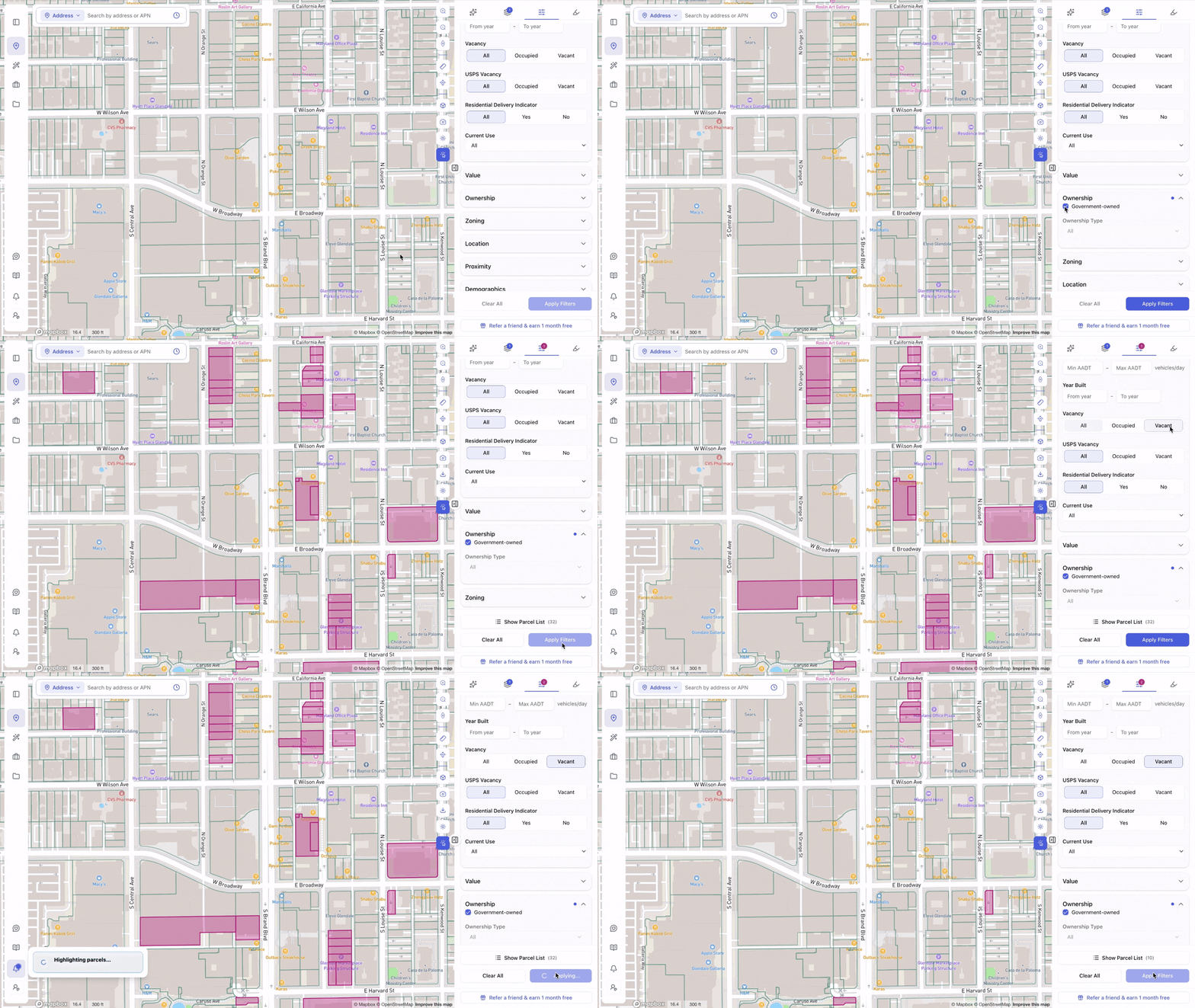
Instead of working through government websites one at a time, you start with the parcels.
The future CDBG databases will serve a specific statutory purpose. ArchiWise addresses a broader sourcing problem today: finding and screening publicly owned parcels across locations and ownership types.
There’s Another Opportunity in the Law
Section 104 isn’t the only part worth watching. Two other sections point money at a specific kind of property.
Section 201 deals with Opportunity Zones – designated areas where the federal government encourages investment. Per the Bipartisan Policy Center’s implementation tracker, it allows the Department of Housing and Urban Development (HUD) to prioritize projects based in or primarily serving Opportunity Zones for any competitive grants relating to housing development or preservation.
In plain terms: if your project is in an Opportunity Zone, it may move up the list for federal grant money.
Section 210 is called the RESIDE Act, short for Revitalizing Empty Structures Into Desirable Environments. It creates a pilot grant program to help local governments turn vacant commercial or industrial buildings into affordable housing, with priority going to economically distressed areas and Opportunity Zones.
In plain terms: there’s now federal money aimed at converting empty commercial buildings into housing.
Put those together and a pattern shows up:
Vacant commercial property + Opportunity Zone
That’s not a legal eligibility test. Qualifying for either program involves more than two data points. But it is a useful screening profile – a way to narrow thousands of parcels down to the ones worth a closer look.
Several of those pieces are already filters. Current Use identifies commercial properties. Vacancy and USPS Vacancy flag empty ones. And Qualified Opportunity Zone (QOZ) appears as a field on the parcel’s Records tab.
What Happens Next?
The law is enacted. The Section 104 requirement starts October 1, 2026.
An open question remains: what will these databases actually look like?
The statute requires them to be publicly accessible and searchable. It does not create one universal platform. Different governments may organize and present information differently, so quality and completeness could vary.
There’s reason to expect this to take time. The Bipartisan Policy Center notes the law spans 12 titles and 60 sections, and that most implementation falls to HUD, which must carry out dozens of statutory directives – many with tight deadlines – with limited staff capacity. Full implementation could take years.
And one more limit worth stating plainly:
Being listed doesn’t mean the land is for sale.
It doesn’t mean the parcel is zoned for housing. It doesn’t mean development is permitted. It doesn’t mean the government plans to dispose of it.
A public land database is an inventory, not a development approval.
The evaluation sequence stays the same: ownership → zoning → current use → vacancy → development potential → feasibility.
What This Means for Developers
The interesting part isn’t that governments will publish more data. It’s what becomes possible once that data is searchable.
Questions that were hard to answer at scale get easier to ask:
Where does the government own undeveloped land?
Which of those parcels are vacant?
Which are in the right market?
Which have development potential?
The law doesn’t answer those questions. It makes the first one much easier to ask.
FAQ
What is CDBG?
Community Development Block Grant – a federal program that funds states and local governments for community development and housing activities.
What does Section 104 require?
That the grantee maintains, on a publicly accessible website, a searchable database identifying all parcels of undeveloped land owned by the grantee.
When does the requirement start?
October 1, 2026, as specified in the statute.
Does every city have to create its own database?
No. It applies to CDBG grantees. In state-administered programs the State is generally the grantee, so the obligation doesn’t automatically fall on every participating municipality.
Does the law require governments to sell the land?
No. It requires publishing an inventory of undeveloped land the grantee owns.
Does being on the list mean a parcel can be developed for housing?
No. Zoning, environmental restrictions, infrastructure, title, and local approvals still apply.
Can I find government-owned land today?
Yes. Use the Government-owned filter under Ownership, then combine it with Vacancy or Current Use.
Can I screen for vacant commercial properties in Opportunity Zones?
Yes. Use Current Use for commercial properties, apply Vacancy or USPS Vacancy, and check the Qualified Opportunity Zone (QOZ) field on the parcel record.
The land was always there. The data is catching up.