

Late last year, the largest homebuilder in the United States made a quiet but massive bet. D.R. Horton handed its land acquisition process, across more than 30 states, to an AI platform called Prophetic. That’s not a “maybe someday” story. That’s already happening, right now.
Zoom out, and the bigger picture backs this up. Proptech funding hit $16.7 billion in 2025, a jump of almost 68% from the year before, according to real estate data firm CRETI. State legislatures introduced 412 housing-reform bills that same year, and 124 of them became law.
Something is shifting in how real estate gets built. And nowhere is that shift bigger than in site selection: the very first step of any deal, and the one most developers, architects, and investors still do by hand.
The Site Selection Bottleneck
Here’s what site selection usually looks like today. One browser tab for the county zoning map. Another for the municipal code PDF. Another for MLS or LoopNet listings. A fourth for a spreadsheet where you’re trying to work out if the numbers even make sense. Now multiply that by every site you’re considering.
This isn’t a small inconvenience. It’s slow. Zoning research alone can take days, sometimes weeks, before you even know if a property is worth pursuing. By the time you find out it isn’t, you’ve already burned time and often money on a deal that was dead from the start.
Meanwhile, the rules keep shifting under your feet. With hundreds of new housing laws passed every year, and zoning updated constantly at the local level, research that was accurate last month can be outdated today.
How to Screen Development Sites Faster
If you want to move faster without cutting corners, here’s a simple process worth following.
- Know exactly what you’re looking for. Write down your buy box: zoning district, allowed use, density, minimum lot size. Skip vague searches like “good corner lots.”
- Look beyond what’s listed. MLS and LoopNet only show properties actively for sale. Many strong opportunities never get listed at all. Tools that scan every parcel, not just listed ones, open up a much bigger pool of options.
- Catch red flags early. Overlay districts, flood zones, and unusual setback rules can quietly kill a deal. Find these before you write an offer, not after you’ve already spent money chasing it.
- Run the basic math first. Before spending real money on formal due diligence, do a quick check on floor area ratio, density limits, and parking requirements. If the numbers don’t work here, they won’t work later either.
- Only then go deep. Once a site clears these four checks, bring in your consultants, lawyers, and architects for full due diligence.
This isn’t about skipping steps. It’s about spending your time and money only on sites that actually deserve it.
Multifamily and Commercial Site Screening: Density, FAR, and Parking
Floor Area Ratio, or FAR, might be the most important number in real estate that most people have never heard of. It simply compares a building’s total floor space to the size of the lot it sits on. A higher FAR means you can build more. Get this number wrong, and your whole project can fall apart before it even starts.
Density works the same way. It tells you how many housing units you’re allowed to build on a piece of land. Both numbers can change from city to city, and sometimes block to block.
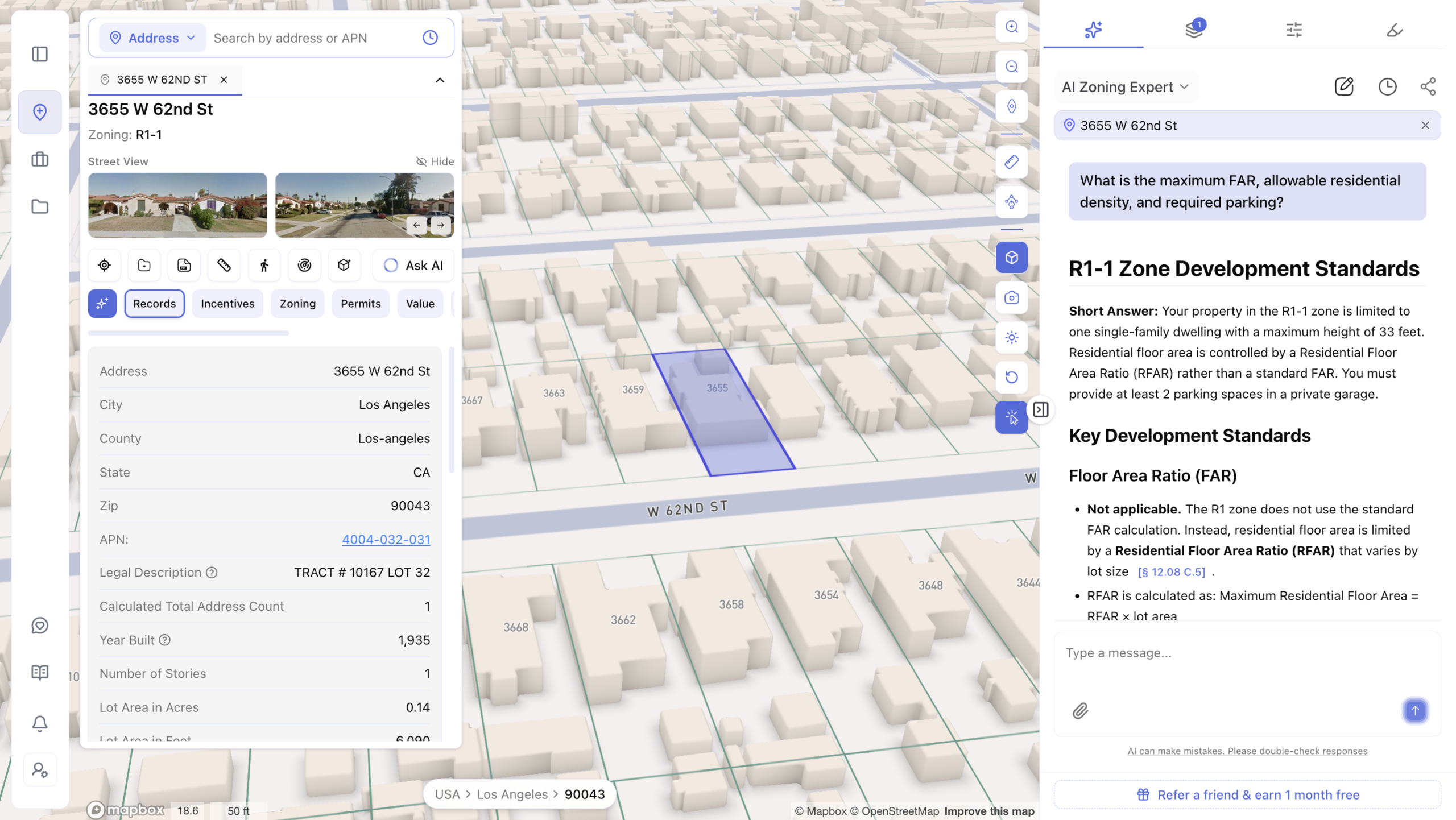 Here’s a real example. One multifamily developer, before making an offer on a site, ran it through ArchiWise. The check showed something they’d missed: parking requirements would cut their usable leasable space by 22%. What looked like a 14% return quickly became a deal that didn’t make sense at all. Catching this before the offer went out saved them from a costly mistake.
This is exactly why multifamily and commercial site screening needs more than a quick glance at a zoning map. Overlay districts and setback rules often hide in the fine print, and they can change your numbers overnight.
How AI Site Selection Actually Works, and Why ArchiWise
So how does AI actually fix this?
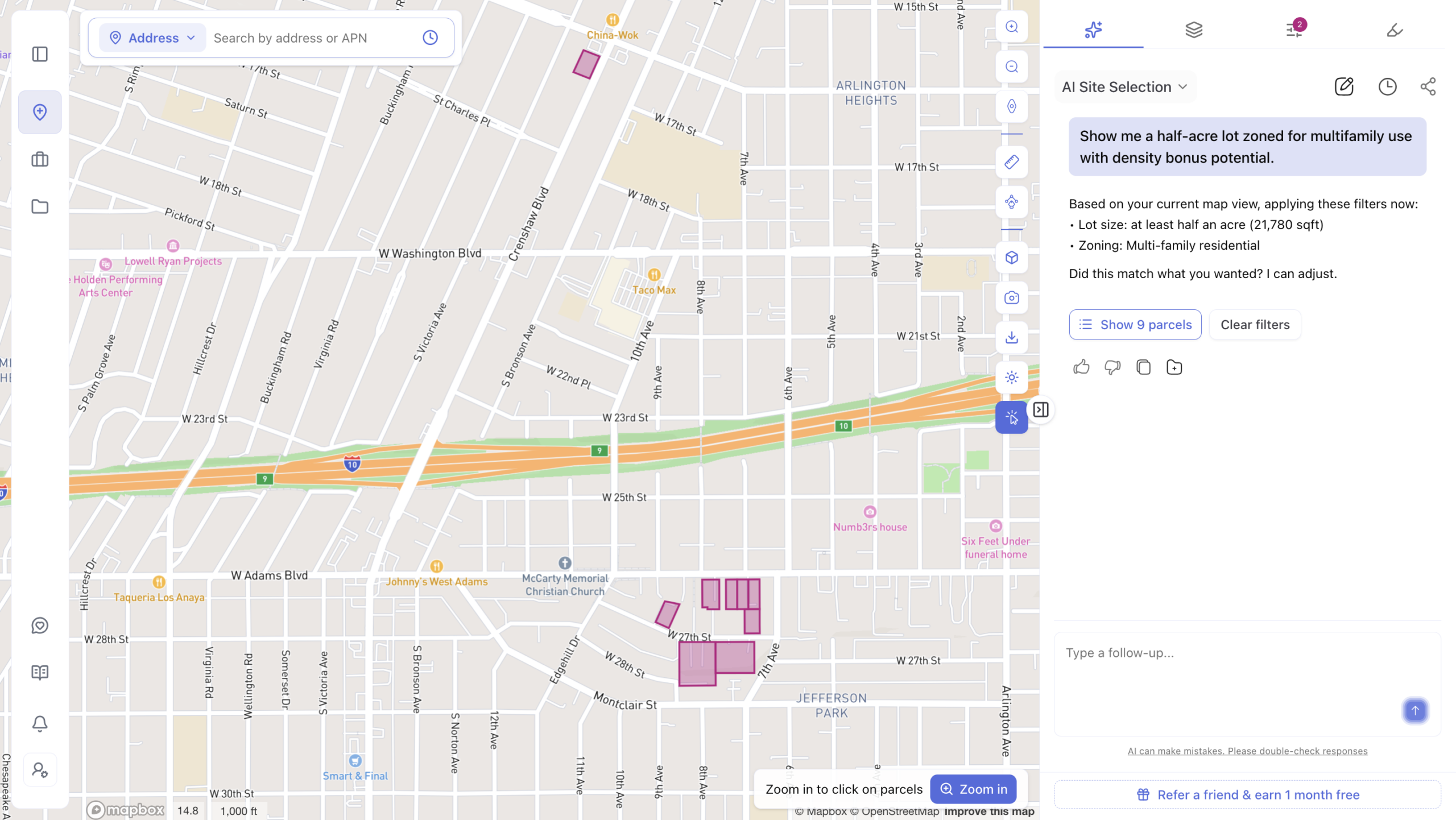
Instead of checking listings one by one, AI-powered platforms scan every parcel in an area, listed or not. You describe what you want in plain language, something like “a half-acre lot zoned for multifamily use with density bonus potential,” and the tool finds matches. It also scores each opportunity and flags things like overlay zones or hazard risks on its own.
This matters a little differently depending on who you are:
- If you’re a developer, it means faster, more confident offers, because you already know what’s buildable before anyone else does.
- If you’re an investor, it means a wider, safer pool of deals, and fewer surprises after you’ve already committed capital.
- If you’re an architect, it means starting a project with the constraints already known, instead of discovering problems halfway through design.
ArchiWise is one platform built around this idea. One architecture firm, EZ Plans Architects, said it replaced its old routine of digging through municipal code sites, zoning maps, and PDFs across multiple tabs with a single tool for daily research. In another case, ArchiWise flagged an overlay zone restriction that both a title company and a real estate attorney had missed, something that would have cost an estimated $380,000 in redesign work and six months of delay if it hadn’t been caught early.
Platforms like this don’t stop at site selection either. Many extend into feasibility checks and approval odds, so the same tool that helps you find a site can also help you decide whether to move forward on it.
ArchiWise vs. Prophetic, Zoneomics, Symbium, and TestFit
ArchiWise isn’t the only name in this space, and it’s worth knowing how the options differ.
Prophetic is the closest full competitor. It’s an AI-native platform built for land acquisition, and it made headlines when D.R. Horton rolled it out across more than 30 states. It’s a strong sign that this whole category is going mainstream, not staying a niche tool.
Zoneomics works differently. Founded in 2018, it’s mainly a zoning data provider. Think of it as a data layer that other platforms plug into, rather than a full decision-making tool on its own. It already powers zoning features inside other platforms, including CREXI and TestFit.
Symbium is well known, but mostly for smaller residential projects like accessory dwelling units, and for helping city planning departments review applications faster. It’s less built for large-scale developer deal sourcing.
TestFit shines at a different stage entirely: turning a site into a buildable design. It generates layout options and tests them against zoning rules, which makes it a favorite among architects. But it isn’t built to help you find sites in the first place.
The short version: these tools solve different pieces of the puzzle. ArchiWise’s approach is combining site discovery, zoning analysis, and feasibility checks in one place, instead of stitching several tools together yourself.
Frequently Asked Questions
What is zoning in real estate? Zoning is a set of local rules that decide what can be built on a piece of land, things like homes, offices, or shops, and how big those buildings can be.
What is FAR in real estate? FAR, or Floor Area Ratio, compares a building’s total floor space to the size of its lot. It’s one of the main numbers that decides how much you’re allowed to build.
What is pre-development in real estate? Pre-development is everything that happens before construction starts: checking zoning, running feasibility numbers, and confirming a project can actually get approved.
How do I check zoning for a property? You can usually check a property’s zoning through your city or county’s planning website, or by using a zoning lookup tool that pulls this information by address in seconds.
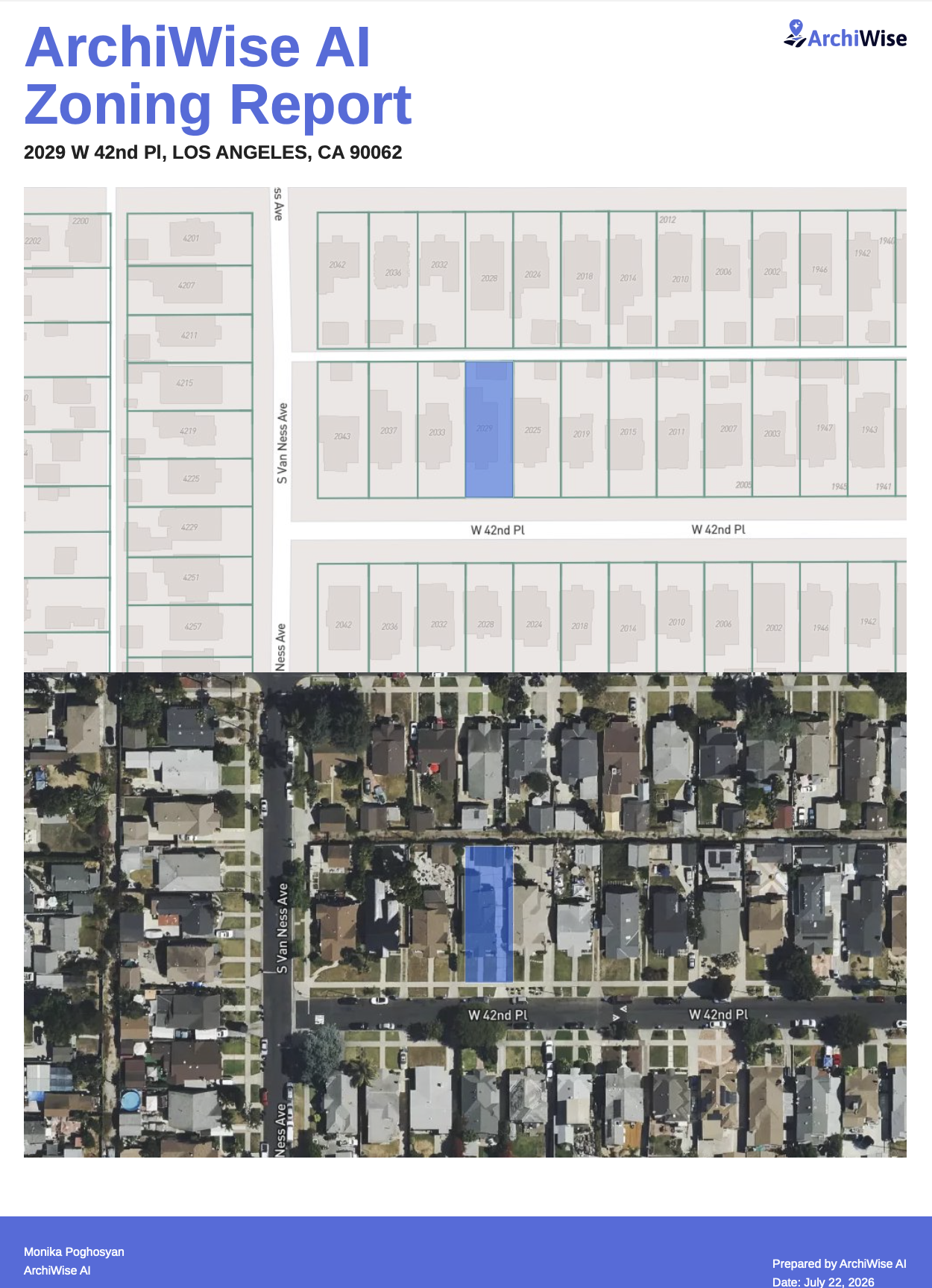
Ready to Move First?
Here’s the truth: site selection has always decided who wins in real estate. The difference now is speed. When the largest homebuilder in the country is already using AI to find and screen land faster than anyone doing it by hand, waiting isn’t a neutral choice. It’s falling behind.
Every week your team spends digging through zoning PDFs is a week a competitor spends closing a deal you never even saw.
Stop guessing. Start knowing. Try ArchiWise free and see, in minutes, what used to take your team weeks. Find the deals hiding in plain sight before someone else does.
Book your free demo today – because in this market, the developers who move first are the ones who win.
Learn more
ArchiWise helps developers, investors, architects, and brokers go from address to decision in minutes, not weeks.
Whether you’re screening sites for multifamily development, evaluating zoning constraints, surfacing incentive eligibility like QCT and LIHTC, or assessing hazard risk before committing capital, ArchiWise runs every layer of analysis in one place.
Explore how ArchiWise helps teams screen development sites, analyze zoning, and make confident go/no-go decisions faster.