

Site selection software is four capabilities in a trench coat: define an area, filter it, shortlist what survives, and act on the result. Most platforms are strong at two and quietly gated on the others, and the gate is rarely in the headline price.
| Platform | Define the search area by | Published pricing | Where the gate is |
|---|---|---|---|
| Acres | Area, acreage, owner address | Plus $9.99/mo · Pro $124.99/mo · Enterprise custom | AI search, zoning and skip tracing are Enterprise |
| Algoma | Site search by criteria and map boundary | Free · Standard $99/seat/mo · Pro $199/seat/mo · Enterprise custom | Site search is Pro |
| ArchiWise AI | Viewport, polygon, named location, radius or travel-time isochrone, each include or exclude | Explorer $29.99/mo · Analyst $99/mo · Builder custom | Travel-time is Analyst; prospecting and outreach are Builder |
| Crexi | Map and location search, with permitted-use filters added June 2026 | Free tier · Select $299/mo · higher tiers on request | Owner contacts need a Pro or Intelligence plan |
| Pillar | Nationwide parcel map, plain-English AI sourcing | Free · Pro $199/user/mo annual · Enterprise custom | Zoning is metered, 3.5 credits per parcel |
| Prophetic | Area, polygon, current map view or radius, plus plain-language intent search | Pro, Expert, Enterprise – not published | Pricing is not disclosed publicly |
Listed alphabetically, not ranked. These six do overlapping but not identical jobs.
Selection, screening and feasibility are three different purchases
Most confusion in this market comes from treating one word as three jobs.
Site selection finds parcels that match acquisition criteria. Site screening eliminates the ones that fail on location, zoning, ownership or physical constraints. Site feasibility works out what could be built and whether it pencils.
A platform can be excellent at feasibility and thin at selection. Several here are. The marketing rarely distinguishes them, so the useful question at a demo is blunt: find me a parcel I have not named.
Behind that sits a second distinction. Data can be retrievable – type an address, get everything known about it – or searchable – describe what you want and get back the parcels in the platform’s coverage that match. Only searchable data surfaces land nobody has listed.
That is one reason off-market inventory stays off-market, though not the only one. And finding an unlisted parcel is not the same as finding a willing seller. It puts you in the conversation earlier, with less competition. It does not mean the owner wants to sell.
The six platforms
Acres
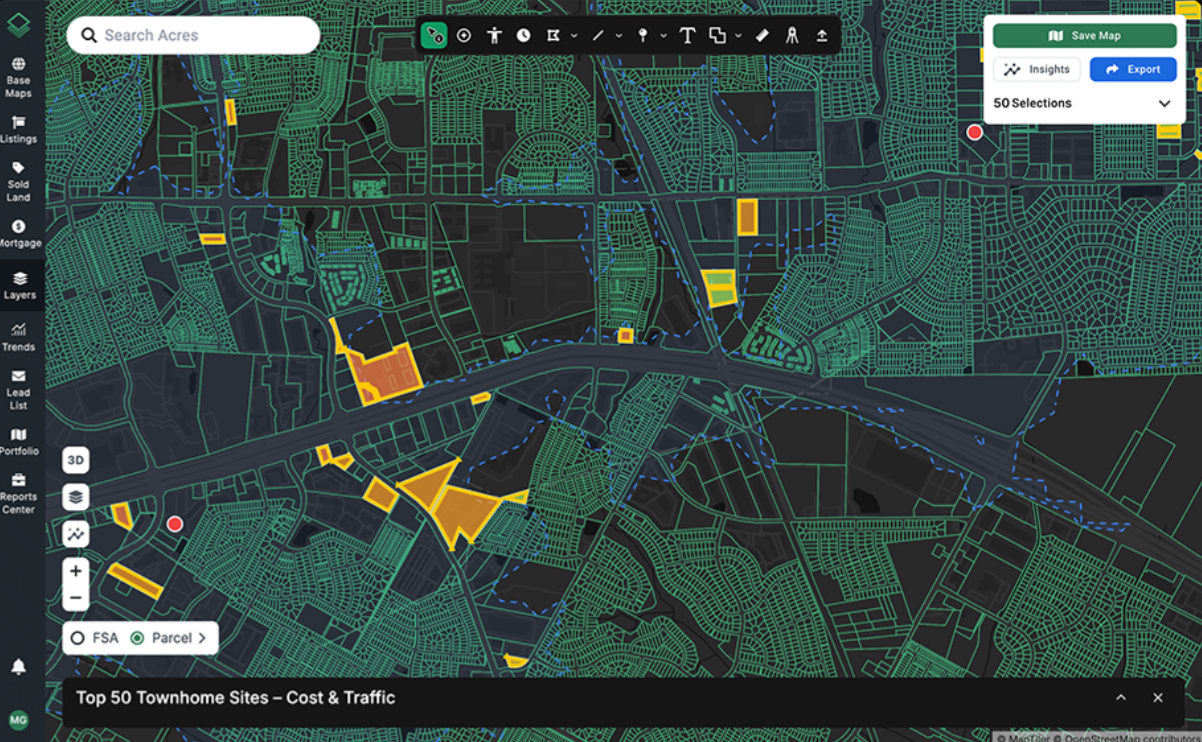
Acres grew out of AcreTrader and is land-first rather than building-first, across over 150 million parcels.
Plus is $9.99 a month ($7.49 annually), an owner-lookup tool. Pro is $124.99 ($94.99 annually), adding parcel search by area, acreage and owner address, weekly sold-land data, valuation reports and KML and CSV export.
Separate the two kinds of search before you buy. Pro gives conventional parcel search on structured fields. The natural-language AI search Acres announced in 2026, along with Acres Intelligence, DeedAI and zoning, sits at Enterprise, and Acres Intelligence carries an add-on cost on top of that.
Best for: land, agricultural and rural work, and valuation, where zoning is not the binding constraint.
Algoma
Algoma is the youngest platform here, having raised a $2.3M seed round in May 2025 led by Zacua Ventures with SOSV, Iron Prairie Ventures, DOMiNO Ventures and Compose VC. It targets small and mid-sized developers.
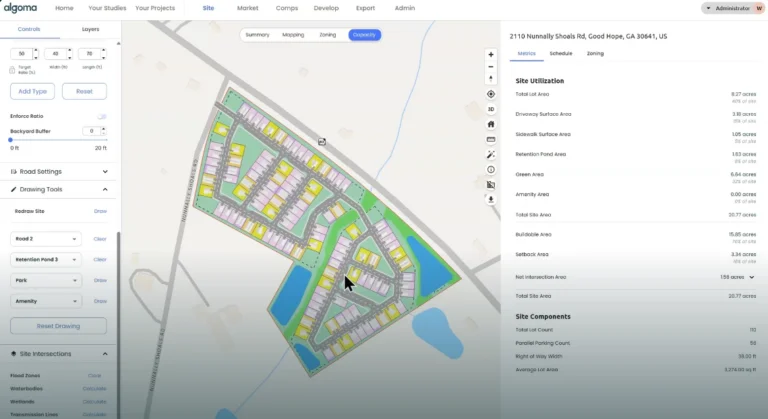
It combines market intelligence, zoning analysis, capacity calculations, construction cost data and pro forma modeling into what the company calls site feasibility in minutes. Named capabilities include zoning analysis with citations to municipal code, site-specific design massing, unit mix and layouts, pro forma generation, and visualization for investors and agencies. Algoma states its site search spans all 50 states with GIS filters and map-boundary search.
Tiers run Free, Standard at $99 per seat, Pro at $199 per seat, and Enterprise custom. Site search, market intelligence, renderings, exports and owner contacts sit on Pro – the $99 tier covers zoning intelligence, capacity studies and CRM but not search.
Best for: small and mid-sized developers who want feasibility, massing and a pro forma quickly.
ArchiWise AI
ArchiWise sells five solutions – AI Site Selection, AI Zoning Expert, Area Intelligence, Feasibility Analysis and Entitlement Viability – of which the first is what this comparison is about.
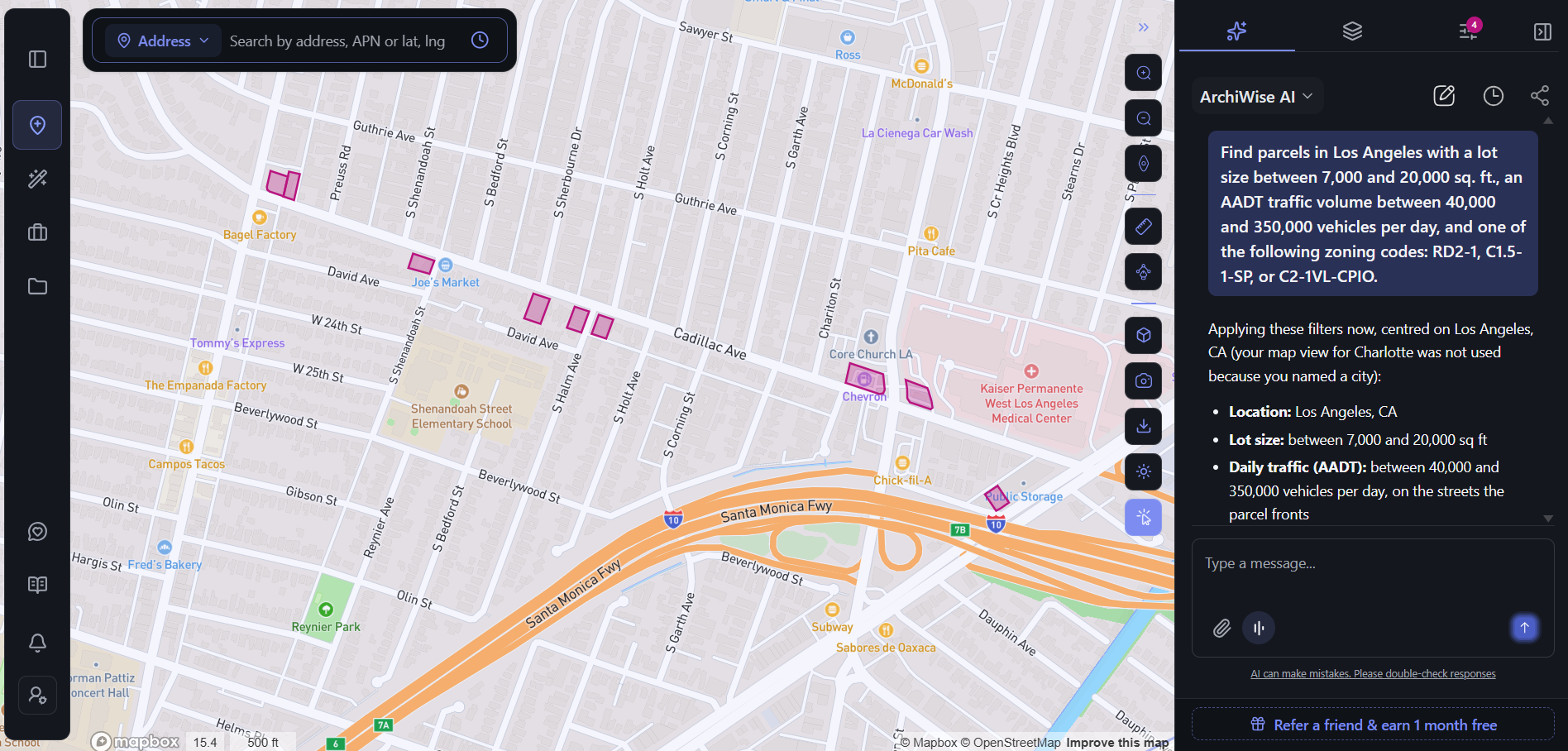
Search starts with the area, and here ArchiWise and Prophetic are the two platforms offering real choice. ArchiWise gives Viewport, Draw, Location, and Proximity as a radius or a walking or driving travel-time isochrone, with each area set to Include or Exclude. The isochrone and the exclusions are the parts the others do not match: screening a corridor while carving out the blocks your team already worked is otherwise a manual job. Filters then narrow by lot size, frontage, corner position, year built, vacancy, traffic volume, zoning code including compound codes, land use, ownership type, current use, value, demographics, flood hazard and mapped wetlands, returning a live parcel count and a CSV-exportable list.
Interpretation rather than display runs through the whole record rather than sitting in one tab. Zoning returns as permissions answered yes or no by use category, with the dimensional standards beneath them and the code section cited. Hazards arrive rated Clear, Moderate or High, each with the underlying figures behind an expander. Incentive and policy programs come back as eligibility rather than overlays you cross-reference yourself – QCT with its tract name and GEOID, DDA, LIHTC and QOZ, alongside state and local screening for SB 79, SB 9, SB 35, AB 2011 and TOC tier. The same pattern continues across ownership, distress signals and the rest of the thirteen tabs.
Explorer is $29.99 a month with 150 credits, Analyst $99 with 500, Builder custom with 2,000. Travel-time starts at Analyst; prospecting, skip tracing and outreach are Builder. Parcel data is nationwide, individual map layers vary by market, and code interpretation runs jurisdiction by jurisdiction with California furthest along.
Best for: screening US markets for parcels that permit what you intend to build.
Crexi
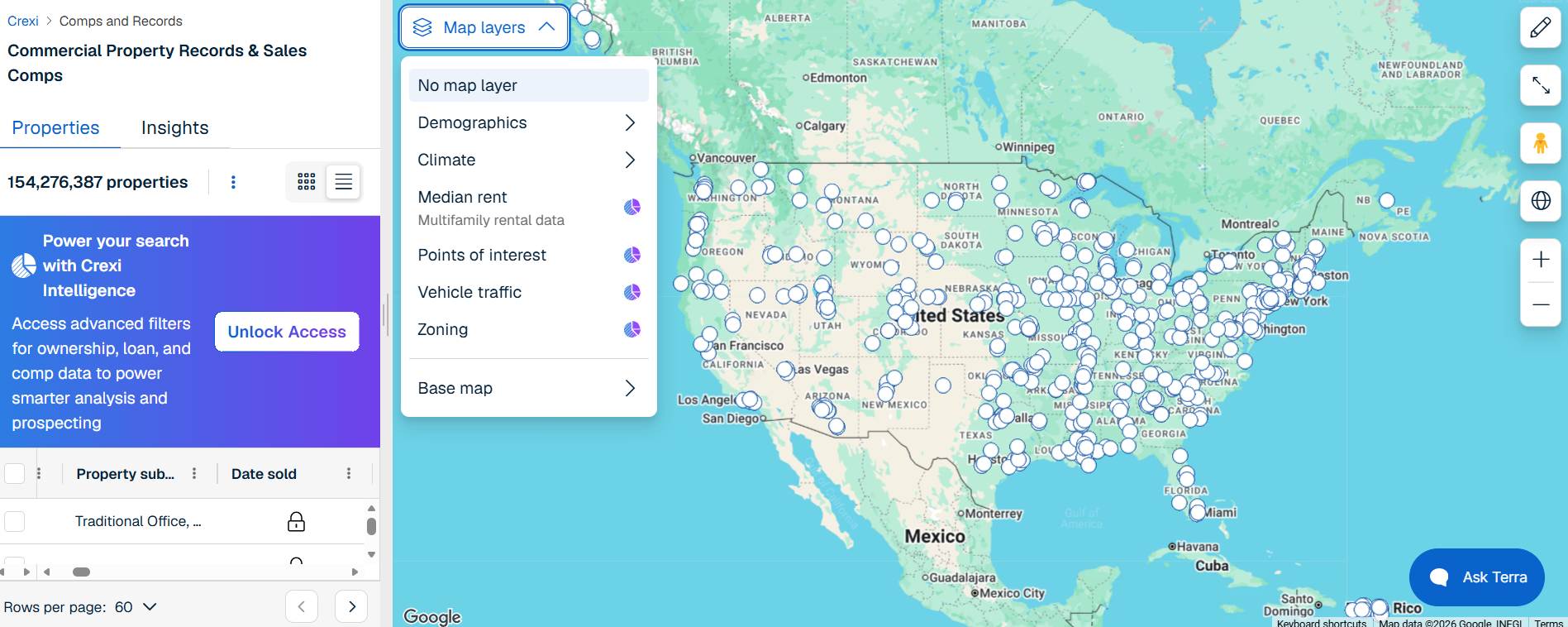
Crexi is the one platform here not built for development site selection, and it belongs in the comparison because so many teams try to use it that way. It is a commercial real estate marketplace with a research layer underneath – Commercial Property Records & Sales Comps – holding over 153 million property records with sales comps and lease data.
June 2026 changed what it can do for search. Through a partnership with Zoneomics it added zoning classifications, permitted uses and parcel geometry to the property page, an AI agent answering zoning questions with source-backed citations, and map filters that search a market by permitted use. The same release added tenant rosters and daily traffic counts.
A free tier shows rows locked; the Select plan runs $299 a month, with a lower annual rate and higher tiers on request. Crexi sells marketplace and Intelligence subscriptions separately and owner contacts require a Pro or Intelligence plan, so confirm which one carries what. Its universe is property records – what exists and what has traded – which is a different thing from undeveloped land. We cover that split in Crexi vs ArchiWise AI.
Best for: transacting existing commercial assets.
Pillar
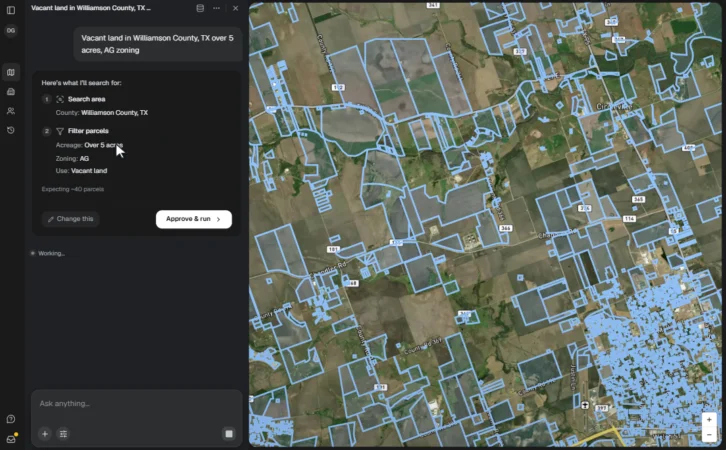
Pillar searches 160 million parcels across every US county with 100+ data fields, and its AI sourcing takes a plain-English request, restates the filters it intends to apply, and waits for approval before running. Its center of gravity is what happens next: skip tracing to verified phones and emails, direct mail, a CRM and a deal pipeline.
Zoning is metered, and Pillar publishes the rates – which is more than most do. Zoning details cost 3.5 credits per parcel and skip traces 3, from 2,400 credits per user per year, with extras at $0.10. The free tier includes three advanced zoning lookups, one time only.
Pro is $199 per user per month, billed annually; Enterprise adds API access, unlimited users and an SLA.
Best for: teams whose bottleneck is owner outreach at volume rather than technical screening.
Prophetic
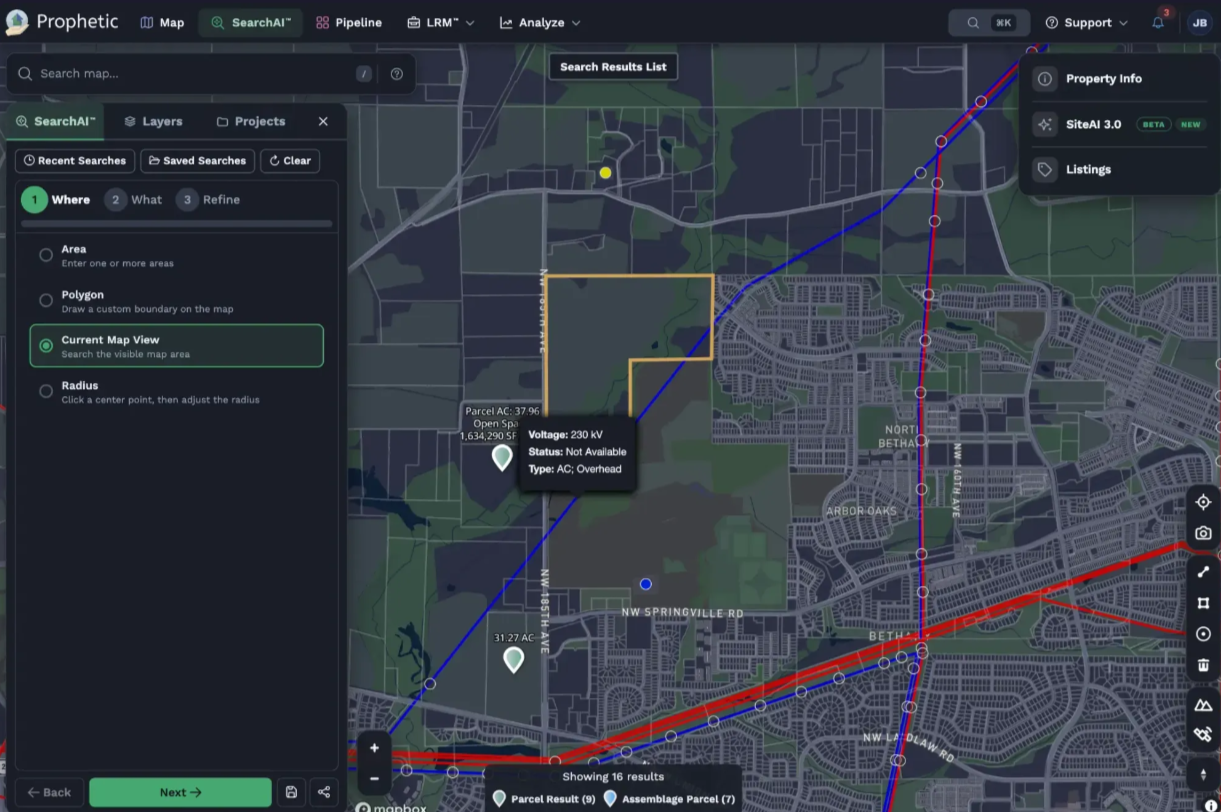
Prophetic’s SearchAI Intentions lets you describe the project you want to build and matches sites to that intent, rather than asking you to translate the idea into zoning language first. Its search area can be set by area, polygon, current map view or radius – the widest choice here after ArchiWise.
Underneath, ZoneAI reads and extracts zoning regulations across every US municipality and returns interpreted values rather than a raw layer: minimum lot area, minimum and maximum density, and permitted land uses for the parcel. The company reports 99% extraction accuracy. That is a vendor figure and has not been independently audited.
It works nationwide across development types from data centers to senior living, and sells in three tiers – Pro, Expert and Enterprise – which it does not publish.
Best for: national-scale land teams where volume justifies an enterprise contract and you are willing to go through sales to learn the price.
What each one puts on the map
| Platform | Map layers |
|---|---|
| Acres | Elevation, flood, wetlands, historical imagery and recreation; Enterprise adds utilities, infrastructure, risk data, national water and sewer lines and 15,000+ further layers |
| Algoma | GIS overlays for flood zones, waterbodies, wetlands and transmission lines |
| ArchiWise AI | Property Data (boundaries, census boundaries, parcels, zoning with a searchable codes index, future land use, postal codes, frontage); Hazards (fire hazard zones, flood hazard zones, wetlands, fire footprints, earthquake faults, seismic, methane); Housing Incentives (Difficult Development Areas, Low Income Housing, Qualified Census Tract, SB79 Transit-Oriented Development); Infrastructure (gas pipelines with a 660-foot consultation buffer, electricity, sewer); Contextual (historic resources, points of interest, data centers, transit stops, terrain contours); Demographics |
| Crexi | Six: demographics, climate with flood and fire risk, median rent, points of interest, vehicle traffic, zoning |
| Pillar | GIS and mapping across 100+ data fields; the layer list is not published |
| Prophetic | State infrastructure sets including pipelines, railroads, sewer and water service, wells and ETJ, plus a diligence group covering Superfund and brownfield sites, building footprints, crime, endangered species habitats, extreme weather, FEMA flood, pollution, power transmission lines, schools and soil |
Layer count is the wrong measure. Two things matter more. First, whether the layer is interpreted or merely drawn – a flood polygon you have to read yourself is not the same as a parcel returned with a flood rating attached. ArchiWise and Prophetic both do this; the others largely show you the layer. Second, whether that layer exists in your market, which varies by platform and by county far more than any marketing page admits.
What to check before you buy
Ask what the search is actually over. Property records, listings, or every parcel in the platform’s coverage. That single answer determines whether the tool can show you land nobody is selling.
Ask it to find a parcel you have not named. This separates selection tools from feasibility tools faster than any feature list.
Price your own mix, not the headline. Two platforms here publish per-action rates, which makes them directly comparable:
| ArchiWise | Pillar | |
|---|---|---|
| Zoning on a parcel | 2 credits | 3.5 credits |
| Skip trace | 3 credits | 3 credits |
| Property record | 1 credit | not published |
| Site prospecting | 1 per 25 results | not published |
| Allowance | 500/mo on Analyst, $99/mo | 2,400/yr on Pro, $199/user/mo |
Those credits buy different action sets, so this is not a like-for-like price – it is the arithmetic you need before comparing monthly figures. Both vendors publish enough to do it. The others do not.
Test coverage at your edges. Platforms are strongest in the metros they built first. Search the secondary market you are moving into.
Treat automated zoning as a screen, not a determination. A cited code section lets you check the answer, which is a good sign. It is not a jurisdictional ruling, and nothing here removes the need to confirm with the planning department before committing capital.
Check what you can export. A result you cannot take with you is one you will rebuild by hand.
Frequently asked questions
What is AI site selection software? Software that screens parcels against development criteria and returns matches, rather than requiring an address first. The AI is usually doing one of two jobs: turning a plain-language request into filters, or reading municipal code so zoning becomes a searchable field instead of a PDF.
What are the best AI tools for site selection in 2026? It depends which of the four capabilities you are short on. For owner outreach at volume, Pillar. For land and rural work, Acres. For fast feasibility on a known parcel, Algoma. For search-area control and interpreted zoning, ArchiWise and Prophetic. For existing commercial assets, Crexi.
Can these tools find off-market land? The ones that search all parcels in their coverage, rather than listings, can surface land that is not for sale. Reaching the owner is a separate capability, and willingness to sell is a separate question again.
How much does site selection software cost? Published entry prices in 2026 run from $9.99 a month for owner lookup to $299 a month for a commercial records platform, with per-seat development tools at $99 to $199. The tier that does the job is usually one step above the headline price.
How accurate is automated zoning? Vendors publish their own figures – Prophetic reports 99% – and none are independently audited. Test on parcels you know, and prefer tools that cite the code section so you can check rather than trust.
The bottom line
If your constraint is owner outreach at volume, Pillar is built for it and publishes what each action costs. If you work in land rather than infill, Acres is the land-native option, provided you can reach the Enterprise tier its AI search sits behind. Algoma is the newest and puts search on its Pro seat. Crexi is excellent at what it is for, which is existing commercial property rather than development land. Prophetic and ArchiWise are the closest comparison in this group – both offer real control over the search area and both return interpreted zoning rather than a raw layer. Prophetic is the enterprise option and will not quote a price without a call; ArchiWise publishes its pricing, adds travel-time and exclusion areas, and is strongest on code interpretation in California.
Several of these appear in our land acquisition software comparison as well, assessed there on sourcing, outreach and pipeline rather than on search.
No platform removes capital costs, construction costs, entitlement politics or planning department timelines. These tools inform a development strategy; they do not replace entitlement counsel, a civil engineer or an attorney.
Getting to a shortlist of parcels you chose, instead of researching the ones that arrived, is the part of acquisition most worth speeding up.
Prices and capabilities are taken from each vendor’s own published pages. Last verified 3 November 2026.