

You lose a parcel. There’s a reason: the seller took a cash offer, or a broker had a relationship you didn’t, or the timing just didn’t line up.
Three months later you lose another one. Different reason this time.
Then a third, and that one was a marginal fit anyway, so nobody loses sleep over it.
Every loss arrives with its own explanation, and every explanation is true. Which is precisely why nobody adds them up.
That’s how teams fall behind in pre-development. Not in a single bad quarter, and not because anyone stopped working hard. It happens one reasonable-sounding loss at a time, and the pattern never forms because each data point has already been accounted for.
Why doesn’t falling behind feel like falling behind?
Because the metrics most acquisition teams report on only count what happened.
Deals closed. Lots under contract. Starts. Pipeline value. All useful, and all backward-looking in the same way – they measure the sites that made it through, and say nothing about how many sites were available to be considered in the first place.
Nobody reports on how many parcels the team screened last quarter. Nobody tracks how long it takes to rule a site out. And you can’t notice a decline in a number you’ve never written down.
So the symptoms get attributed elsewhere. The market got more competitive. Sellers are harder to reach. There’s less inventory than there used to be. Those things may all be true, and they also make a convenient home for losses that had a different cause.
What does “behind” actually mean here?
It isn’t about working slowly. It’s about how many sites a team can afford to reject.
Most pre-development research produces a no, and that’s the function rather than a failure – you check a site to find out whether something disqualifies it, and usually something does. Which means the ceiling on a pipeline is set by how expensive rejection is, not by how quickly the good ones move through. We made that case at length in The Housing Constraint Nobody Measures.
What’s worth adding here is what that ceiling does to a team that can’t see it. The number of sites you were able to examine was settled long before any individual deal came up. By the time you’re losing parcels one at a time, the constraint has already been applied – you’re just watching the output.
How would you know if it’s happening to you?
Four questions, none of which need software to answer.
How many sites did we seriously evaluate last quarter, against how many we closed? If the first number doesn’t exist, that’s the finding. The ratio tells you more than either figure alone.
How long does it take us to kill a site? Not approve one – kill one. Time the last three. If the answer is measured in days, rejection is your bottleneck.
When a deal dies on timing, what actually ran out? Occasionally a site fails on the merits. If the recurring cause is that diligence didn’t finish before the option expired or the seller moved on, that’s a process problem being filed as a market problem.
When we walk into a seller conversation, who knows more? This one has shifted quietly over the past few years. A buyer who arrives having already read the zoning, run preliminary numbers and understood the owner’s position is a different counterparty from one working off a flyer.
What actually closes the gap?
Four things, and most of them cost nothing.
Optimise the path to no, not the path to yes. Almost every team has refined how a promising site moves toward approval. Far fewer have thought about how a bad site gets eliminated, which is where the volume is. Write down the three or four conditions that most often disqualify a site in your markets, and check those first instead of working through a standard sequence.
Separate screening from diligence, with different standards. A screening pass should be fast and allowed to be wrong in one direction, because rejecting a site that might have worked is far cheaper than running full diligence on a site that didn’t. Plenty of teams apply diligence-grade rigour to everything, which is thorough and slow.
Keep the research where someone else can find it. When a parcel resurfaces a year later, the earlier work should exist somewhere other than in the head of whoever did it. That’s a filing discipline before it’s a technology question.
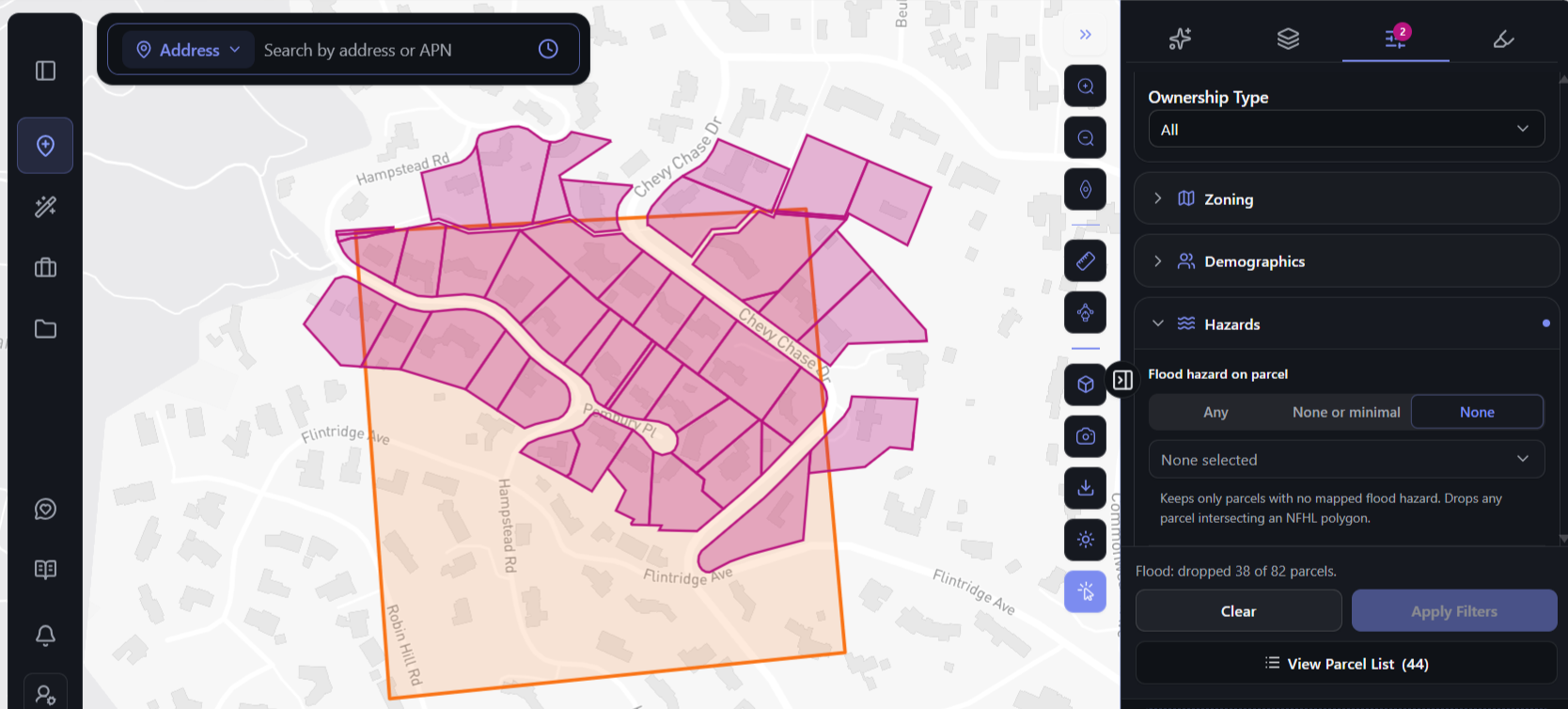
Pull constraint data earlier in the sequence. Zoning, hazards, utilities and ownership are all public. They surface late not because they’re hidden, but because each one is a separate errand – and nobody runs six errands for a site that might not survive the first.
Collapsing those errands is what moves the kill decision earlier, whether a GIS analyst, a consultant or a platform is doing it. It’s worth separating three things that tend to get lumped together, though.
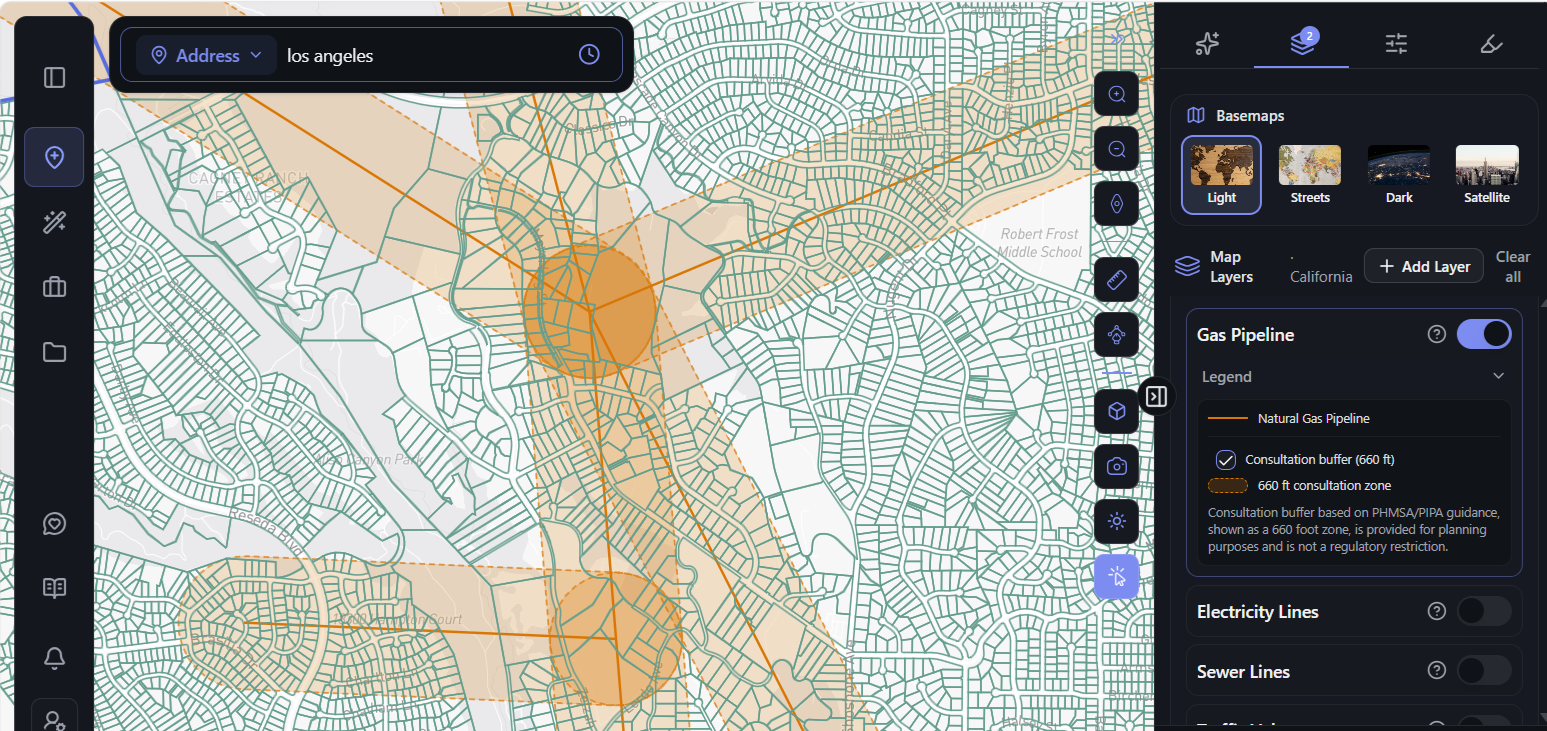
Matching parcels to criteria is one job. Reading a whole area is a different one – whether a site is unusual or whether everything around it looks the same is a question no parcel lookup answers, and it’s the reason hazard, infrastructure or incentive data is more useful spread across a corridor than checked one lot at a time.
Going deep on the few that survive is a third job again, and that’s where ownership belongs: how long someone has held a property, whether they live in it, what else they own, how leveraged it is. A site can be perfectly buildable and completely unavailable, and that’s usually the cheapest thing to find out and the last thing anyone checks.
We built ArchiWise’s site selection around that sequence, but the sequence holds whatever you use. The earlier a disqualifying fact arrives, the less it costs.
What won’t fix any of this
Worth saying plainly.
Faster evaluation doesn’t improve your land basis, change construction costs or move interest rates. It won’t shorten a hearing calendar or soften a community meeting, because those are queues rather than information problems. It won’t tell you a landowner will sell – only that their situation suggests they might.
And it doesn’t make an unbuildable parcel buildable. You just find out in week one instead of week three.
There are also real reasons a team loses deals that have nothing to do with process. Sometimes a competitor genuinely wanted it more, paid more than it was worth, or knew the family. No amount of screening speed touches that.
The part worth sitting with
Nobody falls behind in pre-development all at once, and nothing announces it when they do.
The losses arrive one at a time, each with a reasonable explanation attached, and the explanations are usually correct. What they obscure is that the number of sites your team could realistically examine was decided before any of those deals came up.
The question isn’t whether you’re behind. It’s whether you’re measuring anything that would tell you.