

Three days of the built world’s best technology – and a reminder of where the real bottleneck still sits.
Blueprint ran September 22 to 24 at the Venetian in Las Vegas, and it was a genuinely great few days for our team. It’s billed as the largest global gathering of people changing the built world, from construction through operations to transactions, and it lived up to that – the conversations on the floor were some of the most useful we’ve had all year.
The programme showed the breadth of the industry right now. Kick-off summits on single-family and build-to-rent, an Apartment Strategy Symposium, Data Centers, Retail, Construction Technology, Hospitality and Homebuilding, with an Innovation Stage running alongside. Serious work is being done across every one of those areas, and it shows.
What struck us most, walking between them, was how much ground the industry has covered – and how one stage of the process remains stubbornly manual.
Almost everything on display improves what happens once the land is secured. Construction tech makes the build better. Operations tech makes the asset perform. Capital markets move the finished product. All of it is further along than it was even two years ago.
The stage before all of it hasn’t moved as far. Deciding which site to buy is still slow, still scattered across dozens of sources, and still mostly done by hand. That’s not a criticism of anyone’s product – it’s a genuinely hard problem, and it’s the one we spend our time on.
Talking with developers and acquisitions teams across the three days, the same obstacles kept coming up – and they weren’t the ones the industry spends most of its time on. Almost none were about construction or capital. They were about the weeks before any of that: finding the site, checking it, and finding out too late that something about it didn’t work.
Here are six of them, and an honest look at which parts technology can actually fix.
1. The Search Still Starts From Addresses
Ask how a site gets evaluated and the answer is usually the same. A parcel arrives – from a broker, a listing, a tip – and the team researches it.
That sounds like a process. It’s really a queue of other people’s suggestions.
Every parcel that reaches you that way has reached your competitors too. And the ones that never reach anybody never get looked at.
The structural issue is direction. Address-first research can only evaluate what’s already been surfaced. It can’t take a set of criteria and return everything that matches, because the tools most teams use need an address before they can do anything at all.
The cost: your pipeline is capped by how many people think to call you.
Reverse it and the pipeline changes shape. Define the criteria, screen the market against them, and the underutilised lot held for thirty years by an owner nobody has approached shows up next to the listed ones. More on that comparison in AI Site Selection vs Manual Parcel Screening.
2. Your Buy Box Isn’t Searchable
Every acquisitions team has criteria. Lot size and frontage. A use type. A value range. Ownership that suggests a seller. A corridor with the right traffic.
Nothing exotic. It’s the same list written on a whiteboard in every development office.
Now try to search for it. There’s no single place where those filters exist together.
Assessor portals hold value and ownership but won’t filter by zoning. Listing platforms cover only what’s for sale. City GIS shows zoning but nothing about who owns it or what they paid. Data vendors cover one slice each, in different formats, for different geographies.
So the buy box stops being a search and becomes a checklist you apply one parcel at a time – after someone else has chosen which parcels you see.
The cost: your criteria only ever get used to reject, never to find.
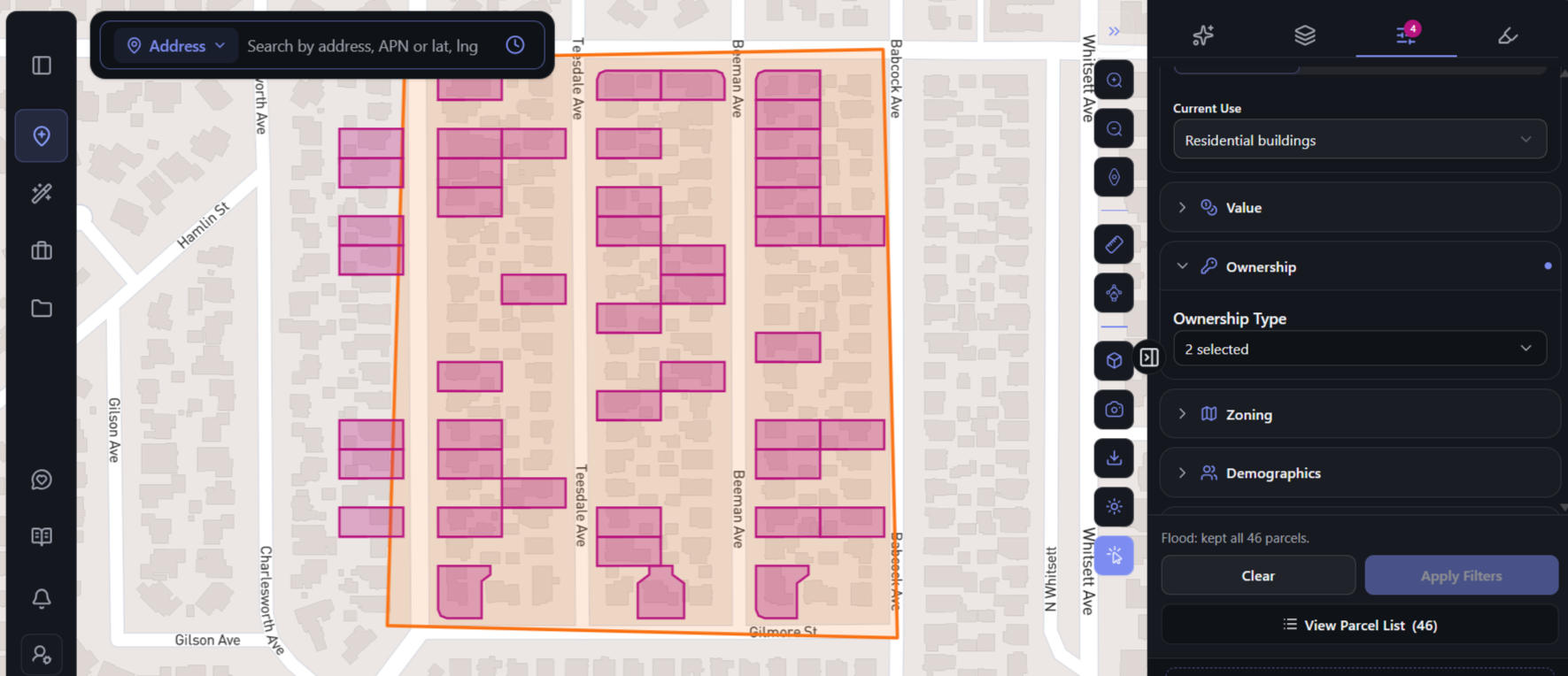
The fix isn’t a better portal. It’s putting the criteria in one place so the market can be screened against them. Draw a corridor, stack the filters that define your buy box – current use, ownership type, value, zoning, hazard exposure – and a list comes back in seconds rather than a week of lookups. Forty-six parcels, every one of them matching, none of them found by waiting for a phone call.
3. Ownership Tells You Who Owns It, Not Whether They’d Sell
Assessor records answer one question: the name on the parcel.
They don’t answer the one that decides whether outreach is worth the effort.
The useful picture is the one around the name – how long they’ve held, how many other properties they own, how leveraged those are, whether they live there, and whether anything is pushing them.
A trust holding a building for 31 years with almost no debt against a $2.6M portfolio, owner absentee, is a specific and readable situation.
A thirty-one-year hold carrying a tax delinquency and a pre-foreclosure flag is a completely different one.
Both look identical in a listing. And neither is findable manually without pulling county records one parcel at a time.
The cost: outreach gets spread evenly across owners who will never sell and owners who are ready to.
That gap is the whole reason off-market deal flow stays concentrated among people with local relationships, which we unpacked in Why Off-Market Deals Stay Off-Market. It’s also the bottleneck that came up most in conversations at Blueprint 2026.
4. The Constraints That Kill Deals Aren’t in the Zoning Code
The zoning designation is the part everyone checks. The expensive surprises live elsewhere – and they usually surface in due diligence, after earnest money is committed.
Methane. In Los Angeles, under LAMC Division 71, Section 91.7101, LADBS can withhold a building permit until adequate mitigation is designed. It appears in no zoning designation.
Pipelines. PHMSA’s Pipelines and Informed Planning Alliance recommends local governments adopt a consultation zone of 660 to 1,000 feet either side of a natural gas transmission line. Not federally mandated and not a setback – but where a local ordinance adopts it, it adds a step that’s far cheaper to absorb at screening than under contract.
Historic overlays. Los Angeles has 35 Historic Preservation Overlay Zones, and they now decide more than design review. HPOZs were largely excluded when the city expanded its Low-Rise housing incentives in June 2026. The same parcel, either side of a boundary, is two different deals.
Fire, flood and seismic. Each in its own agency portal, in its own format, with no view of how they intersect on one lot.
None of this is secret. It’s scattered, which in practice means it gets checked after commitment rather than before.
The cost: the cheapest moment to walk away is during screening. The most expensive is after diligence has started.
We went deep on one of these in Methane: The Site Hazard Hiding in Plain Sight.
5. And When You Reach Zoning, the Answer Has a Shelf Life
Most teams treat zoning as a fact to look up. It behaves more like a quote that expires.
Codes move constantly, and they move locally. A jurisdiction can rewrite its housing incentives, add an overlay, or opt out of a state programme in a single council session – and nothing tells you it happened. The designation on the map looks the same the next morning.
California in 2026 is the clearest example. A statewide transit-oriented housing law, SB 79, took effect on July 1, allowing significantly taller development by right near major transit. Then Los Angeles adopted its own ordinances on June 23, effective June 30, that paused SB 79 citywide and replaced it with a narrower local programme covering specific station areas.
Two different answers to the same question, eight days apart, in the same city.
Anyone who priced an LA site that spring off the state law was working from a document that no longer applied – and the parcel’s zoning designation never changed.
This is where underwriting goes wrong quietly. Not because someone looked up the wrong thing, but because they looked up the right thing at the wrong time and had no reason to check again.
The cost: a number in the pro forma that was accurate when it was written, and isn’t when the offer goes in.
The practical defence is unglamorous. Date every zoning assumption. Know which ordinance it came from. And before anything load-bearing goes into a model, confirm the rule is still current – particularly in states where housing legislation moves every session.
6. The Research Doesn’t Travel
This one comes up less often, and costs more than people expect.
A site gets researched. The findings end up in an analyst’s spreadsheet, a broker’s email thread, a consultant’s PDF, and somebody’s memory.
Six months later the deal resurfaces – different price, different partner, different market conditions. And most of the work gets done again, because nobody can find what was already established, or trust that it’s still current.
The same happens across a team. Two people screen the same corridor without knowing it. A constraint someone found in March doesn’t reach the person underwriting in September.
The cost: research that should compound gets repeated instead.
The fix is unglamorous. One record per parcel, current, shared, and exportable – so screening work from last quarter is still there next quarter, and the analysis travels with the deal rather than with the person who did it.
What Technology Can Fix, and What It Can’t
Worth being honest about the split.
Solvable, because they’re information problems. Finding candidate sites without an address. Screening a market against a buy box. Reading an owner’s situation. Surfacing hazards, infrastructure and overlays before an offer. Decoding a city’s zoning stack and knowing whether the rule you’re relying on is still current. Keeping all of it in one place so it doesn’t need redoing.
All of that is data that exists and is badly distributed – exactly what software is for.
Not solvable by software. Capital costs. Construction costs. Entitlement politics and community opposition. How long a planning department takes. Whether a seller wants to sell this year. No platform moves those, and anyone implying otherwise is selling something.
The honest claim is narrower and still worth a lot: the research that used to take weeks and mostly produced rejections can now take an afternoon – which means more sites evaluated, earlier in the cycle, with the constraints known before money moves.
The Bottom Line
The built world is getting faster at nearly everything except choosing where to build.
That stage is slow because the information is scattered across thousands of jurisdictions, dozens of agencies and a handful of records systems that were never designed to be read together.
It isn’t a hard problem intellectually. It’s a finding-and-translating problem, repeated per parcel, mostly on parcels that won’t work out.
Collapse the finding and the translating, and what’s left is the decision.
Know what a site actually allows before you make the offer.
If that’s the part of your process you’d like to speed up, see how ArchiWise works and what it costs.