
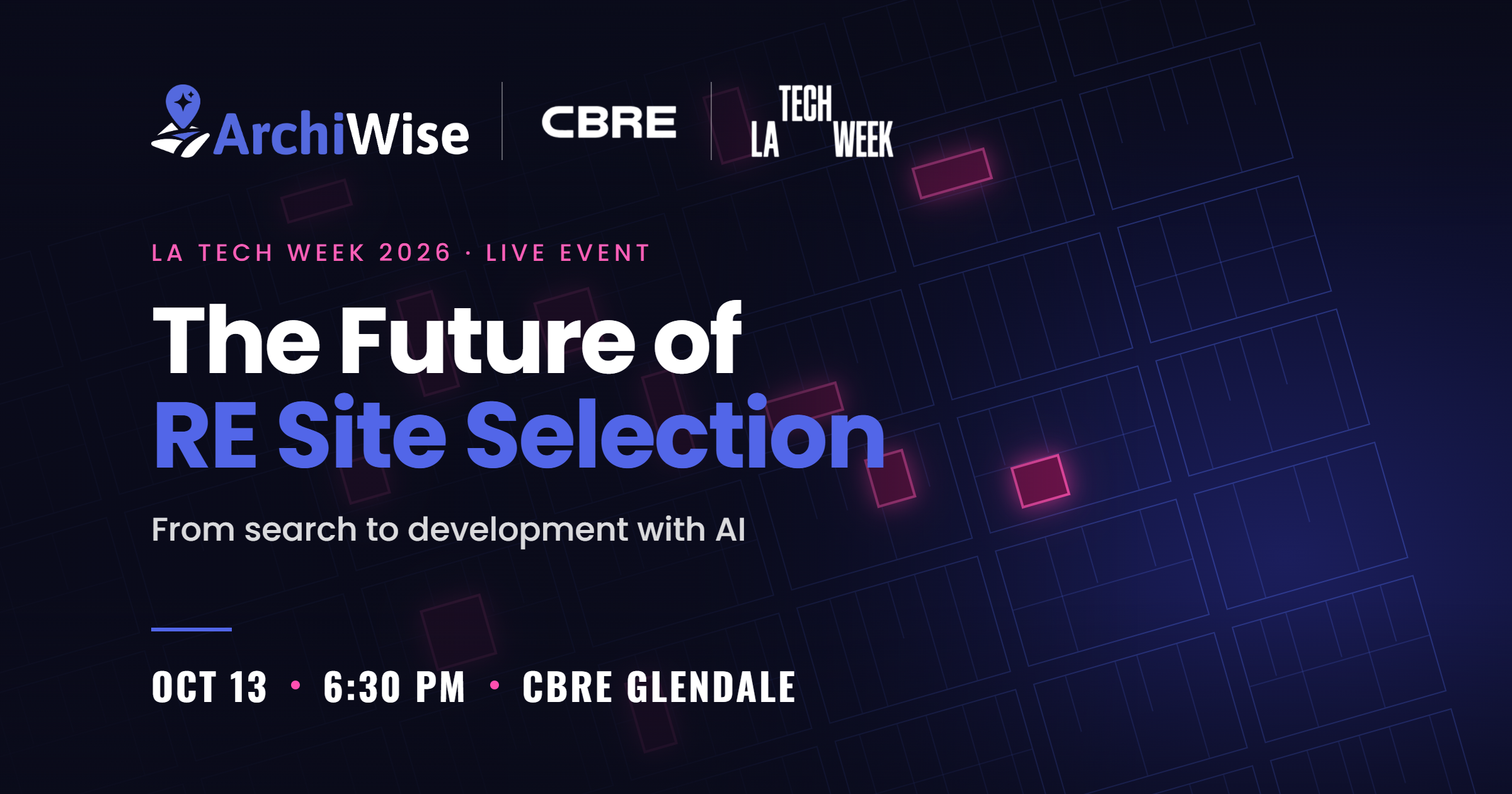

ArchiWise is heading to LA Tech Week 2026
Every building starts as an idea attached to a piece of land that nobody has found yet. Somewhere between that idea and the ribbon cutting sits the hardest, least visible part of real estate development: figuring out where to build, whether the site actually works, and how long it will take to find out. For most teams, that distance from search to development is measured in months, sometimes years, and it is exactly where good projects quietly die long before anyone breaks ground.
Artificial intelligence is starting to close that distance. Not by replacing the judgment of experienced developers, brokers, and planners, but by giving them a faster, clearer path from an open question, “where should we build,” to an answer they can actually act on. That shift, from scattered manual research toward AI-powered site selection, is what we will be talking about when ArchiWise joins LA Tech Week 2026 this October.
The Distance Between Finding a Site and Building on It
Ask most acquisition teams how they source new sites and you will hear some version of the same story. Someone drives a neighborhood looking for vacant lots or underused buildings. Someone else pulls parcel records from a county website that was clearly built for a different decade. A third person spends an afternoon on the phone with a planning department, trying to get a straight answer about what a piece of land is actually zoned for and what it would take to change that.
None of this is a failure of effort. It is a failure of tools that were never designed to talk to each other. Zoning codes live in one place, permit history in another, ownership records in a third, hazard and environmental data somewhere else entirely, and market comparables in whatever spreadsheet the last analyst left behind. A team can find a promising parcel in an afternoon and still spend the next six weeks figuring out whether it is worth pursuing.
That gap between finding a site and understanding it is where most of the real cost of development hides. Not in the land itself, but in the months of research it takes to learn whether a project is even possible before a single design decision gets made.
What AI-Powered Site Selection Actually Means
The term gets used loosely, so it is worth being specific. AI-powered site selection is not a map with a search bar bolted onto it. It is a system that pulls zoning language, permit history, ownership records, hazard overlays, demographic patterns, and infrastructure data into one place, and then does the harder work of interpreting what all of that means for a specific parcel.
That interpretation part matters most. A municipal code can run hundreds of pages, written in language that assumes a planner is reading it, not a developer trying to move quickly. Reading through an overlay district, a conditional use requirement, or a density bonus provision and translating it into a plain answer, can I build a four story building here, is precisely the kind of task that used to take a land use attorney an afternoon and now takes a well built system a few minutes.
Done well, AI-powered site selection does not just help a team find more parcels. It helps them ask better questions about the parcels they already have in front of them, and get honest answers faster.
From Search to Development, One Continuous Line
For a long time, site search and site feasibility have been treated as separate stages, handled by separate people, weeks or months apart. A broker or acquisitions manager finds candidates. Then feasibility gets checked. Then a land use consultant is brought in to assess entitlement risk. Then, finally, the deal team runs the numbers. Each handoff adds time, and each stage often repeats research the previous one already did in a slightly different form.
The more useful version of AI-powered site selection collapses those stages into one continuous line of information. The same tool that surfaces a promising parcel can also tell a team, in that same sitting, what is actually buildable there, what approvals it would likely need, roughly how long entitlement might take based on similar recent cases, and what the deal economics look like under a few different scenarios. Search stops being a separate step from development planning. It becomes the front end of it.
That is the real shift underneath the phrase “the future of site selection.” Not faster search results, but a shorter, more connected path from an open question about a piece of land to a confident decision about whether to develop it.
Los Angeles Is Where This Gets Tested Hardest
If a system can make sense of site selection in Los Angeles, it can probably make sense of it almost anywhere. Few markets in the country layer as many rules on top of a single parcel: base zoning, community plan overlays, hazard and hillside designations, historic preservation districts, and a state housing framework that keeps evolving what density is actually allowed on a given lot. Two properties on the same block can carry entirely different development potential, and the only way to know which is which has traditionally been to dig through the code yourself, one section at a time.
That complexity is exactly why Los Angeles is the right place to have this conversation. It is a city where the gap between what a zoning map suggests and what a project actually requires shows up constantly, and where developers, planners, and technology teams are all working through the same question from different angles: how do you make confident decisions faster in a market this layered.
Meet Us at LA Tech Week 2026
We will be joining that conversation in person this October. ArchiWise is taking part in LA Tech Week 2026, and we would like to see you there.
| Event: ArchiWise at LA Tech Week 2026
Date: October 13, 2026 Time: 6:30 PM to 8:00 PM Location:CBRE, 234 S Brand Blvd, Suite 800, Glendale, CA 91204 |
Expect an informal evening rather than a sales pitch. We will walk through what AI-powered site selection looks like in practice, show how it plays out on real Los Angeles parcels, and talk honestly about where the technology helps and where a good planner or broker still matters more. If you work in real estate development, acquisitions, urban planning, or you are simply curious where this technology is headed, come find us.
Space will be limited, please RSVP here. If Los Angeles is not on your calendar this October, you can still get in touch, we are always glad to walk a team through what ArchiWise does over a call.
Why This Conversation Matters Beyond One Event
AI-powered site selection is not a feature you add to an existing workflow. It is a different way of getting from a question to a decision, one where the research that used to take a team weeks to piece together is available in the same sitting the question gets asked. That changes what a development team can pursue, how many sites they can seriously evaluate, and how early they can say no to the ones that will not work.
We built ArchiWise because we kept meeting developers who had the instinct to find a great site, but not the time to confirm it before someone else did. The future of site selection is not about replacing that instinct. It is about giving it the information to move as fast as it deserves to, from the first search all the way through to the ground being broken.
We hope to see you in Los Angeles this October. Until then, if you want an early look at how AI-powered site selection works on a real parcel, reach out and we will show you.