
Every developer has a story about the deal that almost happened. The parcel looked perfect on paper, the location checked every box, and then somewhere between the letter of intent and the closing table, a zoning restriction, an environmental flag, or a setback requirement nobody caught turned a promising site into a write off. It is one of the most expensive and most common mistakes in real estate development, and it usually traces back to the same root cause: not enough information, gathered too slowly, at the exact moment when speed and accuracy both matter most.

That is the problem ArchiWise was built to solve, and it is why we are excited to share that ArchiWise will be at Blueprint 2026, taking place September 22 through 24 at the Venetian in Las Vegas.
What Blueprint 2026 Is and Why We Are Going
Blueprint has grown into one of the largest gatherings in the industry, bringing together real estate owners, operators, developers, construction leaders, technology builders, and investors who are all focused on the same bottom line question: how do we build and operate real estate more intelligently. Past editions have drawn thousands of attendees, hundreds of speakers, and companies representing markets around the world, spanning multifamily housing, industrial development, data centers, and everything in between.
For a company like ArchiWise, Blueprint is not just a conference. It is a chance to sit down with the people who feel the site selection problem every single day, walk them through what modern zoning and feasibility software actually looks like, and hear directly from them about where the process still breaks down.
We will be there showing what ArchiWise does before a site is chosen, which is exactly where the expensive mistakes tend to happen. If you are attending Blueprint 2026, we would love to talk. Stop by, comment on our announcement, or send us a message and we will find a time to connect in Las Vegas.
The Site Selection Problem Real Estate Developers Actually Face
Ask any developer how they evaluate land today and you will usually hear some version of the same workflow. A promising parcel comes across someone’s desk. Someone pulls the municipal zoning code, tries to interpret setbacks, height limits, and use restrictions written in dense legal language that was never meant to be read quickly. Someone else calls the local planning department to confirm what the code actually means in practice, because zoning documents and real world enforcement do not always match. Meanwhile, a third person is trying to track down utility capacity, flood zone data, and any overlay districts that might apply.
This process can take days or weeks per site, and most development teams are evaluating far more sites than they end up pursuing. Every hour spent manually researching a parcel that ultimately does not pencil out is an hour not spent on the deals that will actually close. Worse, manual research is where human error creeps in. A missed overlay district or an outdated zoning map can turn into a deal that looks viable right up until it collapses in due diligence.
This is the part of development that happens before a site is chosen, and it is where the most expensive mistakes actually get made.
How AI Site Selection Software Changes the Process
Artificial intelligence site selection software like ArchiWise takes the same information a development team would gather manually and processes it in minutes instead of weeks.
Here is what that looks like in practice.
Zoning and Municipal Code Analysis
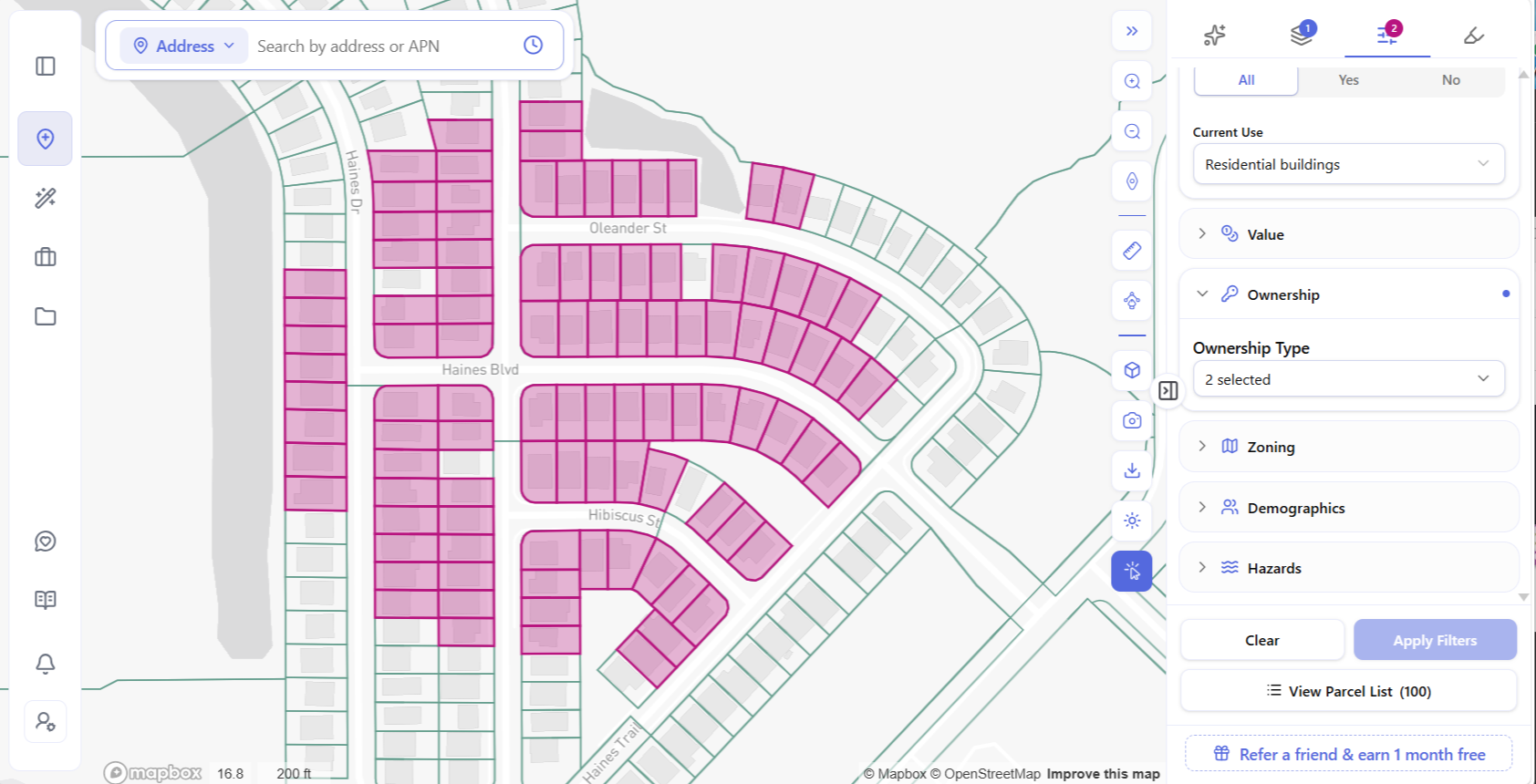
Instead of manually reading through a municipal code, ArchiWise reads and interprets zoning ordinances directly, surfacing the permitted uses, density limits, setbacks, and height restrictions that apply to a specific parcel. This turns hours of legal document review into a task that takes minutes.
Overlay and Hazard Detection
Zoning maps rarely tell the whole story. Overlay districts, floodplains, environmental hazards, and other site specific restrictions can quietly disqualify a property that otherwise looks ideal. Automated detection surfaces these issues early, before a team invests time and money into a site that was never going to work.
Area and Market Intelligence
Good site selection is not only about what is allowed on a parcel. It is also about what is happening around it. Demographic trends, nearby development activity, and infrastructure capacity all factor into whether a site makes sense for a given use.
Feasibility Testing
Once the zoning and site data are in hand, the next question is whether a project actually pencils out. Feasibility testing models different scenarios against the constraints of the site, giving developers a realistic picture of what can be built and what it might return, long before they are locked into a contract.
Better Decisions, Not Just Faster Ones
It is tempting to frame software like this purely around speed, and speed matters. Going from an address to a real answer in minutes rather than weeks changes how many sites a team can realistically evaluate. But the bigger shift is in the quality of the decision itself.
When zoning interpretation, hazard detection, and feasibility analysis are handled consistently and thoroughly for every parcel, teams stop relying on whoever happens to have the most experience reading a specific municipal code. They stop missing the overlay district that was buried on page forty of a document nobody had time to finish. They start making land acquisition decisions based on complete information rather than whatever could be gathered before the offer deadline.
That is the difference between a tool that saves time and a tool that changes outcomes. ArchiWise is built to do both.
Why This Matters for the Whole Deal Team
Site selection is not a task that lives with one person. Acquisitions teams need to know quickly whether a parcel is worth pursuing. Development and entitlement teams need accurate zoning interpretation to plan a project correctly. Investors need feasibility numbers they can trust before capital gets committed. Legal and planning consultants need a reliable starting point instead of building every analysis from scratch.
By putting accurate, consistent site intelligence in front of every one of these stakeholders at the same time, ArchiWise removes a lot of the back and forth that normally slows a deal down. Everyone is looking at the same information, generated the same way, at the same point in the process.
Meet Us at Blueprint 2026
If you are heading to Blueprint 2026 at the Venetian in Las Vegas from September 22 through 24, we want to hear about the sites you are chasing and the parts of your process that still feel harder than they should. Comment on our announcement, send us a message, or find us on the show floor. We will bring the software. Bring your toughest parcel and we will show you what ArchiWise can tell you about it in minutes.
You can also read more site selection breakdowns like this one on the ArchiWise blog.
Frequently Asked Questions
What is AI site selection software?
It is software that uses artificial intelligence to analyze zoning codes, municipal regulations, hazard data, and site conditions for a piece of land, giving developers a fast and accurate read on what can be built and where the risks are, before they commit capital.
Who is ArchiWise built for?
ArchiWise is built for real estate developers, acquisitions teams, investors, and the consultants who support them, anyone who needs to evaluate land quickly and confidently before a deal moves forward.
When and where is Blueprint 2026?
Blueprint 2026 takes place September 22 through 24 at the Venetian in Las Vegas. You can view the sponsor lineup here.
How can I meet ArchiWise at Blueprint 2026?
Comment on our event announcement, send us a direct message, or stop by in person. We are happy to set up a time to talk through your site selection process and show you how ArchiWise works.