

Most data center siting starts with a power question. Where is there capacity, what does the interconnection queue look like, can we go behind the meter. Every guide published this year leads with it, and one of the largest platforms in the category puts permitting near the bottom of its priority list without explaining why.
That order holds up right until you look at what actually stops projects.
Data Center Watch tracked $64 billion in US projects blocked or delayed between May 2024 and March 2025. In the first quarter of 2026 alone the figure reached $130 billion across at least 75 projects, roughly matching the whole of 2025. Almost none of it was a grid problem. It was rezoning denials, conditional use permits, ordinance amendments and withdrawals ahead of hearings.
There is a screening step that comes before power, costs almost nothing, and most teams skip it: read what is already on the map.
Why this matters now
Three things changed at once, and they compound.
The buildout accelerated. AI workloads pushed demand past what transmission and generation can absorb. Interconnection queue waits now run beyond six years in parts of PJM, and non-refundable readiness deposits reach $4,000 per megawatt – the unit data centers are sized in, measuring how much power a facility can draw at once. For a 250 MW campus that is roughly $1 million in entry fees before anything is built. More than a quarter of new US data center capacity is now going behind the meter to avoid the queue entirely.
Resistance accelerated faster. The $130 billion blocked or delayed in Q1 2026 roughly equals the whole of 2025. On a single day in July 2026, organizers held 142 protests across 42 states. Local moratoriums reached 219, with 183 still in force. Gallup found 71 percent of Americans opposed to a data center in their own community, and only 14 percent told Reuters/Ipsos they would support one.
So the shelf life of market knowledge collapsed. This is the part that catches experienced teams. A county that approved a campus eighteen months ago may now have a moratorium, a new ordinance, or a board that lost an election over the last one. In Warrenton, Virginia, council members who backed an Amazon project lost their seats in November 2024. San Marcos, Texas went from denying one project in June 2026 to prohibiting data centers in every zoning district in the city.
Knowing where data centers already are is not trivia about the competition. It is the fastest available read on four things that are otherwise slow and expensive to learn:
- Whether power is plausible here. Operating facilities mean the grid, the utility and the interconnection path have already worked in this corridor for this load type.
- Who else wants the same capacity. Approved and under-construction projects nearby are claims on the same substation, the same contractors and the same council.
- How the jurisdiction behaves. Suspended and cancelled projects are a record of what happens when someone asks.
- Whether your information is current. A map that updates beats a relationship-based read of a market that was accurate last year.
Four signals in the existing landscape
Each status answers a different question.
Operating tells you power exists, the utility has done this before, and the jurisdiction has lived with the result. A corridor with operating facilities has cleared every hurdle a new site faces – not a guarantee, but proof the path exists.
Expanding is the strongest positive signal on the map. An operator adding capacity at an existing campus has re-cleared the local process against current politics, current power constraints and current community sentiment. Expansion is a vote of confidence backed by capital.
Approved, permitted or under construction tells you about competition. Those projects have claims on the same substation capacity, the same construction labor and the same council’s attention. A cluster of approvals near your target site is not purely encouraging.
Proposed shows where everyone else is looking right now. Useful for that reason, and useful in reverse: a thin proposed pipeline in a well-powered area is worth understanding rather than assuming you spotted something others missed.
Suspended and cancelled are worth the most, and nobody models them.
Why suspended and cancelled matter most
A cancelled project is a jurisdiction telling you how it behaves.
The mechanisms are municipal and repeatable:
- Tract withdrew a $14 billion project in Goodyear and Buckeye, Arizona in May 2024 rather than proceed with its rezoning request.
- Peculiar, Missouri amended its zoning ordinance to remove data centers entirely, effective 17 October 2024, ending a $1.5 billion project.
- Culpeper County, Virginia’s planning commission denied a $12 billion proposal in June 2024.
- Naperville, Illinois rejected a project 6-1 in January 2026, after the developer had already scaled it back and removed diesel generators.
- San Marcos, Texas denied zoning for a roughly 200-acre project in June 2026, then prohibited data centers in every zoning district in the city.
Each of those is a dot on a map with a status attached. Individually they are news stories. As a layer, they are a pattern: a county with a suspended project and an organized opposition group is a different risk than a county with three operating campuses, whatever the grid says about either.
Checking whether a project died nearby, and why, is the cheapest diligence available on a site. It happens before the first call to the utility.
The classification problem underneath it
There is a structural reason so many of these end up in hearings, and you can watch it happen on a single parcel.
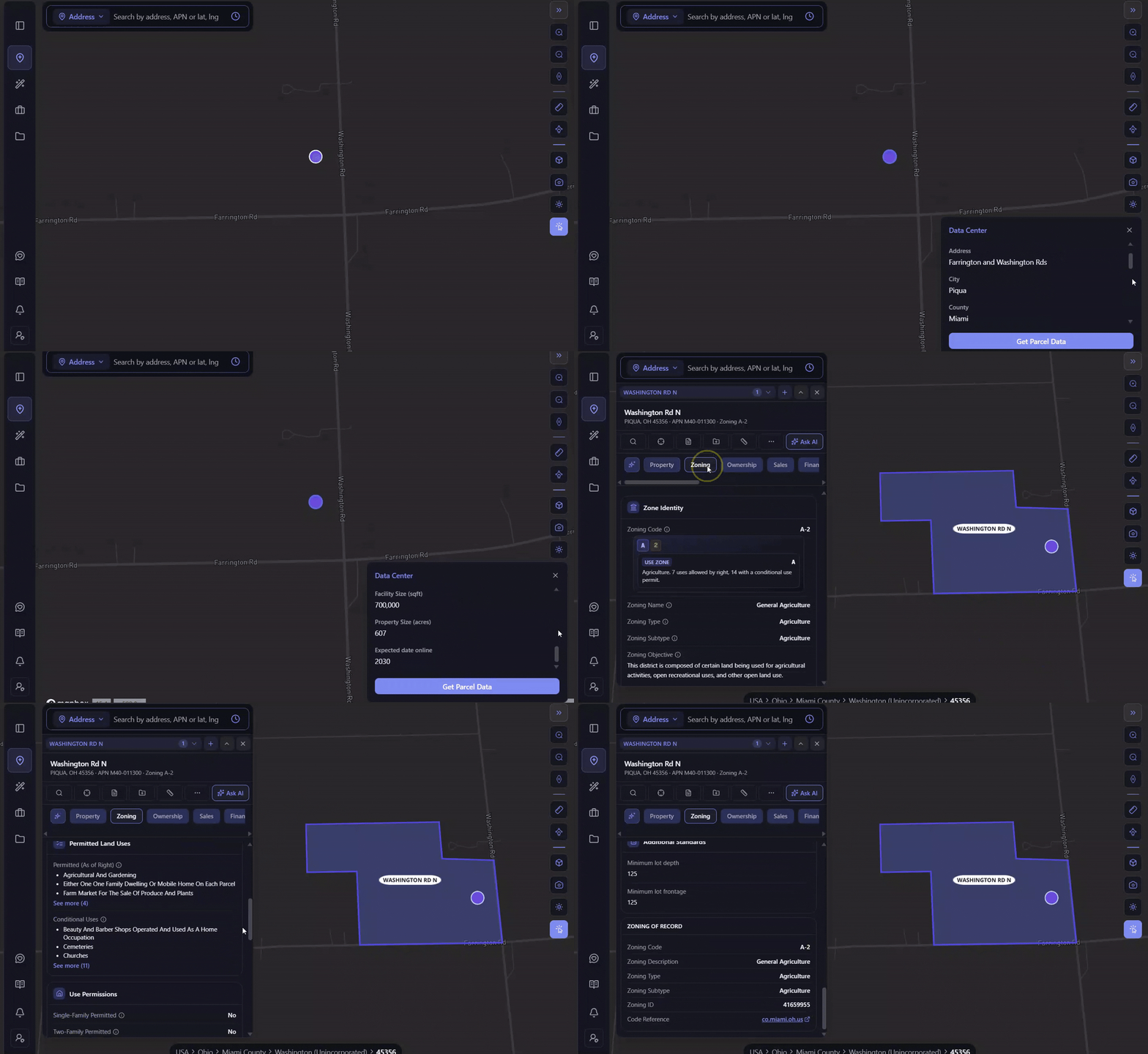
Take a proposed data center in Miami County, Ohio. Open the parcel underneath it and the zoning is A-2, whose stated objective is land used for “agricultural activities, open recreational uses, and other open land use.” Permitted by right: agriculture and gardening, one dwelling or mobile home per parcel, a farm market selling produce and plants. Conditional uses: barber shops operated as a home occupation, cemeteries, churches.
Data centers appear in neither list. Not permitted, not conditional, not prohibited – simply absent. Which means the project cannot proceed without a rezoning, and a rezoning means a hearing.
That absence is the norm, not an oddity. Aurora, Illinois had no data center category either, so it classified them as warehouses – which meant facilities were approved administratively, with no hearing and no review of the impacts people object to. Anchorage, Alaska had the same gap: “warehouse” meant buildings for storing physical goods, and its “data processing center” category described 1990s office work.
That silence resolves one of two ways, both expensive to discover late.
Either the project sails through until the community notices and the jurisdiction responds with a moratorium. Aurora declared one in September 2025 and adopted permanent rules in spring 2026 covering renewable load share, battery storage, and water, energy and sound studies before occupancy.
Or the project is routed into a discretionary permit by default. Anchorage adopted exactly that in March: data centers limited to commercial and industrial zones, barred from residential, conditional use permit required, roughly 200-foot setbacks from noise-sensitive uses, and proof of adequate power, water and wastewater capacity.
So the question on a shortlisted site is not only how much power is available. It is what a data center is, in this jurisdiction’s code, this month.
From market to parcel
Once the map has narrowed the geography, the parcel screen is mechanical:
Does the code name data centers? If so, in which zones and in which column – by right, conditional, or prohibited. If not, what would they be classified as, and who decides.
By right or by hearing? The single largest schedule variable on a site, and it is knowable before you make a call.
What changed recently? Peculiar and San Marcos both moved by amendment. Ask when the code was last updated.
What are the dimensional standards? Setbacks from noise-sensitive uses, height, lot coverage, screening and buffers. A 200-foot residential setback quietly removes a large share of a parcel’s usable area.
What is adjacent? Residential adjacency is the clearest predictor of organized opposition, and it is visible on a parcel map before anything is filed.
What sits on the land? Flood, seismic and fire exposure, and historic resource designations – all of which surface at hearings whether or not you raised them.
Run that across a market and most parcels fall out before anyone prices an interconnection study. Run it after a power commitment and a purchase agreement, and you are negotiating from a worse position.
What ArchiWise gives you
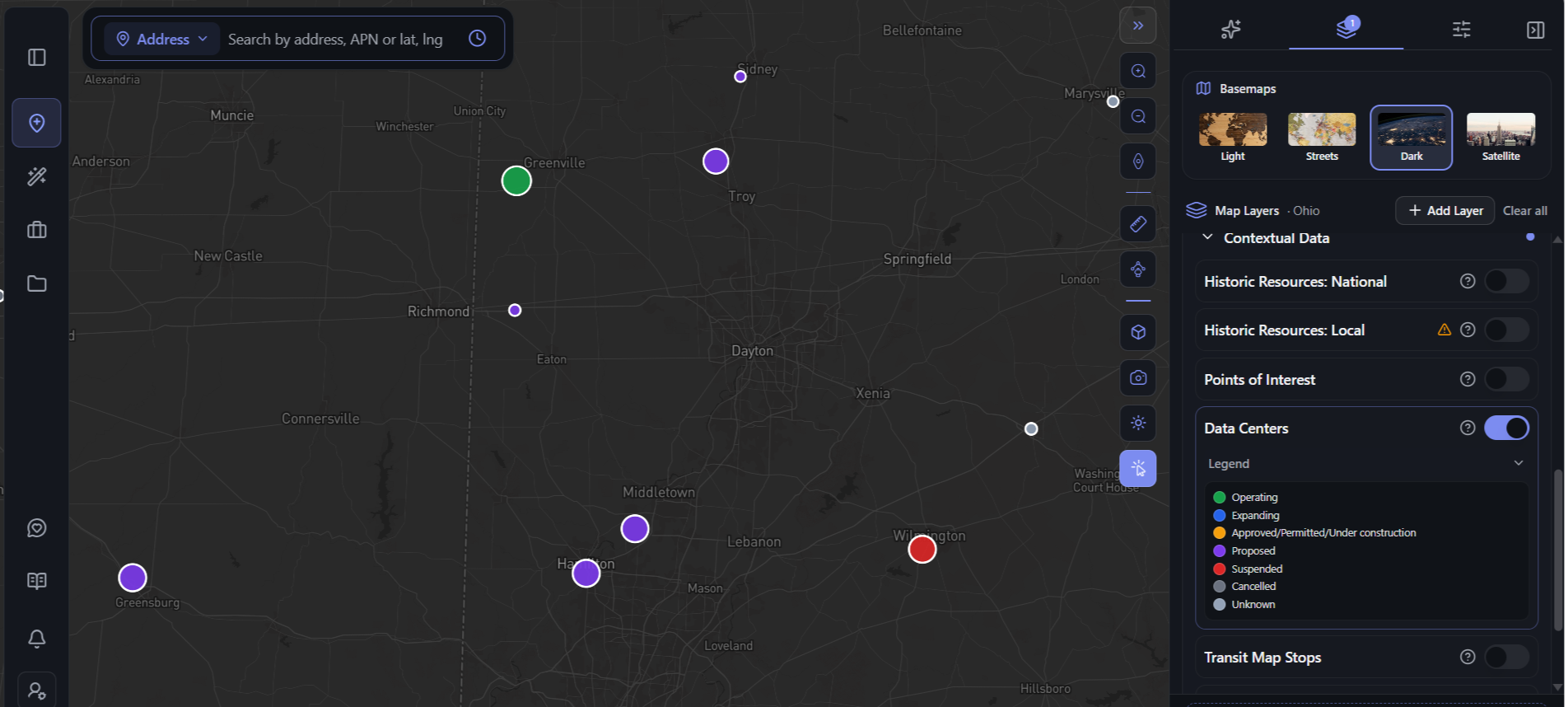
The existing landscape. A data center map layer showing locations categorized by status – operating, expanding, approved or permitted or under construction, proposed, suspended, cancelled and unknown – and scaled by facility size, so the signals above are a toggle rather than a research project.
The parcel underneath. Any facility on the layer opens its record and resolves to the parcel it sits on, with zoning, ownership and sales one tab away.
Market-wide search. AI Site Selection treats zoning, land use and zoning type as search criteria rather than attributes you read after finding a parcel. You describe the conditions you need across a market and get candidates back, instead of checking sites one at a time.
The land use answer per parcel. The AI Zoning Expert panel returns the zoning objective, the complete permitted, conditional and prohibited use lists – so you can see whether data centers appear and in which column – plus the dimensional standards with their conditional language intact, and a link to the ordinance itself.
Context layers. Parcel boundaries, future land use, frontage and zoning as map layers, alongside historic resources at national and local level – so residential adjacency, district boundaries and designated constraints are visible rather than inferred.
Site-level check. AI Site Feasibility returns hazards, infrastructure and area context with a massing study on the real parcel geometry.
What it does not do. It does not model power – substation capacity, available transfer capacity and interconnection queue position are a different data layer, and you should use a platform built for them. It does not track pending ordinance amendments or read the politics of a board. It does not replace land use counsel on entitlement strategy.
What it does is tell you which parcels are worth a phone call, in an afternoon rather than a quarter.
Frequently asked questions
What should I screen first when selecting a data center site? Power and land use are both disqualifying, so neither is truly first. But reading the existing data center map – what is operating, expanding, suspended or cancelled nearby – costs minutes and narrows the geography before any paid diligence starts.
Why do suspended and cancelled projects matter for site selection? They show how a jurisdiction behaves when a data center is proposed. A cancelled project usually means a rezoning denial, an ordinance change or a withdrawal under pressure – all of which apply to the next applicant too.
Are data centers permitted by right? It depends entirely on the jurisdiction, and many codes do not address data centers at all. Where a code is silent, the use is typically assigned to the nearest existing category, often warehouse or light industrial, or routed to a discretionary permit.
How many jurisdictions have data center moratoriums? One tracker counted 219 local moratoriums as of August 2026, 183 still active. The number moves quickly, so treat any figure as a snapshot.
What is a megawatt, and why are data centers measured in them? A megawatt is one million watts – how much electricity a facility draws at any moment. Data centers are sized and leased in megawatts rather than square feet because power, not floor area, is what constrains them. A large campus can draw more than 1,000 MW, roughly what a large nuclear reactor produces.
Can software predict community opposition? No. It can show you what the code permits, what the dimensional standards require, what sits next door and what has already failed nearby. The political read is human work.
Power gets you a shortlist. What is already on the map tells you which part of it is real.
Screen a market in ArchiWise with the data center layer on.