

A county assessor can tell you in seconds that a parcel belongs to a city, a state land department or a federal agency. What it cannot tell you is the only thing that matters: whether that parcel is for sale, and whether you are allowed to buy it.
Government owned land for development does not sit on a listing site waiting for the best offer. It moves through a public process with a fixed deadline, and almost always with a line of other public bodies ahead of you. By the time a sale is visible to the general market, the question period has often already closed.
The short answer to “where do I find it” is four places: federal agencies, state land offices, cities and counties, and special districts such as transit agencies. The longer answer, and the useful one, is knowing which line each parcel is in and when a private developer is allowed to step into it.
Contents
- Why is government-owned land for development so hard to buy?
- How does federal surplus land reach developers?
- Where do states sell land?
- How do cities and counties release land?
- What about transit agencies?
- How do you build a watch list for public land?
- What software can and cannot do here
Why is government-owned land for development so hard to buy?
Public land is not hard to find. County assessor records show who owns every parcel, and governments are easy to spot in an ownership column. The hard part is that ownership tells you nothing about availability.
A government only sells land it has formally declared it no longer needs. Once it does, most laws require it to offer that land to other public uses first. Each level of government runs its own version of that queue, with its own notices, windows and buyers who get priority.
The cost of ignoring the queue is simple: you find out about the sale after the deadline, or after the land was already promised to someone with a better place in line.
How does federal surplus land reach developers?
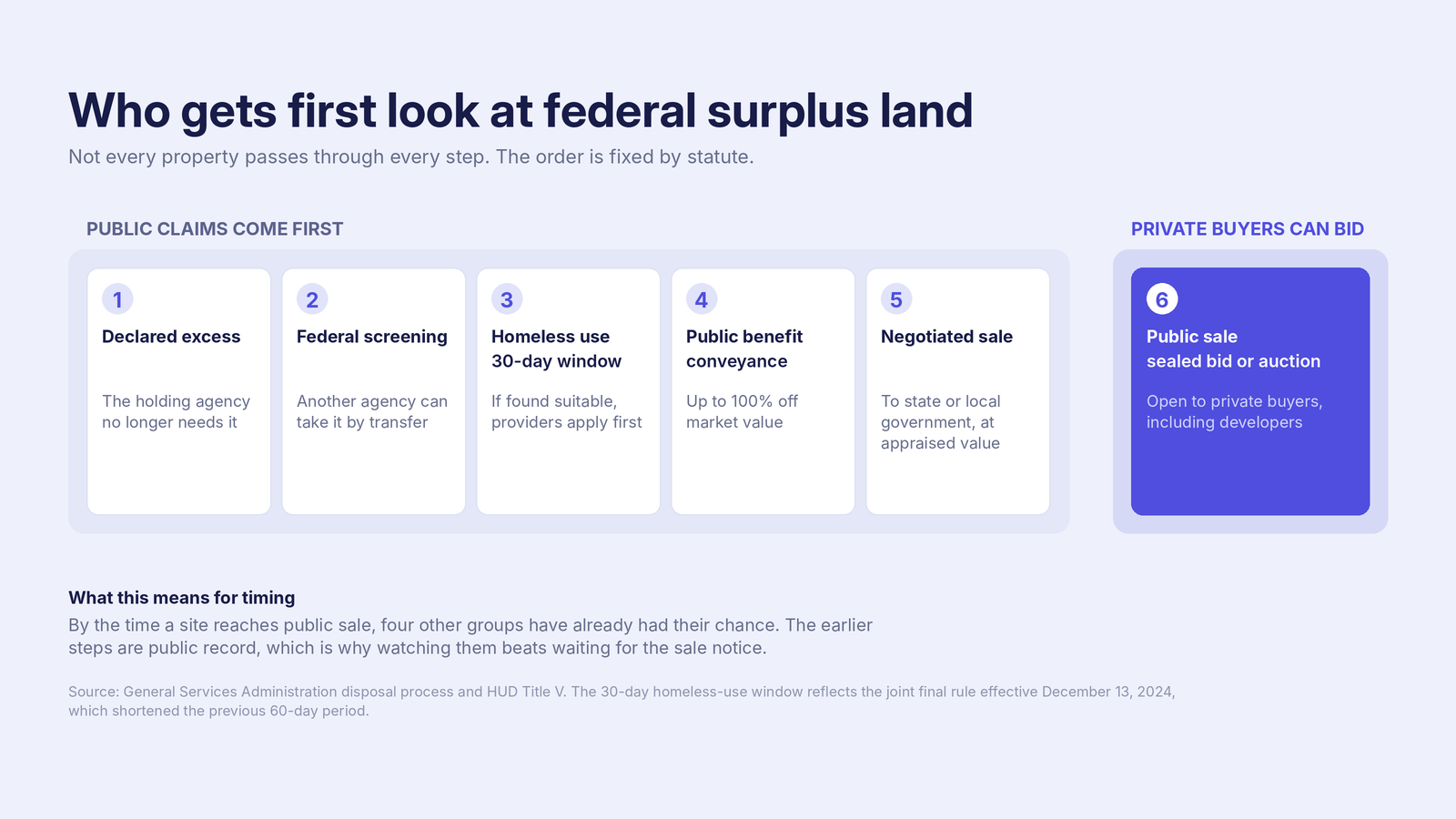
Federal buildings and land are disposed of mainly through the General Services Administration. Its published disposal process runs in a fixed order:
- The holding agency reports the property as excess to its needs.
- The General Services Administration offers it to other federal agencies first.
- If no agency needs it, the property is declared surplus. If it is found suitable for homeless use, it must first be considered for a homeless conveyance.
- It can then go to a qualifying public use through a public benefit conveyance, at a discount of up to 100 percent of fair market value.
- It can be sold by negotiation to a state or local government at appraised fair market value, for a public purpose.
- Only then can it be sold to the public, generally by sealed bid or auction.
The homeless use step has a fixed clock. Under the Department of Housing and Urban Development’s Title V process, suitable properties are published weekly and carry a 30-day holding period from the date posted. During that window the landholding agency cannot proceed with any disposal action, which leaves a homeless service provider time to file a notice of intent.
Land in the West often belongs to a different agency: the Bureau of Land Management. Its sales follow Section 203 of the Federal Land Policy and Management Act, and in Southern Nevada they also run under the Southern Nevada Public Land Management Act of 1998. A 2018 notice for the Las Vegas Valley shows the mechanics: 20 parcels totaling 87.5 acres, sold by sealed bid and oral auction, with a deposit of 20 percent of the bid.
Two points matter for a private buyer. Federal land is not sold cheap to developers – by law, no parcel can be sold for less than fair market value, and the deep discounts go to public uses, not to private ones. And the federal pipeline may widen: in March 2025 the Secretaries of the Interior and of Housing and Urban Development announced a joint task force on federal land for housing, noting that Interior oversees more than 500 million acres. The announcement gave no figure for how many acres or homes would follow. Separately, the rule that makes local public land inventories searchable took effect on October 1, 2026, requiring Community Development Block Grant recipients to publish the undeveloped land they own.
Where do states sell land?
State land offices get less attention than city sales, and in parts of the West they hold a great deal of land. Arizona is the clearest example: the state holds roughly 9.2 million acres of trust land, sold at public auction to the highest bidder, with the proceeds going largely to education.
What makes Arizona useful to a developer is that a buyer can start the process. A developer can apply to have a specific parcel put up for auction, paying for the studies and preparation before anyone bids. The department can also bring land forward on its own when it believes a parcel is ready.
The catch is the capital the auction itself demands, and it is easy to underestimate. When TSMC bought 902 acres of trust land near its Phoenix campus on January 7, 2026, it registered with a $55.9 million cashier’s check, bid $197.25 million, owed 25 percent of the appraised value at the close of bidding and the balance within thirty days. There were no other bidders, and the auction was over in under five minutes. Single-bid auctions on large industrial trust parcels are not unusual in Arizona.
Smaller parcels can run the other way. A 48-acre Scottsdale parcel with a minimum bid near $56.9 million sold for $84 million, well above its floor.
The cost here is different from a private deal: the applicant pays for the groundwork, fronts a deposit at registration, and can still lose the auction.
How do cities and counties release land?
Local land is where most infill and multifamily developers will find their sites, and it comes out in two main ways.
The first is a request for proposals. The city chooses the lots, sets its goals and scores the responses. In early 2026 Phoenix took proposals on 17 vacant lots along 16th Street at Broadway Road, seeking proposals consistent with the city’s housing plan that would create “quality, affordable housing for low- and moderate-income households.” Written questions closed on January 30 and proposals were due on April 3. A developer who first heard about those lots in May had already missed them. Price is only one factor in solicitations like these.
The second is a right of first refusal written into state law. California’s Surplus Land Act is the strongest version. Cities, counties and special districts must send a notice of availability for non-exempt surplus land to the state housing department, to local public entities, and to developers who have told the department they want to build affordable housing on surplus public land. Those parties have a mandatory 60 days to respond. If anyone does, the agency must then negotiate in good faith for a minimum of 90 days, and proposals must include 25 percent affordable units to be part of those negotiations, with priority going to the proposals carrying the most affordable units and the deepest affordability.
For a developer, that means one practical step: register your interest with the department so notices reach you directly, instead of finding them on page four of a city council agenda.
Counties also hold land taken for unpaid property taxes, and many regions run land banks that resell vacant property under their own rules. These follow state tax law and vary widely, which is one of the reasons so much land changes hands before it is ever listed – a pattern covered in why off-market deals stay off-market.
What about transit agencies?
Transit agencies own station parking lots, maintenance yards and leftover parcels from construction, often in exactly the locations that zoning reform now favors. The Federal Transit Administration calls private use of that land joint development, governed by its Circular 7050.1C. Its own examples are a developer leasing agency land near a station to build offices or housing, and a station built with mixed-use development in the air rights above it.
Expect a ground lease rather than a sale, and a selection process that rewards transit ridership and revenue to the agency as much as price. In California, where state law now allows more height and density near major transit, these sites pair with the rules explained in our guide to what California’s transit-oriented density law allows near stations.
How do you build a watch list for public land?
A developer who learns about a public site from the notice is already behind. A simple watch list fixes that.
- Map public ownership in your target submarket. Pull every parcel owned by a federal, state, county, city or special district owner. Vacant land, surface parking and underused buildings are the candidates.
- Sign up for every notice channel. Federal Register notices and agency sale pages for federal land, the state land office’s auction calendar, the city’s procurement portal, and in California the housing department’s interested developer list.
- Screen each candidate before the notice drops. Zoning, flood and other hazards, utilities and access. A request for proposals rarely leaves enough time to start from zero. Our guides to finding land for development with AI and the mistakes developers keep making in pre-development cover what to check.
- Know what the seller scores. Many public sellers weigh affordability, ridership or community goals as heavily as price. If you build affordable housing, check whether the parcel sits where federal tax credits stretch further, using our Qualified Census Tract and Low-Income Housing Tax Credit basics.
Step one is where most of the time goes. Assessor ownership names are inconsistent: one city can appear under several spellings, and a public agency can be recorded a dozen different ways across a single county.
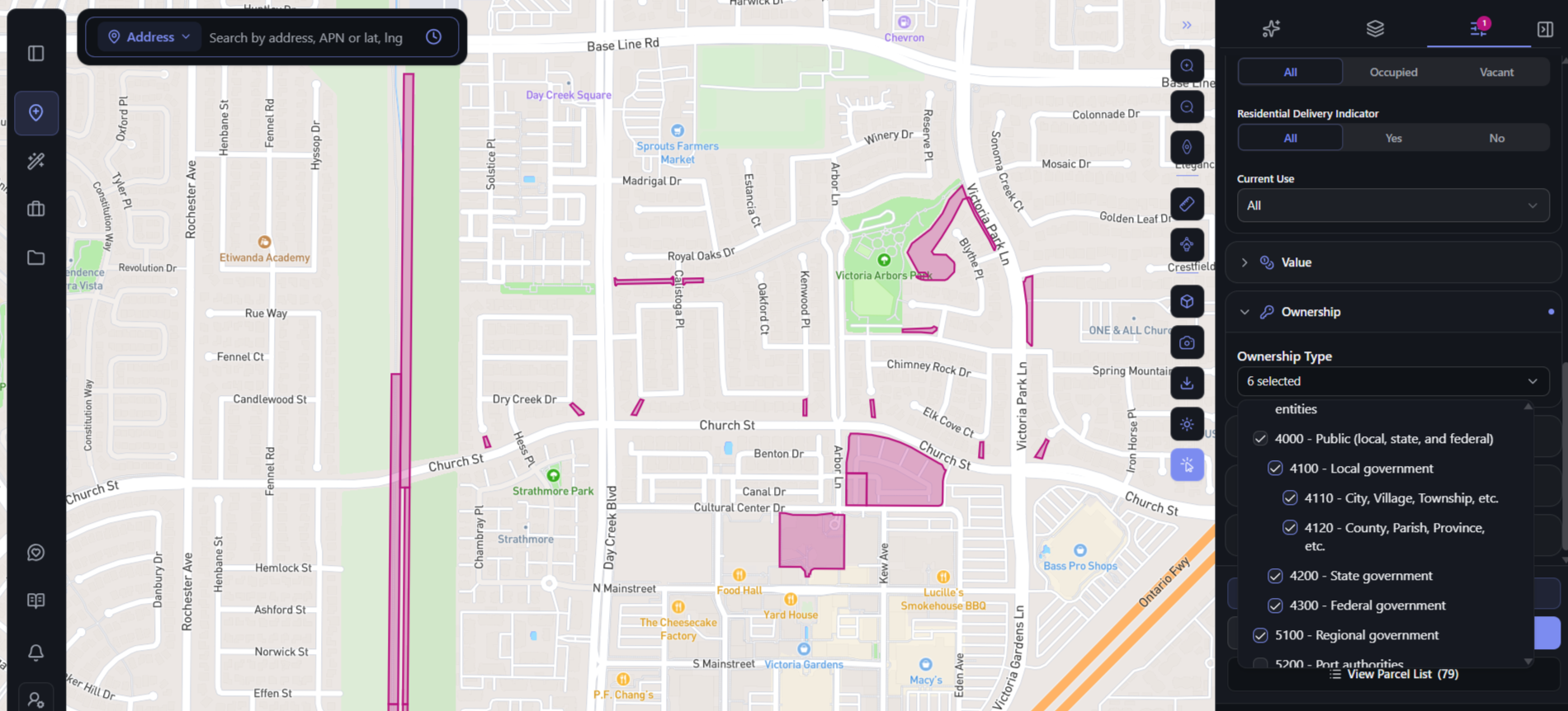
In ArchiWise, the Ownership filter has a government-owned toggle and a coded ownership hierarchy rather than a single flat category: 4000 Public (local, state and federal), which opens into 4100 local government with its own 4110 city, village and township and 4120 county and parish codes, then 4200 state government, 4300 federal government, 5100 regional government and 5200 port authorities. You can combine any of them with zoning, lot size, vacancy and flood filters on a drawn search area or the current map view. The result is a live parcel count – 79 in the submarket shown here – and a Parcel List you can export as a spreadsheet file or add to a project. One caution: a very large search area returns roughly 100 parcels at most, so draw tighter areas when you want every public parcel in a submarket. Each parcel then opens with its zoning, hazards and incentives tabs, which covers most of step three.
What software can and cannot do here
Solvable, because it is an information problem: finding which parcels are publicly owned, screening them against your buy box, and checking zoning and hazards before a notice appears.
Not solvable by software: whether an agency declares a parcel surplus, how a selection committee scores proposals, the politics of a council vote, and the use restrictions that come with discounted public land. A parcel showing a government owner is not for sale, and no data layer tells you when it will be. Read every notice in full, and have counsel review any public disposition agreement before you sign it.
Know which public parcels in your market are worth watching before the notice goes out.
If you want to map every government-owned parcel in a submarket and screen each one in the same place, find land faster with ArchiWise.
Frequently asked questions
Can a private developer buy surplus federal property directly?
Yes, but usually only at the last stage, when the General Services Administration sells to the public by sealed bid or auction. Earlier stages favor other federal agencies, homeless providers and public bodies. A developer can also take part earlier by partnering with a local government or nonprofit that qualifies for a negotiated sale or a conveyance.
Is government-owned land cheaper than private land?
Not for private buyers, as a rule. Bureau of Land Management parcels cannot be sold for less than fair market value, and competitive auctions can push prices well above the minimum. The large discounts are reserved for public purposes, and they come with use restrictions.
How do I get notified when a California city or county sells surplus land?
Tell the California Department of Housing and Community Development that you want to develop affordable housing on surplus local land. Agencies must send their notices of availability to developers on that list, and you then have 60 days to respond.
Does a public land database mean the land is for sale?
No. Inventories such as the federal requirement for grant recipients show what governments own. A parcel only becomes available when the owning agency declares it surplus and follows its own disposal process.
How long does it take to buy government-owned land?
Longer than a private deal, and the timeline is set by the seller. In California, the 60-day response window and the 90-day minimum negotiation period alone add five months when developers respond. Requests for proposals add scoring, council approval and a disposition agreement on top.