
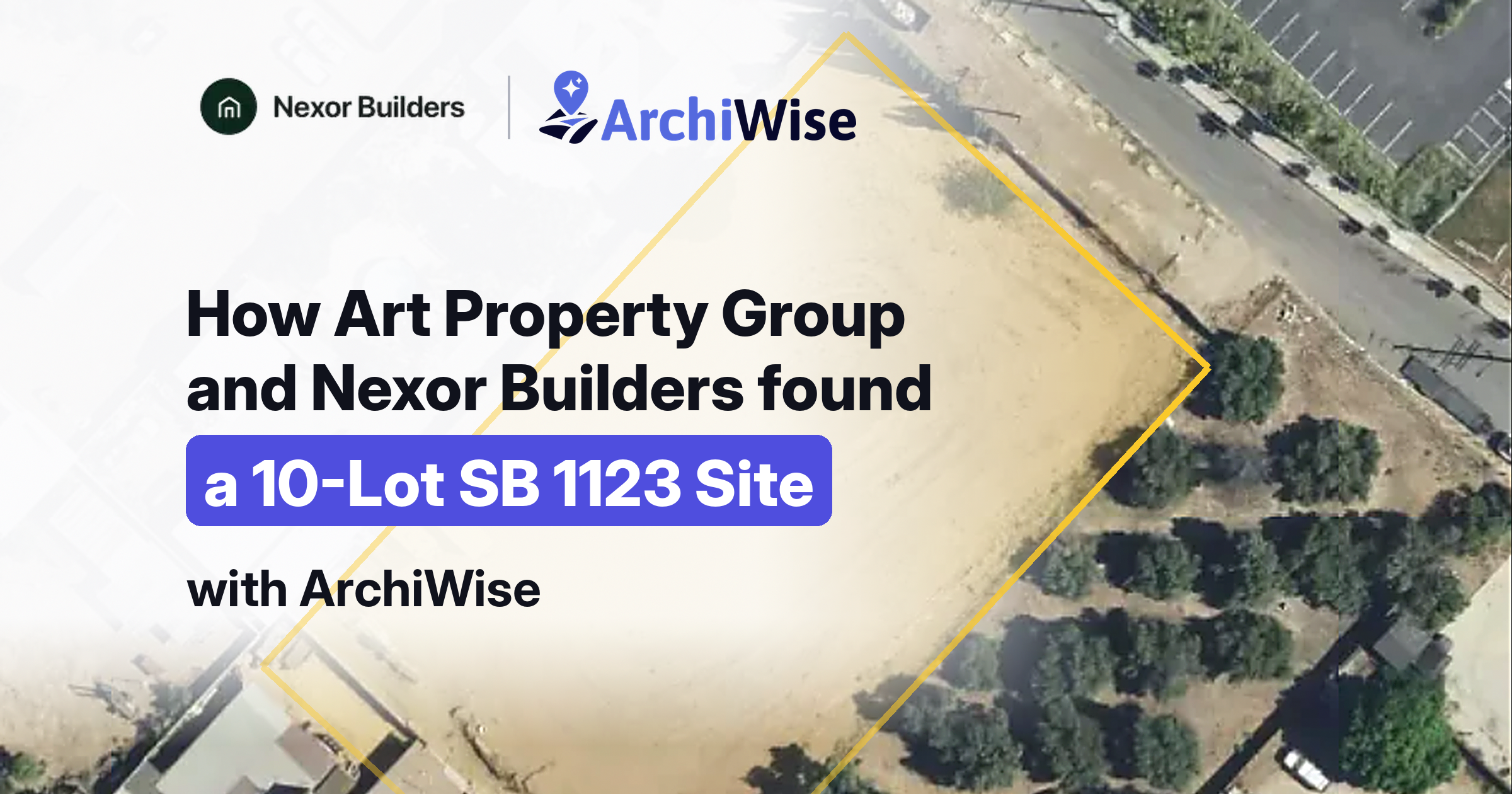

Most vacant land in Los Angeles is zoned for one house. That is the whole problem. A parcel can be an acre and a quarter, flat, serviced, surrounded on four sides by built blocks, and still pencil as a single lot, because the zone says the minimum lot is 17,500 square feet and three lots is all the arithmetic allows.
SB 1123 changed the arithmetic. It did not rezone anything. It created a parallel path through the same parcel.
This is how a team found a site where that path was worth taking, and what the screen looked like.
The parcel
Art Property Group and Nexor Builders were looking for vacant residential land in the San Fernando Valley. What they found, through ArchiWise, was a parcel in Sylmar:
- Lot size 54,494 sq ft, 1.251 acres
- Building area 0 sq ft. Building count 0. Dwelling units 0.
- Zoning RA-1-K, City of Los Angeles
- Current use Residential – Single, use code 010V
- Frontage 173 ft, depth 315 ft, not a corner parcel
Four of those numbers are the ones that matter, and they matter because SB 1123 asks for exactly them.
The number that decides it
RA is a suburban single-family zone. Under § 12.07 the minimum lot area is 17,500 sq ft, and the minimum lot area per dwelling unit is the same figure.
54,494 divided by 17,500 is three.
Three lots. Three houses. On a parcel wide enough for a street.
SB 1123 sets the minimum new lot at 1,200 sq ft and caps the project at ten. On this parcel the cap binds long before the lot size does – ten lots on 54,494 sq ft averages about 5,449 sq ft each, which is an ordinary Los Angeles single-family lot, not a crammed one.
Same ground. Three lots the normal way, ten through the statute.
That is the entire case, and it is why the screen was worth building.
How the screen was built
The filter does not know about SB 1123. It does not need to. The statute asks four questions about a parcel, and three of them are parcel data.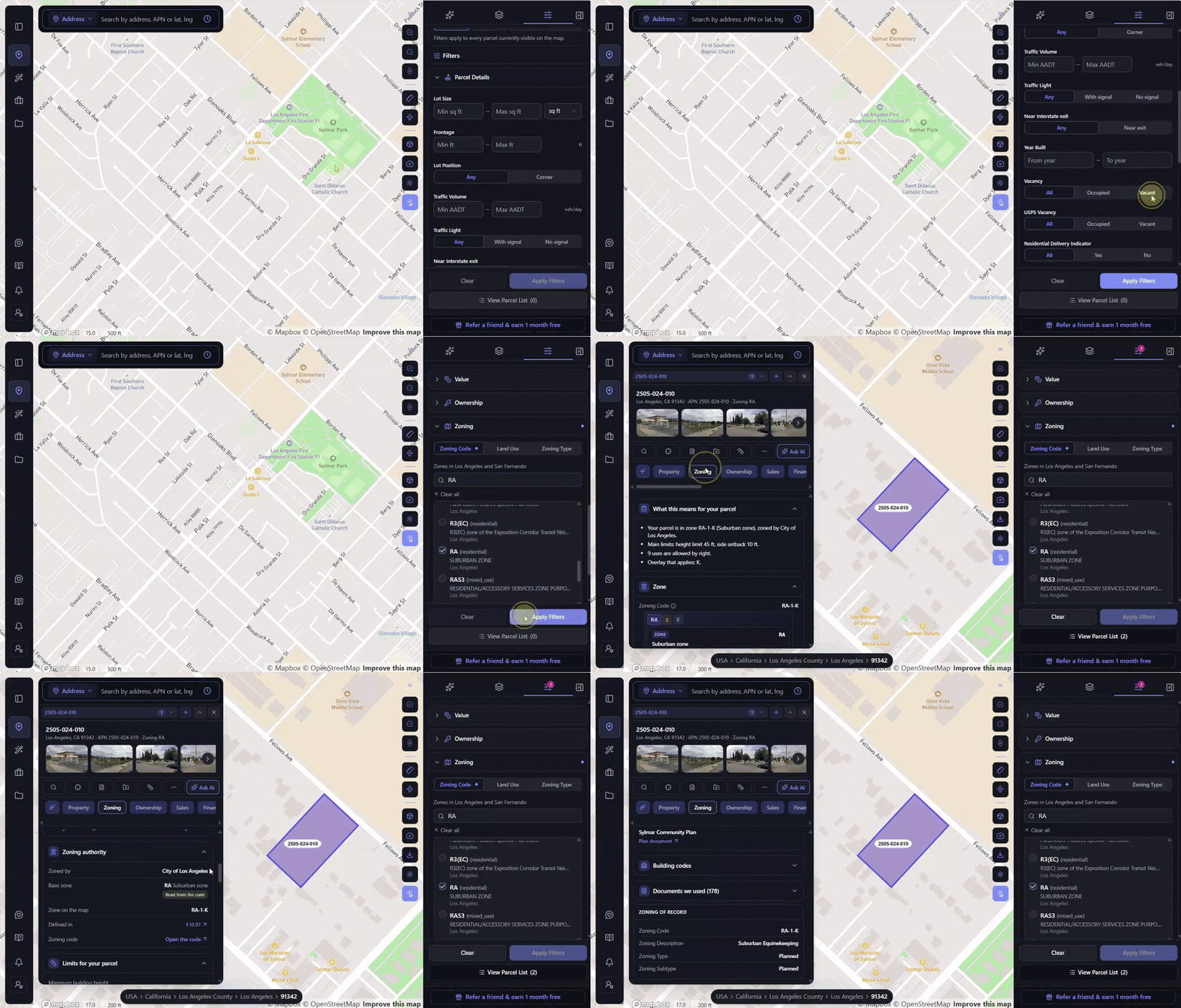
The screen runs on the map area, not on a listing feed:
- Lot size 30,000 – 65,000 sq ft. The ceiling is deliberate. SB 1123 applies to lots up to 1.5 acres, which is 65,340 sq ft. Anything above that is out of the statute regardless of how good the dirt is.
- Vacancy: Vacant. The statute requires a vacant lot – no permanent habitable structure, not occupied in the last five years.
- Zoning code: RA. In Los Angeles, the Starter Home path runs through the vacant single-family zones – A, RA, RE, RS, R1, RU, RZ and RW1.
Two parcels came back across the mapped area.
That is the honest result, and it is the point. The ratio is the product. A screen that returns two parcels out of everything on the map is a screen that did the reading for you.
What the parcel modal showed
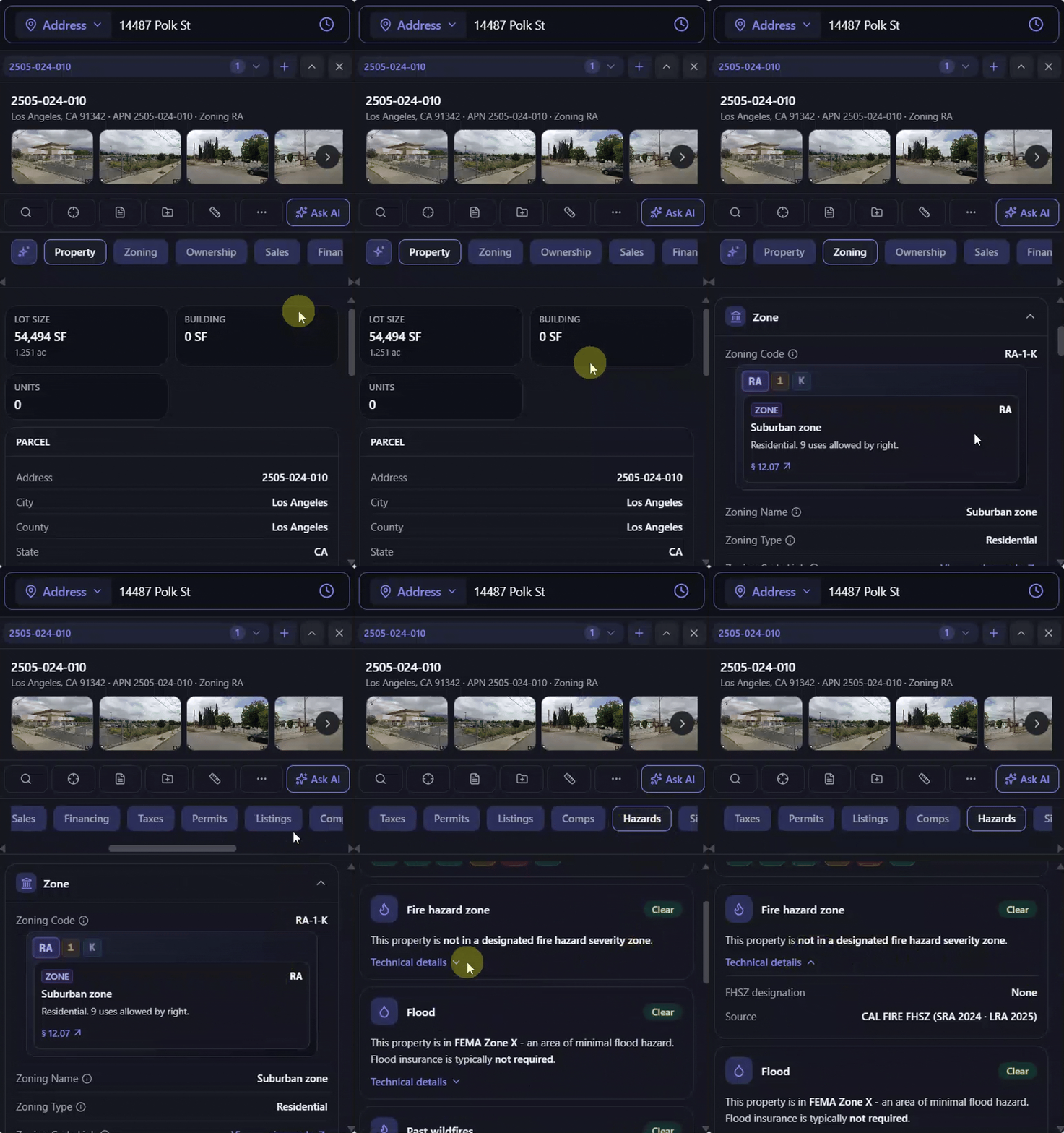
Opening the parcel does not just confirm the zone string. It returns the code limits that apply to that parcel, with the section they come from:
- Maximum building height 45 ft, § 12.21.1
- Minimum front yard 25 ft, § 12.07
- Minimum lot area 17,500 sq ft, § 12.07
- Minimum lot width 70 ft, § 12.07
- Minimum parking 2 spaces per unit, § 12.21
- One-family dwellings permitted by right, § 12.07
It also returns the overlay. RA-1-K is not just RA – the K is the Equinekeeping District, § 13.05. Overlays are the usual way a desk check goes wrong, because the base zone reads clean and the suffix carries the condition. The screen returns both.
That 17,500 sq ft line is the whole article in one row. It is the number that makes three lots the default and the number SB 1123 steps around.
What SB 1123 actually does
SB 1123 took effect July 1, 2025. It amends the Starter Home Revitalization Act (SB 684, 2023), which previously reached multifamily-zoned land. SB 1123 extended it to vacant single-family-zoned lots up to 1.5 acres.
On a qualifying site it allows:
- Up to 10 lots and 10 units
- New lots as small as 1,200 sq ft
- Ministerial approval – no discretionary review, no CEQA, no public hearing, no appeal
- A 60-day decision window
In Los Angeles, the local implementation adds its own terms. Units average no more than 1,750 net habitable square feet, a project of five to ten lots goes through a tract map, and a site in a High or Very High Fire Hazard Severity Zone is out.
That last one is a hard disqualifier and worth confirming before anything else on a Valley site.
Why this is a screening problem, not a research problem
A developer who already knows SB 1123 can evaluate one parcel in an afternoon: pull the APN, pull the zoning, confirm the lot is vacant, measure it, read the minimum lot area, do the division.
The work is not in evaluating one parcel. It is in finding the parcel.
There is no SB 1123 layer on a map anywhere, because qualification is a combination – vacant, under 1.5 acres, single-family zone, urban surroundings, outside a fire severity zone. No single data field says yes. Five fields together do.
What changes with a parcel-level screen is that the combination becomes a query instead of a reading list. Lot size range, vacancy, zone code, mapped area – and what comes back is a shortlist with the code limits already attached, so the three-versus-ten arithmetic happens on the first parcel you open rather than the thirtieth.
The statute is yours. The parcel facts the statute tests against are the thing worth automating.
If you are looking for one of these
Four things to set up front:
- Cap your lot size search at 65,340 sq ft. Above 1.5 acres the statute does not apply.
- Filter on vacancy, then confirm it on the parcel. Building area 0 and dwelling units 0 is the signal.
- Screen the single-family zones, not the multifamily ones. The multifamily Starter Home path exists and reaches 5 acres, but it is a different set of rules.
- Check the fire hazard severity zone before anything else. It kills the site outright, and in the Valley it is not a remote possibility.
Then open the parcel and find the minimum lot area. If the number is large and the parcel is bigger than three times it, you are looking at the same gap Art Property Group and Nexor Builders found.